In short: A heated lithium battery warms its own cells before it takes a charge. Lithium (LiFePO4) must not be charged at freezing, so a normal battery’s BMS simply blocks charging on a frosty morning. A heated one, such as a Fogstar Drift Gen2, uses the incoming charge current to run heating pads, then starts charging at 5°C. You need one if the battery sits somewhere cold and you want solar, the alternator or hook-up to refill it in winter. If it lives inside the warm van, you usually don’t.
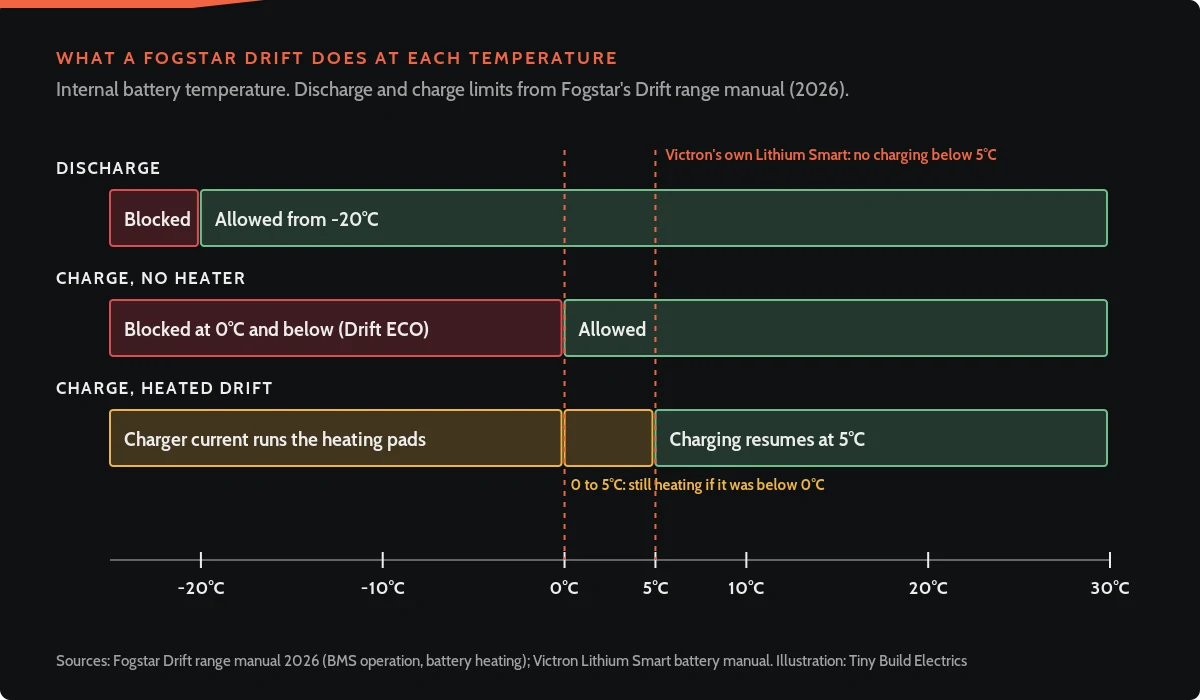
- Lithium will run your van down to -20°C. It’s charging that stops near freezing.
- The heater only runs while a charger is supplying current.
- Every Drift and Drift Gen2 has heating built in. The Drift ECO doesn’t.
- With Victron chargers, the battery’s own BMS does the protecting.
A heated lithium battery solves one winter problem. The battery runs the van happily, but it won’t take a charge when it’s cold. This guide explains why that happens and when heating is worth having in a UK campervan or motorhome. It also shows how a heated battery works with Victron chargers. We’re an Authorised Victron Energy Installer in Witherslack, Cumbria, so it comes from the vans we build and look after.
On this page 8 sections
- Why lithium can't be charged below freezing
- How a heated lithium battery works
- When a heated lithium battery is worth it
- How a heated lithium battery fits a Victron system
- Winter set-up checklist for a heated lithium battery
- Heated lithium batteries we fit and stock
- Heated lithium battery FAQs
- Sources
Why lithium can't be charged below freezing
Lithium can run the van in the cold, but it must not be charged below freezing. Our guide to charging lithium below freezing covers the cut-off, Victron settings and why a charger may show no amps on a frosty morning.
Capacity also drops in the cold. For example, Victron says its Lithium Smart batteries give about 20% less at 0°C and about half at -20°C. So in a frosty week you use energy faster than you’d expect, just when the chargers can’t put it back.

How a heated lithium battery works
A heated lithium battery has heating pads inside the case, and the BMS controls them. Fogstar’s Drift and Drift Gen2 ranges use 36 W pads. This is the sequence its manual sets out:
- The cells drop to 0°C, so the BMS stops charging.
- A charger starts supplying current. The 2026 manual gives 0.5 A as the minimum for the pads to start, though the 36 W pads draw about 3 A at 12 V.
- The BMS sends that current to the pads instead of the cells.
- The battery reaches 5°C, and then charging starts again on its own.
The key detail is that the heater only runs on charge current. The manufacturer is clear that it doesn’t use the battery’s stored energy. That’s a good thing, because a heater running from the battery would flatten it in a long cold spell.
It also means no charger, no heat. A van parked with the solar switched off stays as cold as the air around it. The battery will still power your loads, but it won’t heat itself until something is charging it.

Which Fogstar batteries have heating
| Fogstar range | Heating | BMS | CAN to a Cerbo GX |
|---|---|---|---|
| Drift ECO | No | 250 A | No |
| Drift | Yes, 36 W pads | 250 A | No |
| Drift Gen2 | Yes, 36 W pads | 300 A | Yes |
Fogstar Drift range compared. Source: Fogstar Drift range manual (2026).
The spec sheet for the Drift PRO Gen2 also lists heating. In our own installs we fit the Drift Gen2 as standard, so nearly every battery we put in has heating. The exception is a Drift ECO for a strict budget.
When a heated lithium battery is worth it
Heating earns its place when the battery gets cold and you still need it to charge. Two things decide that: where the battery sits and how you use the van in winter.
Battery location: inside the van or under the floor
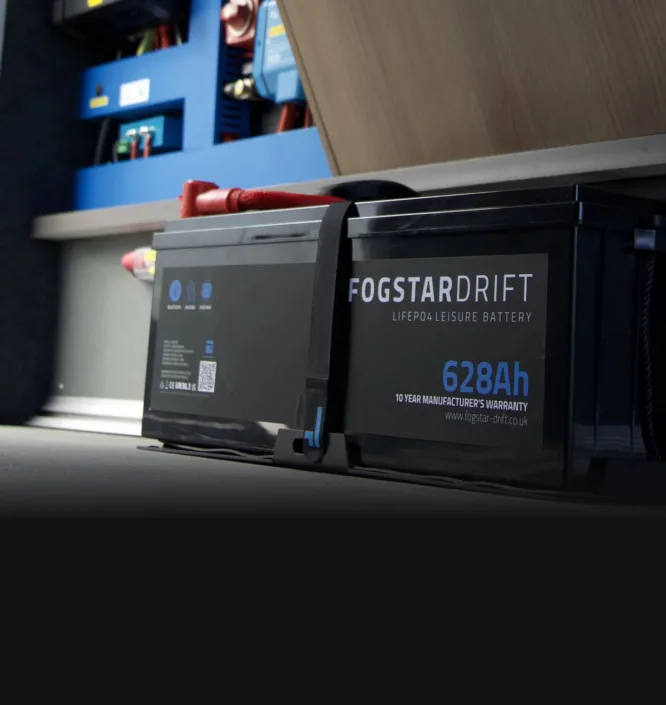
Inside the living space, under a seat or the bed, the battery shares the warmth you sleep in. With a diesel heater on most evenings, it rarely gets near freezing.
Under the floor, in a rear locker or in a motorhome garage, it’s a different story. Those spots aren’t heated, so they get far colder on a frosty night. Fogstar’s manual asks for a space with moderate, stable temperatures, and for insulation or an air gap if the battery sits on a metal vehicle floor.

How you use the van in winter
| How you use the van | Heated battery? |
|---|---|
| Weekends away, battery inside, heater on | Nice to have |
| Ski trips and Alpine winters | Worth it |
| Full-time or long winter tours | Worth it |
| Battery in a locker, garage or under the floor | Worth it |
| Parked at home with solar keeping it topped up | Worth it, so the solar can charge |
| Laid up for winter with everything switched off | Not needed, because nothing is charging |
Our view, based on how the Fogstar heater works. Tiny Build Electrics.
Ski trips are the clearest case. The van sits in sub-zero air all day, and then you need the alternator to refill the battery on the drive. Without heating, a cold battery can refuse that charge until it warms up.
Storage is the other one. If the van sits on the drive with solar keeping the battery topped up, heating lets the solar do its job on cold days. On the other hand, if you lay the van up with the chargers off, heating does nothing at all.
In that case storage temperature matters more. Fogstar’s Drift 100Ah spec sheet lists storage at 10°C to 35°C, so a battery left in a freezing van for months is outside that range. Our guide to winterising campervan electrics covers lay-up step by step. For UK December solar figures, and how driving and hook-up fill the gap, see campervan solar in winter.
How a heated lithium battery fits a Victron system
In a Victron system, the battery protects itself. The chargers just need to work with it, not against it. Here’s how each part plays its role.
The battery's BMS does the protecting
A Fogstar battery has its own BMS inside the case. It blocks charging when the cells are too cold, whatever the chargers are doing. So you don’t need a separate Victron BMS with it.
Victron’s own BMS range, including the Smart BMS CL 12/100 and the Smart BMS 12/200, is built for Victron’s Lithium Smart batteries. When the battery is too cold, the BMS sends a charge disconnect signal to turn the chargers off. The batteries’ default minimum charging temperature is 5°C, and Victron’s datasheet lists no heater for them.
Drift Gen2, the Cerbo GX and DVCC
The Drift Gen2 has a CAN port that talks to a Cerbo GX. Fogstar says the BMS sends the Cerbo its voltage, state of charge, current, internal and external temperatures, cell voltages, alarms, a current limit and a maximum charging voltage.
With DVCC switched on, the Cerbo then passes those limits to the MultiPlus-II, the solar chargers and the Orion XS, which follow the battery’s instructions. For the Cerbo GX MK2 and Ekrano GX, the manufacturer’s set-up steps also turn on shared temperature sense. That way, every charger sees the battery’s temperature. Fogstar’s steps don’t name the newer Cerbo GX MK3. However, Victron gives the MK3 the same two VE.Can ports as the MK2, and either can be set to 500 kbit/s as those steps require. We’ve also run a Drift Gen2 over CAN with a Cerbo GX MK3 in our own installs.
Fogstar’s manual includes DVCC in the Drift Gen2’s Victron set-up steps. Fogstar isn’t on Victron’s own tested battery list, so that support comes from Fogstar. We only use DVCC with batteries that support it over CAN. The Drift ECO and the original Drift have no CAN port, so we leave DVCC off for those. Our Cerbo GX guide explains DVCC in more detail.

Low temperature cut-off on the MPPT, Orion XS and MultiPlus-II
Victron’s SmartSolar MPPT has a low temperature cut-off setting. It’s off by default, and when you switch it on the default is 5°C. It only works if the charger gets a battery temperature over VE.Smart networking, from a Smart Battery Sense or a battery monitor with a temperature sensor.
The Orion XS has the same setting. Victron notes it has no effect when a BMS controls the charger. Victron also says the setting is only needed for lithium batteries that can’t block charging themselves.
A Fogstar battery can, and the manufacturer says you can leave the cut-off off. With a heated battery we keep it off on purpose. If the charger stops at 5°C, it never feeds the pads, so the heater can’t warm the cells. With a Drift Gen2 on CAN and DVCC on, the chargers also follow the limits the battery sends, so set DVCC up exactly as the battery manual’s Victron steps say.
Victron’s MultiPlus-II manual doesn’t describe a low temperature cut-off for its charger. Its temperature sensor is there for temperature-compensated charging, which Victron says lithium doesn’t need. With a Drift Gen2 on CAN and DVCC on, it simply follows the battery’s limits.
Temperature sensing: SmartShunt, Smart Battery Sense or Cerbo GX
You don’t need extra sensors to protect the battery. Even so, they help you see what’s going on. A SmartShunt reads battery temperature through its aux input when you add the optional temperature sensor. It can then share it with Victron solar chargers over VE.Smart networking.
Alternatively, a Smart Battery Sense gives a SmartSolar MPPT the battery’s voltage and temperature wirelessly. The Cerbo GX also has its own temperature inputs, and it shows every reading in VRM next to the battery. Our battery monitor guide compares the SmartShunt and BMV-712.
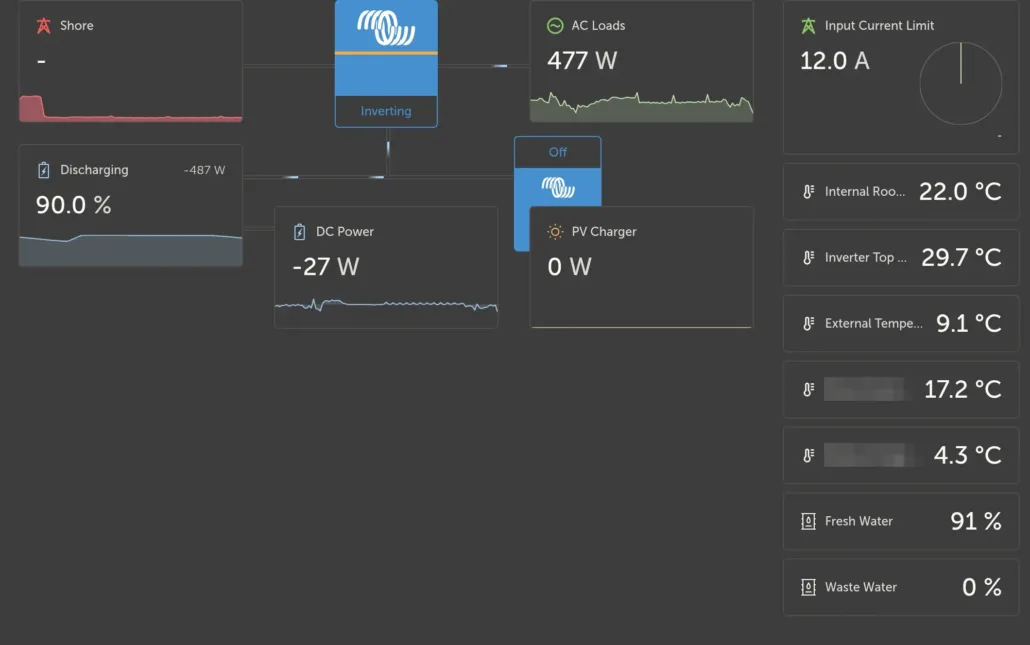
The Cerbo can also switch a relay on temperature. Victron’s manual gives the example of heat pads that switch on at 5°C and off at 10°C, with a contactor if the pads draw more than the relay can take. Still, we’d rather fit a battery with heating built in, because its BMS runs the pads from the battery’s internal temperature.
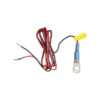
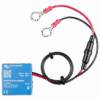
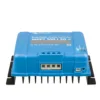
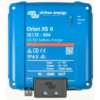
Victron kit in our shop, with live stock. Product images: Victron Energy.
Winter set-up checklist for a heated lithium battery
- Check the battery has heating. Fogstar’s Drift and Drift Gen2 do, but the Drift ECO doesn’t.
- Leave low temperature cut-off off on the MPPT and Orion XS. The manufacturer says that’s fine, and it lets the chargers feed the heater.
- Make sure a charger can supply at least 4 A on a cold day, so the 36 W pads get their full power. Snow on the panels can stop solar altogether.
- With a Drift Gen2 and a Cerbo GX, switch DVCC on and follow the manual’s set-up steps.
- Insulate or leave an air gap under a battery on a metal floor.
- Expect less capacity in the cold, and watch the battery voltage as well as the state of charge.
- Laying the van up? Follow our winterising guide instead.
Heated lithium batteries we fit and stock
Every Fogstar Drift and Drift Gen2 battery below has heating built in. The Drift ECO in our shop doesn’t, so we only suggest it when the budget is strict. Each card shows live stock. In-stock items are usually dispatched in 1 to 2 working days.
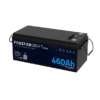
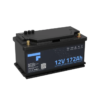
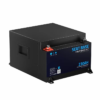
Fogstar Drift batteries with heating, with live stock. Product images: Fogstar.
Fitted at our Witherslack workshop. We supply and fit the battery as part of a campervan electrical installation or motorhome electrics, sited where it stays warmest. We’re now booking installs from February 2027.
Self-Build. With the Self-Build package, Tom designs your custom kit after a free call and matches the battery to where it’ll sit. The package comes included when you buy your kit through us. Want a head start? Try the system designer, or read about campervan leisure battery types first.
Not sure your van needs a heated battery?
Tell us where the battery sits and how you use the van in winter, and we’ll tell you straight.
Heated lithium battery FAQs
Can you charge a lithium battery below freezing?
No. Lithium must not be charged below freezing, as our guide to charging lithium below freezing explains. A heated battery warms itself first, then charges.
Do I need a heated lithium battery in the UK?
Only if the battery gets below freezing and you need it to charge then. Inside a heated van it rarely matters. In a locker, garage or under the floor, or on ski trips, it’s worth having.
Does a self-heating lithium battery drain itself?
No. Fogstar’s heater only runs on current from a charger, not on the battery’s stored energy. When nothing is charging, the heater stays off.
How much current does the heater need?
Fogstar’s 2026 manual gives 0.5 A as the minimum charge current for its 36 W pads to start, while its online FAQ still says 4 A. The pads draw about 3 A at 12 V, so plan for a charger that can give at least 4 A on a cold day.
Does a heated lithium battery work with Victron?
Yes. The battery’s BMS runs the heater, and Victron chargers simply supply the current. With a Drift Gen2, a CAN link to a Cerbo GX also shares the charge limits through DVCC.
Should I set low temperature cut-off on my Victron MPPT?
Not with a Fogstar, because it blocks cold charging itself and Fogstar says you can leave it off. Victron says the setting is only for batteries that can’t. With a heated battery, the cut-off would also stop current reaching the pads.
Can I use a heat pad instead?
You can. Victron’s manual shows a Cerbo GX relay switching heat pads on temperature, with a contactor for bigger pads. That said, a battery with heating built in is simpler, because its own BMS controls the pads.
Sources
- Fogstar, Drift range user manual (2026)
- Fogstar, Drift 100Ah specification sheet
- Fogstar, Drift PRO Gen2 12V 628Ah specification sheet
- Fogstar, Knowledge Hub (Victron settings for Drift batteries)
- Victron Energy, Lithium Smart battery manual
- Victron Energy, SmartSolar MPPT manual (configuration and settings)
- Victron Energy, Orion XS DC-DC battery charger manual
- Victron Energy, Cerbo GX manual (configuration, DVCC, temperature relay)
- Victron Energy, Cerbo GX manual (DVCC chapter)
- Victron Energy, Cerbo GX MK2 and MK3 datasheet
- Victron Energy, SmartShunt manual
- Victron Energy, MultiPlus-II manual
About the reviewer: Tom Alderdice
Tom holds the 18th Edition (BS 7671) and inspection and testing qualifications, plus NCC training in caravan and motorhome electrics.
Tiny Build Electrics is an Authorised Victron Energy Installer. See Tom’s full qualifications