We design, build and look after the Victron systems inside premium off grid cabins. One proven system, built in our Cumbria workshop and repeated across every unit you make.
Replacing a generator?See what solar and a battery would save on each unit Authorised Victron Energy Installer



…working with Tiny Build Electrics has been transformational for our business!
Friendly, efficient, and incredibly knowledgeable. Ten out of ten!
Guests book for the quiet, the view and the log burner. They should never have to think about batteries. We take the electrics off your plate, from first drawing to the day each cabin goes live, and keep an eye on every system after handover.
Our cabin electrical installation covers log cabins, tiny homes, shepherd's huts and glamping pods. One Victron system, designed around how each cabin gets used and wired to BS 7671.
Boards built and tested in our Witherslack workshop, then commissioned and tested on site.
Planned around a tight space, with a fridge that doesn't go off at 3am.
Smaller footprint, same standard. Every pod reports to VRM, so we spot a flat battery before a guest does.
Solar and battery sized to your loads and your site's winter sun, so the cabin keeps going through a grey December week.
Four typical units we build boards for, from a single pod to a unit on a holiday park or glamping site. They are worked examples, not client systems: each load is a typical appliance, worked out line by line from the manufacturer's datasheet for a full occupied day. Heat, hot water and cooking come from wood, gas or diesel, so the battery carries the electrics only.
Every figure is a full occupied day with guests in. Logged real-world use is often lower, because units sit empty between stays and guests rarely run everything for the hours shown. The daily figure sets the Fogstar lithium battery, sized to carry the unit through a run of grey days, then the Victron solar and charging around it, checked against your site's December sun.
Your own load list will differ. Send it over and we size your system from it on a free call.
Book a free callTypical loads from the manufacturers' datasheets: Victron MultiPlus-II, Cerbo GX, GX LTE 4G, Dometic NRX 50C, Bosch KUR15ADF0, Labcraft Callisto, Philips CorePro GU10, Eberspächer Airtronic S2 D2L, Shurflo Trail King 7, Separett Villa, Vent-Axia Lo-Carbon Silhouette 100, Samsung UE32T4300, Apple 20W USB-C.
Every litre a generator burns comes off the margin on the night you let. Pick the kind of unit you let and what powers it now. You get the saving and payback for each unit, and the total across your site.
Per unit, every year
Your figures appear here
Nothing is chosen for you. Pick your unit and what you'd do otherwise, and your saving and payback show here straight away.
Generator top-up by month, averaged over 2005 to 2023.
Sun: PVGIS, Witherslack, panels at 35° facing south. Fuel without VAT from DESNZ, week of 19 October 2026: petrol 145.5p, diesel 166.1p. Diesel top-ups assume the same 6kVA set worked at three-quarters load, 1.8 litres an hour on its maker's sheet, which needs a charger the size of a 48/5000 inverter/charger. Grid running cost uses Ofgem's October to December 2026 cap: 26.32p a kWh and 54.83p a day. Business tariffs aren't covered by the cap. This is a guide, not a quote.
"Tom has redesigned our solar systems from scratch, builds and supplies our electrical boards, and looks after remote on-going management of them for us, working with Tiny Build Electrics has been transformational for our business!"Tom ChaletOperations Director, Unplugged
"Tom and Charlie are our go-to guys when it comes to designing and building custom Off-Grid kits for our cabins and saunas. Friendly, efficient, and incredibly knowledgeable. Ten out of ten!"Joe BowerFounder, JM Bower Timber Products
A simple route from first call to cabins your guests can rely on.
Book a callTell us about your build. Tom will talk it through with you and come back with a clear plan.
Updated 20 October 2026
Yes. We design the system once and build it the same way for each cabin, as we do for Unplugged. Every unit behaves the same, which makes each one easier to fit, use and support.
Boards are built and tested in our workshop and delivered ready to connect. Local on-site installation is available on request, subject to a site review. When we wire in and commission a system, you get an electrical installation certificate and a walk-through of how it all works.
Yes. With a Victron GX device, each system reports to Victron VRM, so you can check them all from one dashboard. We can see them too, so a flat battery or a fault on a glamping pod gets spotted before a guest notices.
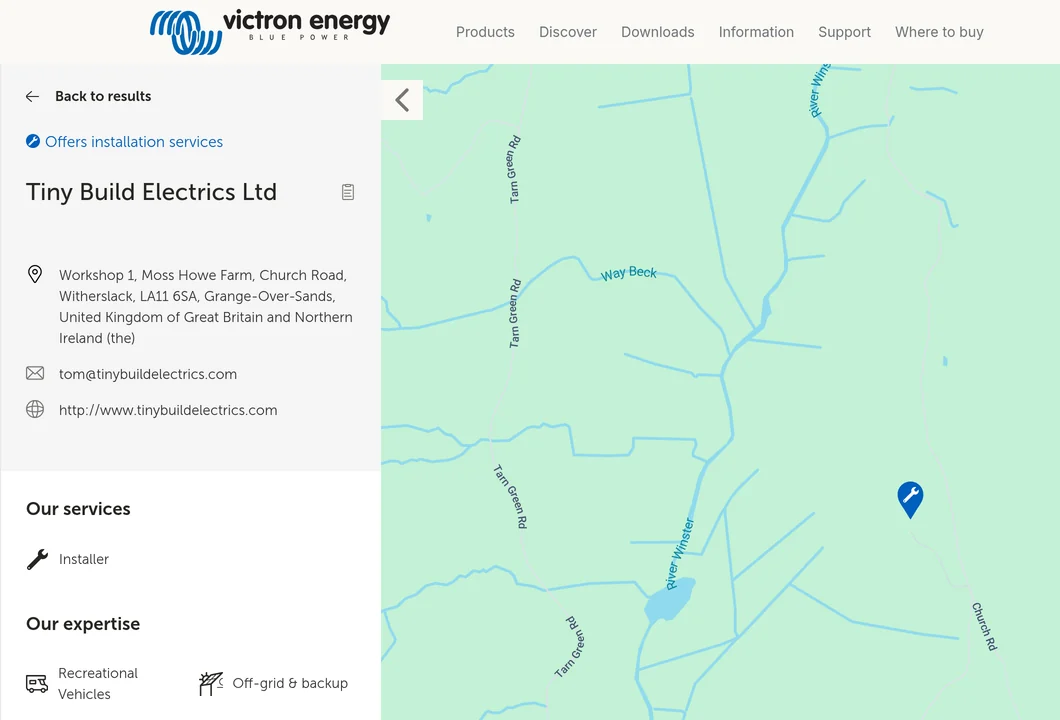
Yes. Tiny Build Electrics Ltd is an Authorised Victron Energy Installer, listed on Victron's own where-to-buy finder at our Witherslack workshop.
It depends on what you run and when you use the cabin. A weekend cabin with lights, a fridge and phone charging needs far less than a home lived in all winter. We work out your daily use, then check winter sun for your exact site with PVGIS, the European Commission's solar data tool. That sets the solar array and battery bank so the cabin keeps going through a grey week in December. Our solar guides explain the basics.
Bring us in before the walls are closed up. We'll agree cable routes, where the board and battery live, and where solar goes, so the build team can leave space. Then the system is built in our workshop and fitted when the cabin's ready.
Either run a supply from the main building or make the hut self-contained with solar and a battery. For remote spots, off-grid is often simpler than digging a long cable run. Space is tight, so we plan where the battery, inverter and board go before anything is built, and solar usually sits on the roof or a ground mount nearby. We'll talk through both on the call.
Most off grid cabins heat with a log burner, gas or a diesel heater. Electric heating eats batteries fast, so we usually power the fans, pumps and controls rather than the heat itself. We'll be straight with you about what's realistic.
Planning and building control are down to your local council, so check with them early. On our side, the electrics are designed and tested to BS 7671 and you get a certificate for the installation.
Yes. A garden office runs much like a small cabin: lights, a laptop, a heater control and a few sockets. If running a cable from the house means digging up the garden, an off grid solar system with a lithium battery can be the simpler job. Winter is the hard part, so we check your site's December sun with PVGIS and size it from what you'll actually run. Heavy tools or electric heating change the sums, and we'll tell you if they do.
Often they can do most of the work. Solar and a lithium battery cover the evenings and nights, and the generator becomes the backup for dark weeks in winter instead of running every day. A Victron inverter/charger charges the battery from the generator, and a GX device can start and stop it automatically if the generator has a remote start. We'll be straight with you about how often it's likely to run at your site.
It depends on the loads. A shepherd's hut with lights, a fridge and phone charging can run happily at 12V or 24V. Add an induction hob, a kettle or several cabins on one battery bank and 48V keeps the current down, so cables are thinner and losses are lower. We pick the voltage when we design your system. Our inverter guides cover the basics.
A finished system. Your board is designed for your cabin, then built and tested in our Witherslack workshop and delivered ready to connect, with the battery, solar and inverter/charger specified to suit. Local on-site installation is available on request, subject to a site review. Building more than one? Every unit gets the same board, so each one is fitted the same way. See our pre-built system panels.
The core is a Victron inverter/charger, an MPPT solar charge controller and a lithium battery bank. On the mains side there's a consumer unit with RCD protection and proper earthing, all wired to BS 7671. A Victron GX device links it to VRM, so you can watch it all from your phone. The same approach covers log cabins, shepherd's huts and glamping pods, sized to each space.
Work it out from a guest's day. LED lights, a fridge, a water pump, phone charging and a Wi-Fi router often come to around 1 to 2 kWh a day. A kettle, hairdryer or induction hob can add that much again on their own. We total it, add headroom for a grey week and check it against winter sun for your site, so the pod keeps going in December.
Cabin systems start from £2,495 + VAT. Every system is priced to your build after our call.