In short
Lithium not charging while driving is nearly always one of three things: the factory split charge relay still in charge, a smart (Euro 6) alternator dropping its voltage, or a DC-DC with the negative never joined up. We’ll deal with the factory relay, size a Victron Orion around your alternator, fit it properly, and fix the classic “Orion XS shows volts but no amps” fault. Spoiler: your DC-DC usually isn’t broken. Your negative is.
- Factory relay still in the charge path
- Smart (Euro 6) alternator dropping its voltage
- DC-DC negative never joined up
- Orion sized around your alternator
1. Why your lithium is not charging while driving
How does a split charge relay work?
Most vans and motorhomes left the factory with a split charge relay: a voltage sensitive relay (VSR), or a relay inside a motorhome power unit such as a Sargent, Nordelettronica or EBL. Engine on, it joins starter to leisure. Engine off, it opens so the living area can’t flatten the starter battery.
That worked for lead acid. Lithium changes it in two ways.
Lithium pulls hard. Victron’s Orion XS manual puts it plainly: the low impedance of lithium batteries results in a high alternator current, and controlled charging protects the alternator from overloading. But a plain relay just joins the two batteries in parallel. So it has no charge profile and no way to limit current.Victron EnergyOrion XS 12/12-50A DC-DC battery charger manualwww.victronenergy.com ↗ All sources
Smart alternators don’t hold a steady voltage. On Euro 6 vehicles the alternator is ECU-managed. Victron puts charge voltage roughly between 12.5V and 15V on a 12V system, and notes the alternator can switch off completely for a while. The starter then falls back to resting voltage (around 12.6V), so a relay that switches on voltage alone can decide the engine has stopped while you’re driving. Victron also notes that a Euro 5 or 6 smart alternator often supplies a charging voltage that is too low for proper charging, even with the engine running.Victron EnergyOrion XS 12/12-50A DC-DC battery charger manualwww.victronenergy.com ↗ All sources
How to tell if you have a smart alternator
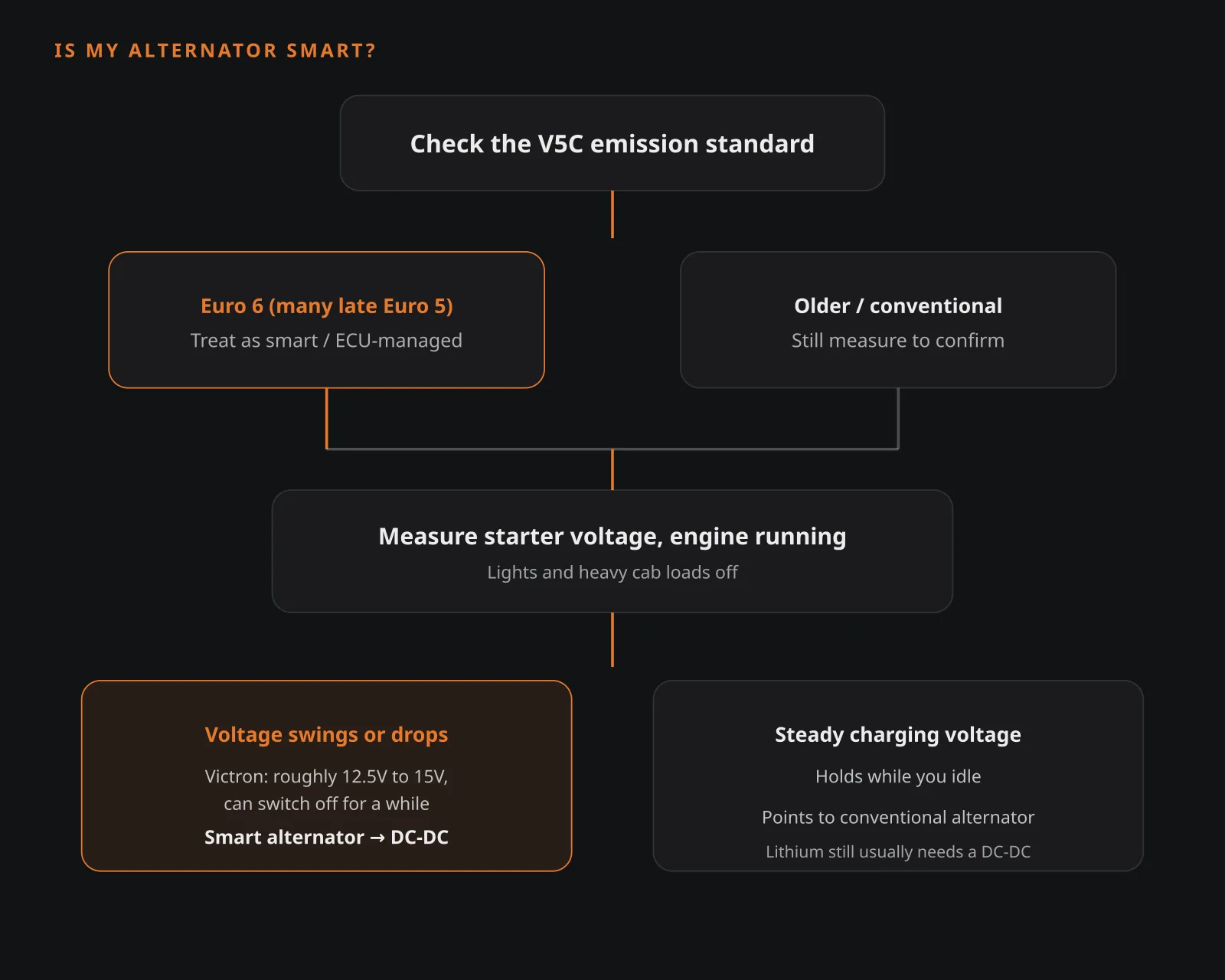
- Look at the V5C. If the emission standard is Euro 6 (and on many late Euro 5 vans), treat it as a smart, ECU-managed alternator and plan for a DC-DC charger.
- Measure the starter battery with the engine running. Keep the lights and heavy cab loads off. A conventional alternator holds a steady charging voltage. A smart alternator often drops and rises while you drive. Victron puts smart-alternator charge voltage roughly between 12.5V and 15V on a 12V system, and notes it can switch off completely for a while.Victron EnergyOrion XS 12/12-50A DC-DC battery charger manualwww.victronenergy.com ↗ All sources
If either check points to a smart alternator, a plain split charge relay is the wrong tool for lithium.
The usual story, then: lithium goes in, factory split charging stays, and the battery is barely topped up after a long drive. Or the relay chatters. Or it works until a hot day, when the alternator is working far harder than it was designed to.
So for most lithium set-ups the answer is a DC-DC charger (B2B or battery to battery charger). It draws a controlled current from the starter side, runs a proper charge profile, and works out when the engine is really running.
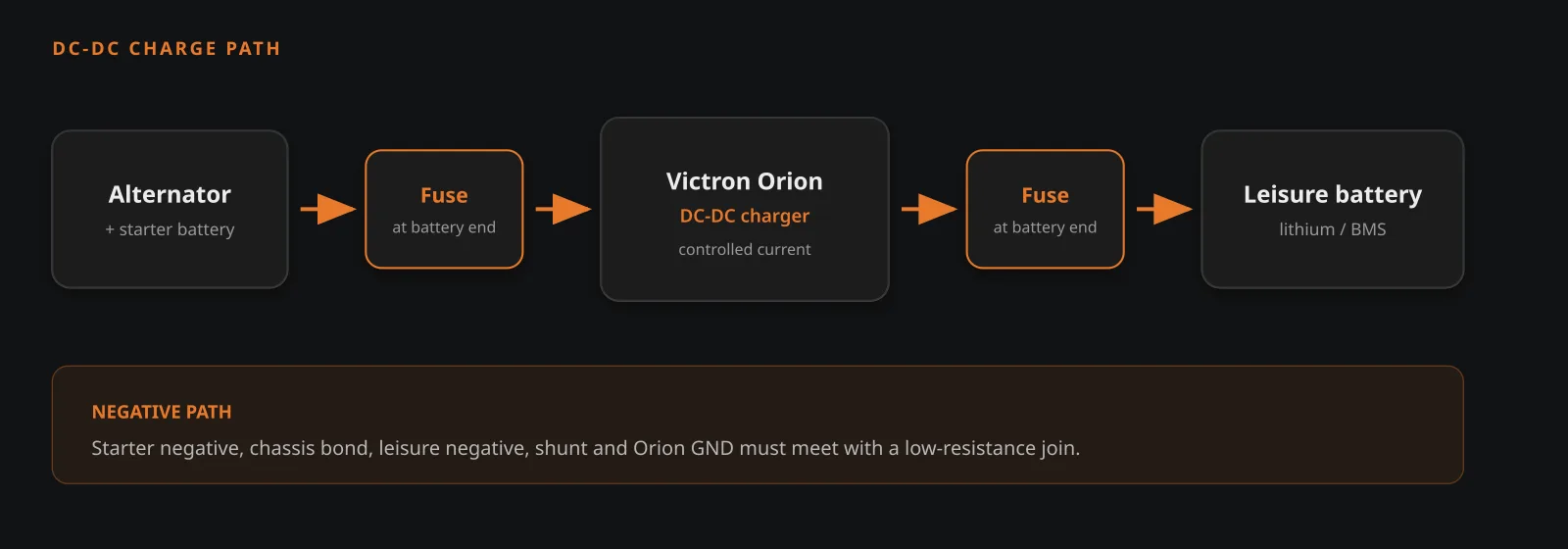
Split charge relay or DC to DC charger?
| Split charge relay (VSR) | Victron Orion DC-DC charger | |
|---|---|---|
| Charge profile | None. The leisure battery sees whatever the alternator gives | Adaptive multi-stage profile with lithium presets |
| Current drawn from the alternator | Not limited | Limited by the charger’s input current setting |
| Smart (Euro 6) alternator | Can drop in and out as voltage swings | Engine shutdown detection, Euro 6 settings, optional engine running signal |
| Monitoring | Usually none | VictronConnect app over Bluetooth |
Victron lists an input current setting on the Orion XS that “limits the maximum current drawn from the input source”, which it calls “particularly important to avoid overloading an alternator”.Victron EnergyOrion XS 12/12-50A DC-DC battery charger manualwww.victronenergy.com ↗ All sourcesVictron EnergyOrion XS DC-DC battery chargers datasheetwww.victronenergy.com ↗ All sources
Do I need a DC to DC charger? If you’ve got a lithium leisure battery, a smart alternator, or both, we’d say yes in almost every case.
2. Dealing with the factory split charge relay
Indeed, this is the step people skip, and it’s the one that causes the oddest faults.
If a DC-DC goes in but the old relay stays connected, the relay can join the two batteries whenever it closes and bypass the charger. Otherwise, you lose the charge profile and the current limit, and the alternator feeds the lithium straight through again. The factory relay has to come out of the charging path so the DC-DC is the only route from starter to leisure.
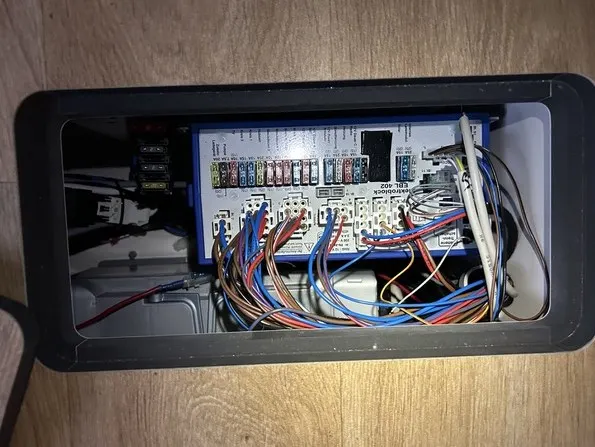
How you do that depends on the vehicle:
- Panel vans and campervans. Often there’s a separate relay or VSR in the engine bay or under a seat, added by the converter. Generally, it can be taken out of circuit at its own connections.
- Motorhomes. The relay is often built into the factory power unit or distribution box (Sargent, Nordelettronica and EBL units are common), alongside fuses for the habitation side. Some units have a way to disable the charge link built in, while some don’t. The power unit’s own manual is the place to start.
A few things to keep in mind:
The fridge circuit
- Don’t cut into the vehicle harness blind. The same engine running signal that drives the relay may also switch other things.
- Keep the fridge working the way it should. Also, in many motorhomes the 12V fridge heating element is switched by the same system. BS 7671 Annex A721 says the auxiliary-battery charge circuit should be separate from the fridge circuit, and that a fridge’s 12V heating should only run with ignition on. So take the relay out of the battery charge path; keep the fridge circuit as designed.IETBS 7671 informative Annex A721: extra-low voltage DC installations in caravans and motor caravanselectrical.theiet.org ↗ All sources
- Write it down. Label what you’ve changed so the next person working on the van knows the relay is no longer part of the charge path.
We do this as part of every DC-DC install. If you’d rather not poke around inside a motorhome power unit, that’s fair enough. It’s exactly the sort of thing we check on a free 30-minute call.
3. How to size a DC-DC charger around your existing alternator
This is where we see the most guesswork. A bigger charger isn’t automatically better. A DC-DC charger draws its full set input current whether or not the alternator can actually supply it, and Victron spells out what happens when it can’t.Victron EnergyOrion-Tr Smart DC-DC charger (non-isolated) manualwww.victronenergy.com ↗ All sources
Victron’s troubleshooting advice puts it in one line: compare the alternator’s continuous rating, including at idle and at operating temperature, with the total input current of all chargers plus the other loads in the system. Here’s how we work it out.
Step 1: Start from the alternator’s rated output
Find the alternator’s rating in amps. It’s usually stamped on the alternator body or listed by the vehicle maker for your engine and trim. Many vans offer more than one alternator option, so check yours rather than assuming.
That figure is a best case. It isn’t what you get at idle on a hot day.
Step 2: Derate it for idle and heat
- Idle. Victron says the power output of an alternator can be reduced to about 50% at idle.Victron EnergyOrion XS 12/12-50A DC-DC battery charger manualwww.victronenergy.com ↗ All sourcesVictron EnergyOrion XS 12/12-70A DC-DC battery charger manualwww.victronenergy.com ↗ All sourcesVictron EnergyOrion-Tr Smart DC-DC charger (non-isolated) manualwww.victronenergy.com ↗ All sources
- Heat. Victron notes that a hot alternator reduces its output further, and that a worn or slipping belt can have a similar effect. It doesn’t give a single figure for this, because it varies by alternator. So we allow an extra margin on top of the idle figure.
Above all, stuck in traffic in summer, with the engine bay hot and the engine at idle, is the case that matters. Size for that, not for the motorway.
Step 3: Subtract what the base vehicle needs
Before the leisure side gets anything, the alternator has to cover cab and engine loads: ECU and fuel system, lights, wipers, heater blower, heated screen/mirrors/seats if fitted, stereo and phone charging, plus putting charge back into the starter after cranking.
Equally, the worst case is a wet winter night with headlights, wipers, blower and heated screen all on. Measure yours with a clamp meter or the handbook. Victron’s example: 150A for 5 seconds of cranking is about 0.2Ah out of the starter, and at a 20A idle output that takes around 37.5 seconds to put back. That’s why the Orion has a delayed start for smart alternators.Victron EnergyOrion-Tr Smart DC-DC charger (non-isolated) manualwww.victronenergy.com ↗ All sources
Step 4: Leave headroom
Whatever’s left is the most the leisure side could take. Don’t plan to use all of it. Then leave headroom for loads you’ve forgotten, for the alternator ageing and for the starter battery’s own recharge. We’d rather a charger runs comfortably all day than pushes the alternator to its limit every time you sit in a queue.
Step 5: Smart alternators and engine running detection
However, on a Euro 6 van, the amps are only half the story. The charger also has to know when to run.
The Orion’s engine shutdown detection decides from the input voltage whether the engine is running. Victron’s defaults (12V models) are:
| Setting | Smart alternator | Regular alternator |
|---|---|---|
| Start voltage | 14V | 14V |
| Delayed start voltage | 13.3V | 13.8V |
| Delayed start delay | 120s | 120s |
| Shutdown voltage | 13.1V | 13.5V |
Engine shutdown detection defaults
Victron says the default works with most conventional and smart alternators. Still, some vans need fine-tuning; charging strategies differ even within the same brand. Where the alternator is off for long periods and base load is low, wire an external engine running signal to force charging on while the engine runs.Victron EnergyOrion XS 12/12-50A DC-DC battery charger manualwww.victronenergy.com ↗ All sources
From Victron’s manual:
- Leave engine shutdown detection enabled with an external signal. The signal only forces charging on; stopping when the engine is off is still the detection’s job.
- D+ is often missing on Euro 6. D+ simulators read the same voltage the Orion already measures, so they don’t help when voltage is the problem.
- Victron doesn’t recommend the ignition switch, because it can flatten the starter with ignition on and engine off.
- Best source is the vehicle’s own engine running signal (sometimes via CAN), though access varies.Victron EnergyOrion XS 12/12-50A DC-DC battery charger manualwww.victronenergy.com ↗ All sourcesVictron EnergyOrion-Tr Smart DC-DC charger (non-isolated) manualwww.victronenergy.com ↗ All sources
Smart alternators and solar can clash too. One Ducato owner on the Victron Community found his Orion-Tr in float while driving because solar was already holding the battery there.Victron CommunityOrion-Tr Smart doesn’t charge properly when solar is active (10 to 12 Oct 2026)community.victronenergy.com ↗ All sources
When solar and a DC-DC can both charge, stay inside what the leisure battery and BMS will accept. Size the Orion for the alternator first, then check the battery’s charge-current limit with solar included.
Step 6: Pick the charger, or two
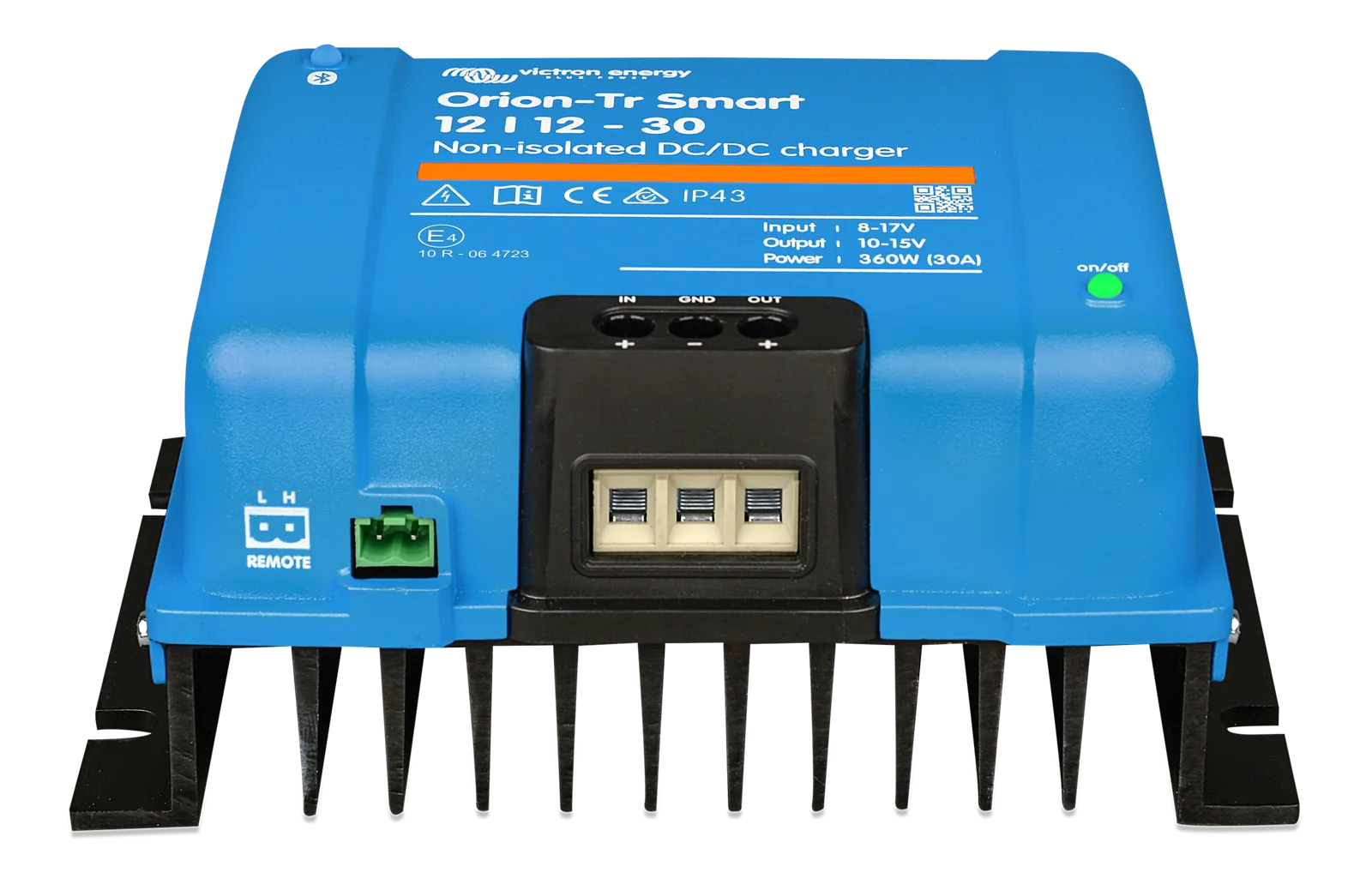
- Victron Orion-Tr Smart 12/12-30 (non-isolated). Victron’s own example says it draws about 35A from the input when running at full capacity.Victron EnergyOrion-Tr Smart DC-DC charger (non-isolated) manualwww.victronenergy.com ↗ All sources
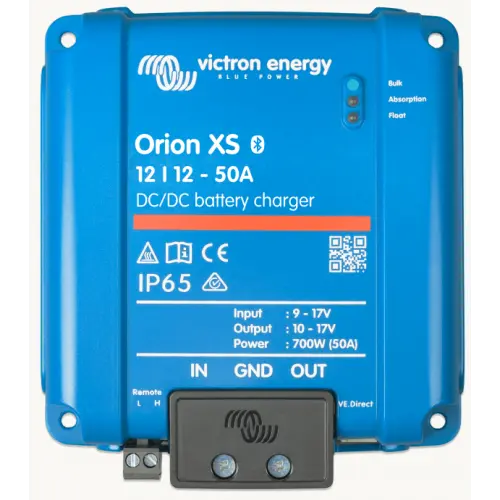
- Victron Orion XS 12/12-50A. Input and output current are adjustable from 1A to 50A in 0.1A steps, with up to 700W continuous output at 40°C.Victron EnergyOrion XS DC-DC battery chargers datasheetwww.victronenergy.com ↗ All sources
- Victron Orion XS 12/12-70A. Adjustable from 1A to 70A, up to 1000W. Note this one is IP20, so it’s for dry indoor installation only.Victron EnergyOrion XS 12/12-70A DC-DC battery charger manualwww.victronenergy.com ↗ All sourcesVictron EnergyOrion XS DC-DC battery chargers datasheetwww.victronenergy.com ↗ All sources
The handy part of the Orion XS: set the input current to suit your alternator. A 50A unit turned down for a modest alternator is sensible, and you can turn it up later if the alternator changes.
Two Orion XS chargers in parallel
Two in parallel. Victron says an unlimited number of Orion XS units can run in parallel. That’s how big-alternator vans get serious rates (one Transit owner on the Victron Community runs an XS 50A plus XS 70A behind a 230A smart alternator). Add each unit’s input current before you compare with the alternator.Victron EnergyOrion XS DC-DC battery chargers datasheetwww.victronenergy.com ↗ All sourcesVictron EnergyOrion-Tr Smart DC-DC charger (non-isolated) manualwww.victronenergy.com ↗ All sourcesVictron CommunityTwo Orion XS chargers behind one BatteryProtect (18 to 19 Oct 2026)community.victronenergy.com ↗ All sources
The dual-Orion reverse-charge loop. The Orion XS can reverse-charge a flat starter from the leisure battery. With two units in parallel, if you only start reverse charge on one, Victron warns the other “reads the voltage rise on the starter battery as a running engine and starts charging forward against the unit that is reverse charging”. Fix: start reverse charge on all parallel units, or switch the others off first. Full detail in our Orion XS reverse charging guide.Victron EnergyOrion XS 12/12-50A DC-DC battery charger manualwww.victronenergy.com ↗ All sourcesVictron CommunityOrion XS reverse charging with dual units (15 Oct 2026)community.victronenergy.com ↗ All sources
A worked example (example numbers only)
Every number below is an example to show the method, not a real van, and not a Victron figure unless we say so. Use your own alternator rating and measured loads.
| Step | Example value | Where it comes from |
|---|---|---|
| Alternator rated output | 180A | Example. Check your own alternator |
| At idle (about 50%) | 90A | Victron: output can drop to about 50% at idle |
| Hot alternator allowance (example 10% off) | 81A | Example allowance. Victron says heat reduces output further but gives no figure |
| Base vehicle loads, winter night | minus 35A | Example. Lights, wipers, blower, heated screen, ECU. Measure yours |
| What’s left | 46A | 81A minus 35A |
| Headroom (example: keep 20% back) | about 37A | Example margin |
| Charger choice | Orion XS 12/12-50A with input current set to about 35A, or an Orion-Tr Smart 12/12-30 (about 35A input at full output, per Victron) | Victron datasheet / manual |
Here a full 50A input would ask more at a hot idle than the alternator can spare once the van’s loads are covered. So turn the input current down, and it works every time, not just on the motorway. On a bigger example alternator (say 250A) you might have room for two Orion XS units in parallel, which is when the reverse-charge loop above matters.
Cable and fuse: Victron’s figures, and why length matters
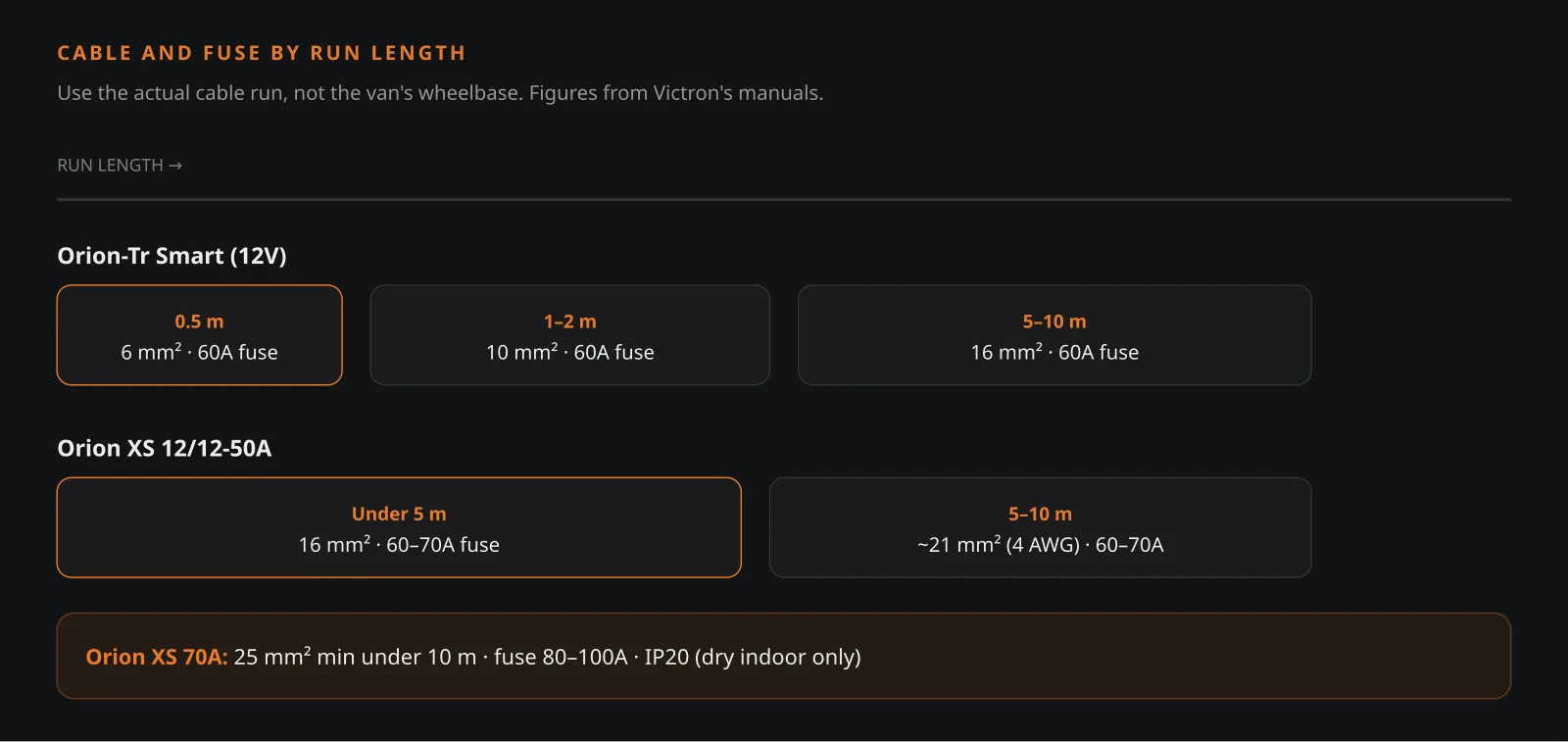
Long, thin input cables drop voltage, and the Orion reads that drop. As a result, it can cut charging short or make a healthy alternator look like a stopped engine. Victron gives minimum cable sizes by run length plus an external battery fuse. So use the actual cable run, not the van’s wheelbase.Victron EnergyOrion XS 12/12-50A DC-DC battery charger manualwww.victronenergy.com ↗ All sourcesVictron EnergyOrion-Tr Smart DC-DC charger (non-isolated) manualwww.victronenergy.com ↗ All sources
Orion-Tr Smart (12V models), from Victron’s cable and fuse table:
| Run length | Minimum cable | External battery fuse |
|---|---|---|
| 0.5 m | 6 mm² | 60A |
| 1 m or 2 m | 10 mm² | 60A |
| 5 m or 10 m | 16 mm² | 60A |
Orion XS 12/12-50A, from Victron:
| Run length | Minimum cable | External battery fuse |
|---|---|---|
| Under 5 m | 16 mm² | 60-70A |
| 5-10 m | 4 AWG (about 21 mm²) | 60-70A |
Cable and fuse for the Orion XS 12/12-70A
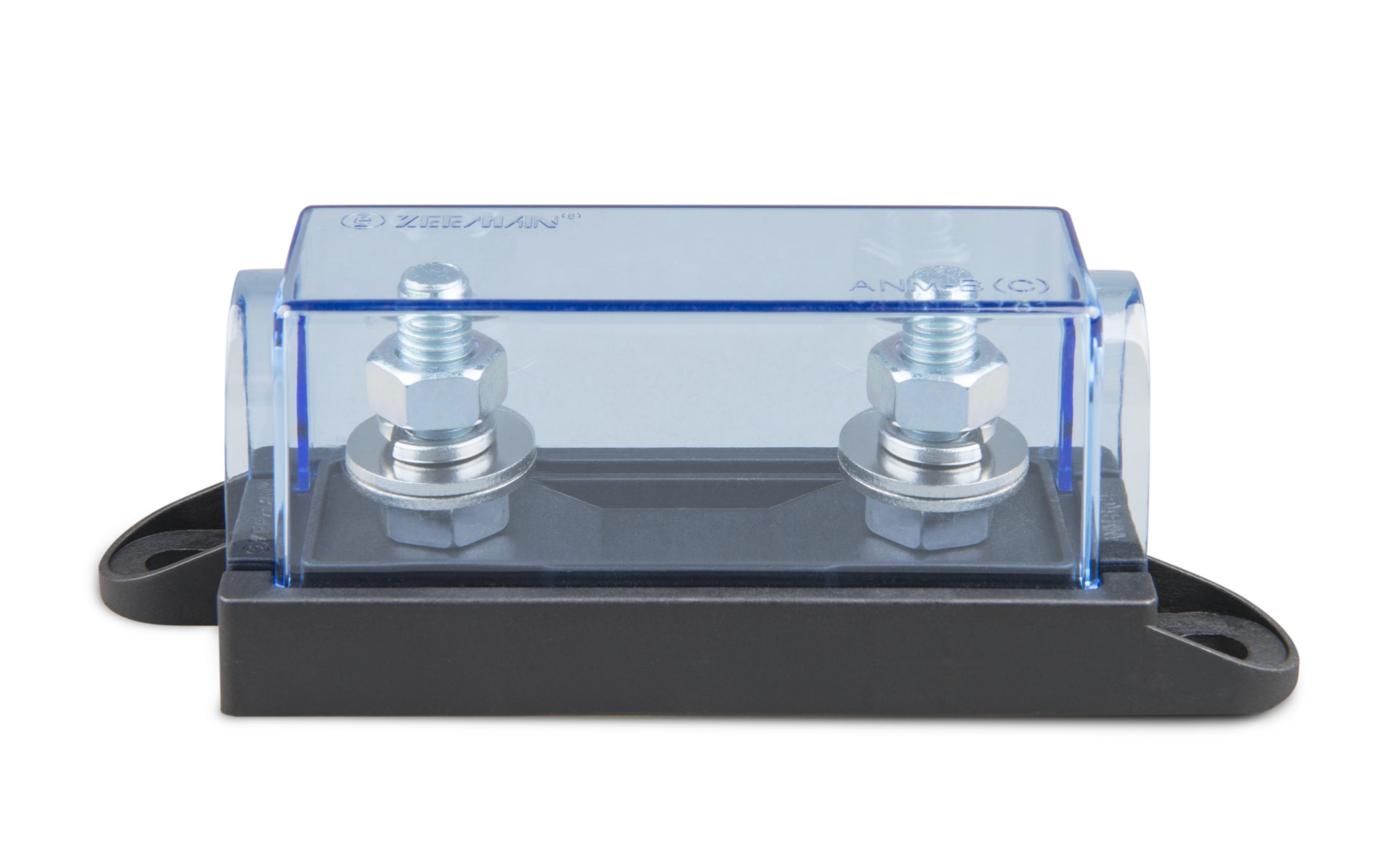
Orion XS 12/12-70A, from Victron: fuse 80-100A, minimum 25 mm² for runs under 10 m. That unit is IP20, so mount it indoors somewhere dry.Victron EnergyOrion XS 12/12-70A DC-DC battery charger manualwww.victronenergy.com ↗ All sources
Around those figures:
- Fuse at the battery end. As close to each battery as you can. BS 7671 Annex A721 also wants auxiliary battery cables sheathed or taped from the terminal to the overcurrent device.Victron EnergyOrion XS 12/12-50A DC-DC battery charger manualwww.victronenergy.com ↗ All sourcesIETBS 7671 informative Annex A721: extra-low voltage DC installations in caravans and motor caravanselectrical.theiet.org ↗ All sources
- Fine-strand cable, terminated properly. Victron wants flexible stranded copper, correct torque held for at least 5 seconds, and warns thick strands give a small contact area and overheating. See cable termination and choosing a DC fuse.Victron EnergyOrion XS 12/12-50A DC-DC battery charger manualwww.victronenergy.com ↗ All sourcesVictron EnergyOrion-Tr Smart DC-DC charger (non-isolated) manualwww.victronenergy.com ↗ All sources
- Include voltage drop in your lock-out. Victron’s example folds input cable drop into the lock-out so the charger doesn’t trip every time it starts drawing current.Victron EnergyOrion XS 12/12-50A DC-DC battery charger manualwww.victronenergy.com ↗ All sources
4. Fitting the Orion properly
Once it’s sized, fitting it properly is what keeps it reliable. Here’s what Victron’s manual asks for, and what we check on every job.
Setting up and connecting the Orion
- Mounting. Non-flammable surface, close to the battery but never directly above it. About 10cm clear for cooling. Also, poor cooling cuts charge current sooner; the heat sink can reach 90°C. Specifically, Victron rates full output to 40°C.Victron EnergyOrion XS 12/12-50A DC-DC battery charger manualwww.victronenergy.com ↗ All sources
- Strain relief. Use the cable-cover clamp. Victron says it grips over 9mm OD, and suggests heat shrink to build up thinner cable.Victron EnergyOrion XS 12/12-50A DC-DC battery charger manualwww.victronenergy.com ↗ All sources
- Set up before connecting the battery. Victron’s order: remove the remote on/off bridge, connect the input, set the charge algorithm in VictronConnect, connect the battery, refit the remote on/off.Victron EnergyOrion XS 12/12-50A DC-DC battery charger manualwww.victronenergy.com ↗ All sources
- Alternator type and input current in the app. Most “it only charges sometimes” faults we see come down to these two.
- BMS control. Also, wire an allowed-to-charge output to the Orion’s remote H-pin where you have one. Certain Victron BMS models can use a GX via DVCC instead; if DVCC is on, the Orion’s output must go to the main battery the GX is managing.Victron EnergyOrion XS 12/12-50A DC-DC battery charger manualwww.victronenergy.com ↗ All sources
- The negative path. Section 5: it’s behind most “volts but no amps” faults.
- Polarity before you power up. The Orion isn’t protected against reverse polarity, and that damage isn’t under warranty. Check both sides before you refit the fuses.Victron EnergyOrion XS 12/12-50A DC-DC battery charger manualwww.victronenergy.com ↗ All sourcesVictron EnergyOrion-Tr Smart DC-DC charger (non-isolated) manualwww.victronenergy.com ↗ All sources
After it’s in: three quick checks
- Start the engine. VictronConnect should show real current in and out, not just voltage, in bulk or absorption depending on what the battery needs.
- Stop the engine. When the engine stops, engine shutdown detection should stop charging once the starter voltage falls. If it keeps drawing with the engine off, go back to the shutdown settings.
- Compare voltages under load. Then, with the Orion drawing current, measure at the starter battery and at the Orion’s input. A big gap points to cable or connection losses. Indeed, Victron uses the same check in troubleshooting.Victron EnergyOrion-Tr Smart DC-DC charger (non-isolated) manualwww.victronenergy.com ↗ All sources
5. “Orion XS shows volts but no amps”: the negative fix
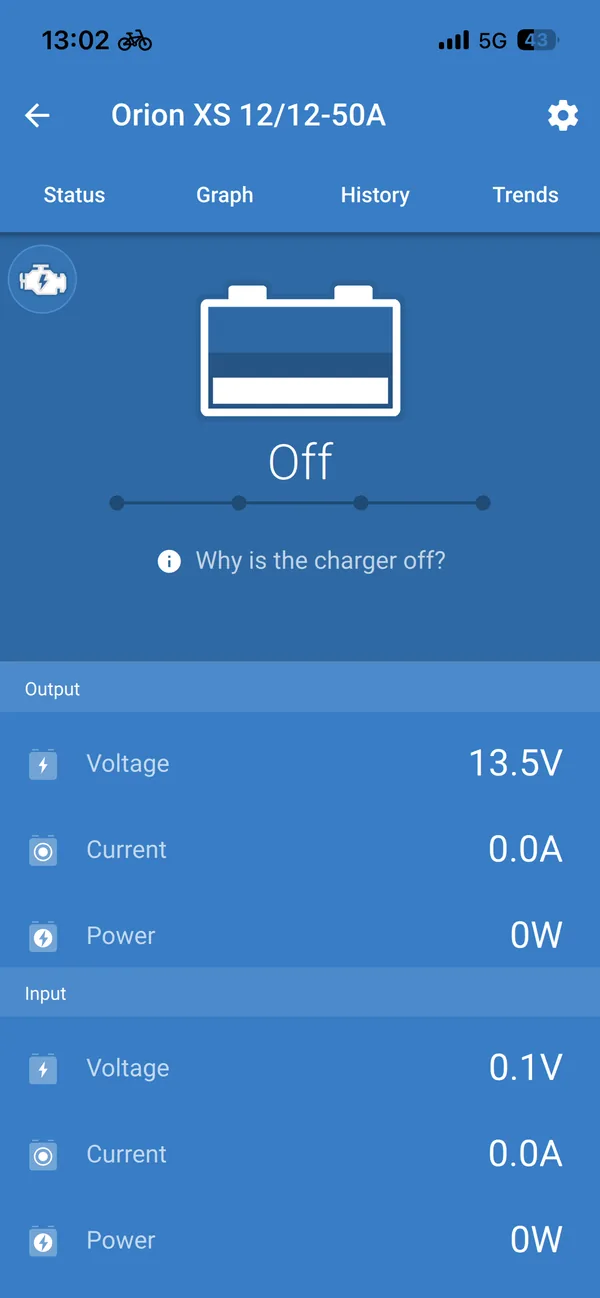
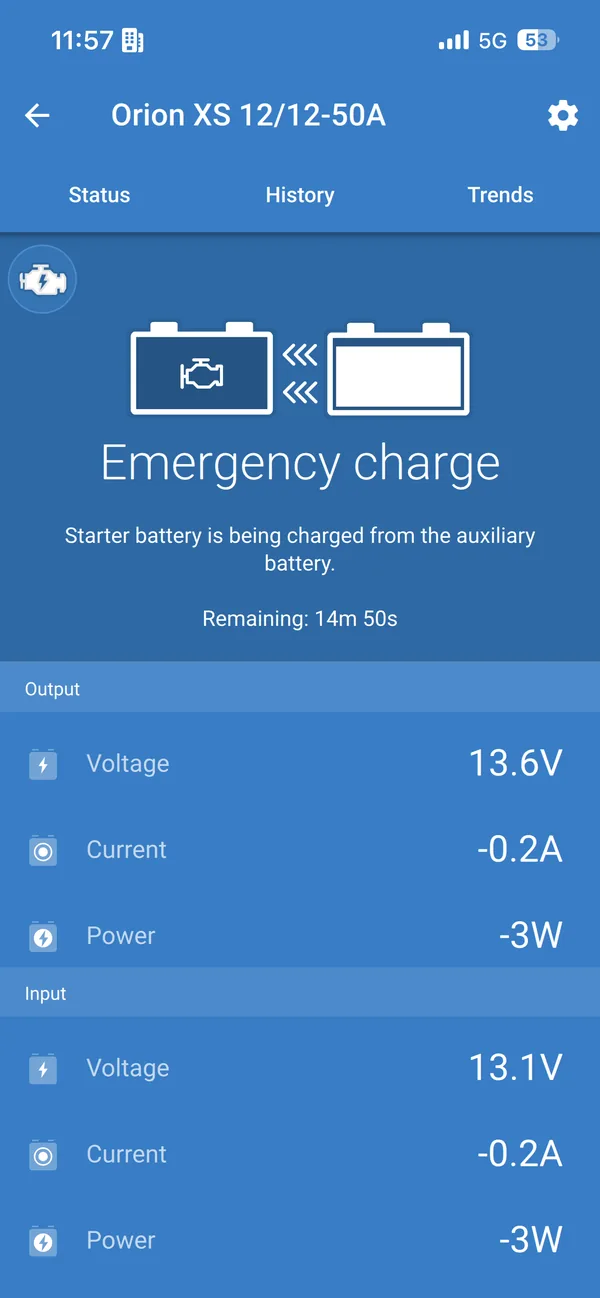
You start the engine, open VictronConnect, and there it is. Input voltage looks fine. Output voltage looks fine. But current in and out sits at zero, or close to it. Or the output reads a strange voltage that doesn’t match your settings.
Before you send the charger back, check the negative.
Why the negative matters
The Orion XS is non-isolated. Current leaves the positive output, through the leisure battery, and back to the Orion’s GND (same idea on the input from the starter). So starter negative (usually body and chassis) and leisure negative must share a low-resistance path. If they don’t, the Orion can read voltage on each side but current has nowhere to go.
Victron says the GND is often a chassis lug on bare metal free of paint, and that connection must have low impedance.Victron EnergyOrion XS 12/12-50A DC-DC battery charger manualwww.victronenergy.com ↗ All sources
Two real examples from this week
- A truck camper with an Orion XS 12/12-50A showed voltage in and out but no amps. The truck’s negative wasn’t joined to the camper shunt negative at all. Fix: join vehicle negative to leisure system negative.Victron CommunityOrion XS 50A shows voltage in/out but no amps in/out (16 to 18 Oct 2026)community.victronenergy.com ↗ All sources
- A 2026 motorhome with an Orion XS 50A showed error 2 and 16.4V on the output. Victron tested the unit fine. Fix: join starter negative to the leisure negative busbar, then run the Orion’s negative from that busbar. “Everything works now.”Victron CommunityOrion XS 50A error no. 2 (14 to 17 Oct 2026)community.victronenergy.com ↗ All sources
That second one ran for three and a half months before it played up. A barely-good negative can hide for a long time.
How to check it
- 01
Draw your negatives
Starter negative, chassis bond, leisure negative, shunt, Orion GND. No clear path between the two battery negatives? That’s likely the fault.
- 02
Check the shunt
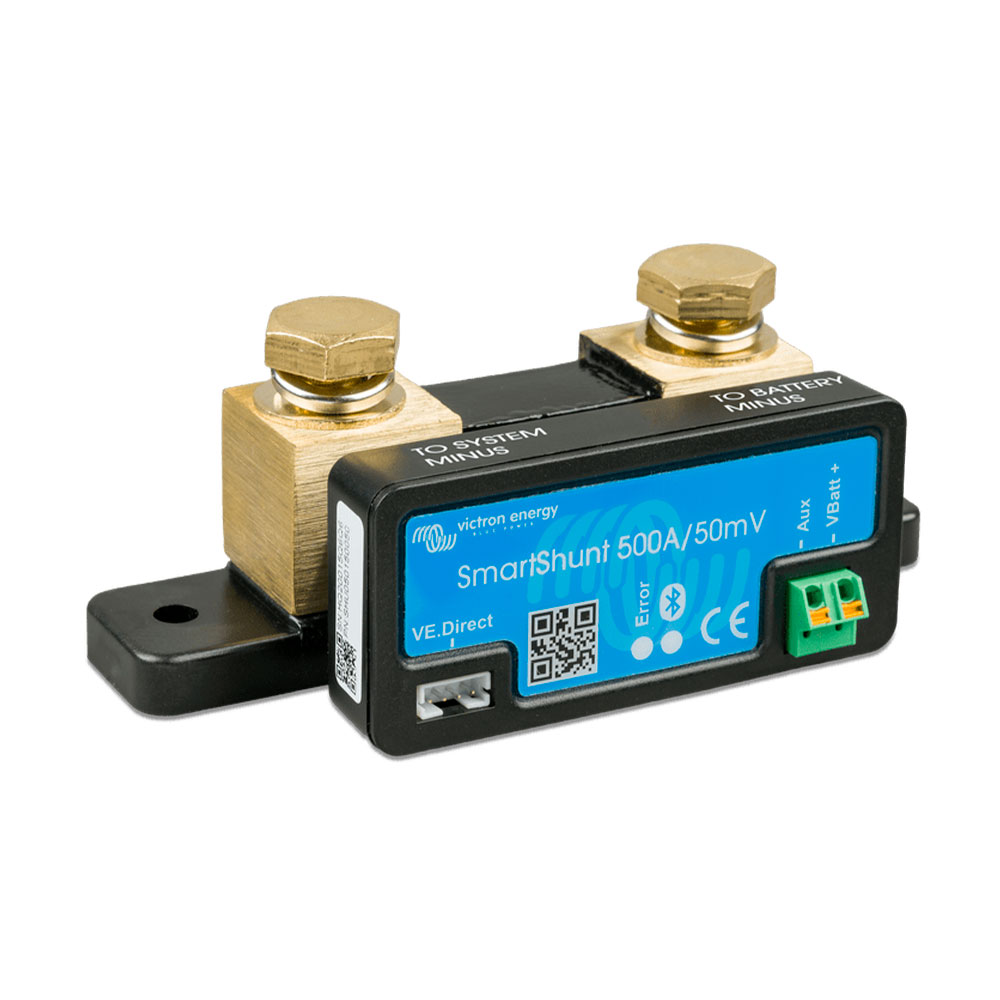
Victron’s Wiring Unlimited: the shunt is last before the battery negative; all DC consumers and supplies sit after it on the system side. Orion negative on the battery side of the shunt (or not reaching leisure negative at all) means charge isn’t counted or doesn’t flow.Victron EnergyWiring Unlimitedwww.victronenergy.com ↗ All sources
- 03
Measure while it’s trying to charge
Engine running, voltage between starter negative and leisure negative should sit near zero. A jump when the Orion draws current points to a high-resistance negative.Victron EnergyOrion-Tr Smart DC-DC charger (non-isolated) manualwww.victronenergy.com ↗ All sources
- 04
Chassis bond
Bare metal, crimped lug, tight, no paint, no corrosion. See earthing and bonding your campervan’s electrical system.
When it isn’t the negative
Not every low reading is a fault. Similarly, a full battery, a BMS that’s stopped charging, or a cold lithium pack in low-temperature shutdown all show low or zero current. One owner charging a power station found its own input limit was capping the current; the Orion was fine.Victron EnergyOrion XS 12/12-50A DC-DC battery charger manualwww.victronenergy.com ↗ All sourcesVictron CommunityOrion XS only 120 watts (7 to 14 Oct 2026)community.victronenergy.com ↗ All sources
Victron also lists an undersized alternator at idle, and the Orion getting hot. Both go back to sizing and mounting above.Victron EnergyOrion XS 12/12-50A DC-DC battery charger manualwww.victronenergy.com ↗ All sources
6. Before you blame the charger: a quick checklist
If the factory relay is out of the charge path and the negatives are sorted, the rest of the checks are the same for any Victron Orion. Our guide to DC-DC charger not charging works through them in Victron’s order: the app’s reason, the remote connector, engine detection, the lock-out, cables, the battery, the BMS and heat.
If those are clear and it’s still wrong, stop guessing around a habitation power unit or a factory second-battery system and bring it into a workshop.
Need it sized and fitted properly?
We’re an Authorised Victron Energy Installer. We design, supply and fit Victron DC-DC charging as part of a complete system in our Witherslack workshop: size around your alternator, take the factory relay out of the charge path, make a proper chassis bond and clean negative, then set up and test. See campervan installations and motorhome installations.
Lithium not charging while driving FAQs
How do I know if I have a smart alternator?
First, check the emission standard on the V5C, and measure the starter battery voltage with the engine running. Euro 6 usually means a smart alternator. Victron describes smart-alternator charge voltage swinging roughly between 12.5V and 15V on a 12V system, and notes it can switch off for a while. A steady charging voltage that holds while you idle points to a conventional alternator.
Do I need to remove the old split charge relay when fitting a DC-DC?
Yes. Leave it in and it can join the batteries directly whenever it closes, and the current bypasses the charger. Then the DC-DC should be the only charge route from starter to leisure. But keep any fridge ignition feed as the vehicle maker designed it.
What size cable and fuse do I need for an Orion?
Use Victron’s table for your model and run length in the Cable and fuse section above. Fuse at each battery end. Don’t guess from the van’s wheelbase: use the actual cable run.
What is a split charge relay?
A split charge relay joins your starter battery to your leisure battery while the engine runs, so the alternator charges both. When the engine stops, it disconnects them so the living area can’t flatten the starter battery.
Can you use a split charge relay with a lithium battery?
It’s rarely what we’d fit. A plain relay has no lithium charge profile (no bulk, absorption or float stages the way a DC-DC runs them) and doesn’t limit the current a lithium battery pulls from the alternator. Also, Victron notes that lithium’s low impedance results in a high alternator current. For most lithium set-ups we fit a Victron Orion DC-DC charger instead.
What size split charge relay do I need?
If you’re on lithium, we’d size a DC-DC charger instead. First, start from your alternator’s rating, allow for idle and heat, take off the vehicle’s own loads and leave headroom. The worked example above shows how.
How do you test a split charge relay is working?
Note the leisure battery voltage with the engine off, then start the engine and check again after a minute or two. If the relay has closed, the leisure battery voltage should rise with the charging voltage. If nothing changes, check the trigger, the connections and the chassis bond.
Why does my Orion XS show voltage but no current?
Most often the starter side negative and the leisure side negative aren’t properly joined, so current has no path back. Check that the Orion’s GND, the starter negative and the leisure negative all meet with a low-resistance connection, and that the Orion’s negative is on the system side of any shunt.
Can I run two Orion XS chargers in parallel?
Yes. Victron says an unlimited number can be paralleled. Add up their input currents and make sure your alternator can supply them, and remember to start emergency reverse charge on all units, or switch the others off, when you use it.
Should I use the ignition switch to turn the Orion on?
Victron doesn’t recommend it, because the Orion can drain the starter battery with the ignition on and the engine off. Instead, use the built-in engine shutdown detection, or a proper engine running signal where your van needs one.
Sources
Victron Energy sources
- 1
Victron Energy Orion XS 12/12-50A DC-DC battery charger manualControlled charging and lithium alternator current, GND connection, cable and fuse table, engine shutdown detection, Euro 6 setup, external engine running signal, input current setting.
- 2
Victron Energy Orion XS 12/12-70A DC-DC battery charger manualMounting and cooling, strain relief, insufficient alternator power (about 50% at idle), full output not reached, emergency reverse charge with parallel units.
- 3
Victron Energy Orion XS DC-DC battery chargers datasheetCurrent setting ranges, continuous output power, IP ratings, unlimited units in parallel.
- 4
Victron Energy Orion-Tr Smart DC-DC charger (non-isolated) manualEngine shutdown detection defaults, starter recharge example, input current at full capacity, cable and fuse, insufficient alternator power.
- 5
Victron Energy Wiring UnlimitedShunt placement: last item before the battery negative, all consumers and supplies after it.
BS 7671 and Victron Community sources
- 6
IET BS 7671 informative Annex A721: extra-low voltage DC installations in caravans and motor caravansA721.55.3.6 auxiliary battery cable protection; A721.55.5 battery charging and refrigerator circuits.
- 7
Victron Community Orion XS 50A shows voltage in/out but no amps in/out (16 to 18 Oct 2026)Vehicle negative not joined to the shunt negative.
- 8
Victron Community Orion XS 50A error no. 2 (14 to 17 Oct 2026)16.4V output on a 2026 motorhome, fixed by joining the starter negative to the leisure negative busbar.
- 9
Victron Community Orion XS only 120 watts (7 to 14 Oct 2026)Power station input limit capping the current.
- 10
Victron Community Two Orion XS chargers behind one BatteryProtect (18 to 19 Oct 2026)XS 50A plus XS 70A on a 230A smart alternator.
- 11
Victron Community Orion XS reverse charging with dual units (15 Oct 2026)The second unit charging forward against the one reverse charging.
- 12
Victron Community Orion-Tr Smart doesn’t charge properly when solar is active (10 to 12 Oct 2026)Solar holding the battery at float on a Euro 6 Ducato.
About the reviewer: Tom Alderdice
Tom holds the 18th Edition (BS 7671) and inspection and testing qualifications, plus NCC training in caravan and motorhome electrics.
Tiny Build Electrics is an Authorised Victron Energy Installer. See Tom’s full qualifications