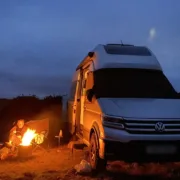
Complete Victron campervan electrics from £6,095 all-in for Compact, or £7,895 for Flagship Gasless. We design your campervan electrical system around how you travel, and Charlie Cable, our Lead Electrician, fits and tests it in our Cumbria workshop near the Lake District. Looking for a campervan electrician? We design, supply and fit the whole system ourselves.
Of that, about £2,395 (Compact) or £2,994 (Flagship Gasless) is labour.
Building it yourself instead? Sketch your system in our free system designer, or see our self-build campervan electrics kit.
Not sure what your van needs? Talk it through before you spend anything. Tom, our founder, runs every call. He holds the 18th Edition (BS 7671) and inspection and testing qualifications.
Need longer, or a deeper look at a system you already have? Paid consults with Tom are 30, 45 or 60 minutes online, £45, £60 or £80.
Choose one of our two complete Victron systems, each with one all-in price. Or, if neither fits, we design a bespoke system with you on the call.
A neat, simple Victron system for lighter power needs.
Cook on induction, run the coffee machine, microwave and air fryer. No gas on board.
We design it with you on the call, so it fits the way you travel.
Already have a system? Add a Victron MultiPlus-II and Cerbo GX, supplied and fitted.
Single upgrades and services, on their own or alongside a full system. Each one is a fixed price.
Not sure which to pick? Choose Bespoke and we'll work it out on the call.
Four stages, from the first conversation to the day you drive away. We're now booking installs from February 2027.
What customers say
Video reviews“I wouldn’t work with anybody else, I’ve worked with Tom for my past three van builds.”Rach Harding
“Some things are actually just better left to the experts.”Charlie Skinner
“Would I recommend Tiny Build Electrics? Absolutely.”Lucy and Marie
“We use a lot of appliances when we cook.”Vivian Forte
“What a game changer with the van, NO battery stress!! Coffee machine, fridge, Cath’s hairdryer, speaker etc etc. Whoop Whoop!!”DarrenYork · October 2026
“Designed and fitted my van system upgrade, very professional and knowledgeable. Couldn’t be happier.”FishGoogle, February 2026
Not the cheapest install. Built so you only pay once.
We design it, supply the kit, fit it, test it and give you the certificate. One price, no separate labour bill, and nobody passing you between firms.
Cables sized to BS 7671, terminations crimped and labelled, RCBO protection and a full test before handover. It's the part that's easiest to skimp on, so we don't.
Charlie Cable, our Lead Electrician, is a gold card electrician and heads up our Witherslack workshop. He fits your van, then inspects, tests and records every circuit. Tom Alderdice, our founder, designs it with you on the free call.
We'd rather book you in a little later than rush your build. Each system gets the time it needs, from design to handover.

 Approved Fogstar installer Read Fogstar's case study










We supply and fit every campervan power system ourselves, as one job at one all-in price. Open any item to see what goes in and why.
On 3000 VA systems we fit the Victron MultiPlus-II inverter/charger. It runs induction hobs, kettles and coffee machines from the battery, charges from hook-up, and switches between the two on its own. Smaller builds use a 1200 VA MultiPlus.
Our standard leisure battery is Fogstar Drift lithium, sized to your usage, typically 300Ah on Compact and about 628Ah on Flagship. Victron batteries are available on request.
Every MultiPlus install includes an AC-in consumer unit, so your campervan electric hook up is isolated and RCD-protected before it reaches the inverter/charger. It's in the price, not an add-on.
Ask in any van-build group and the same worry comes up: is my earthing right, and would my RCD actually trip if something went wrong? With an inverter/charger on board, the protective conductors, the chassis bond and the neutral-to-earth link all have to be right, or the RCD may not protect you at all.
"I've read three forums and asked AI. I still don't know if my chassis bond is right." We hear that every week.
What we do on every campervan
Every campervan electrical installation we do is built around one board, laid out in the same order every time. Here's what's on it, and the manual or regulation we check each part against.
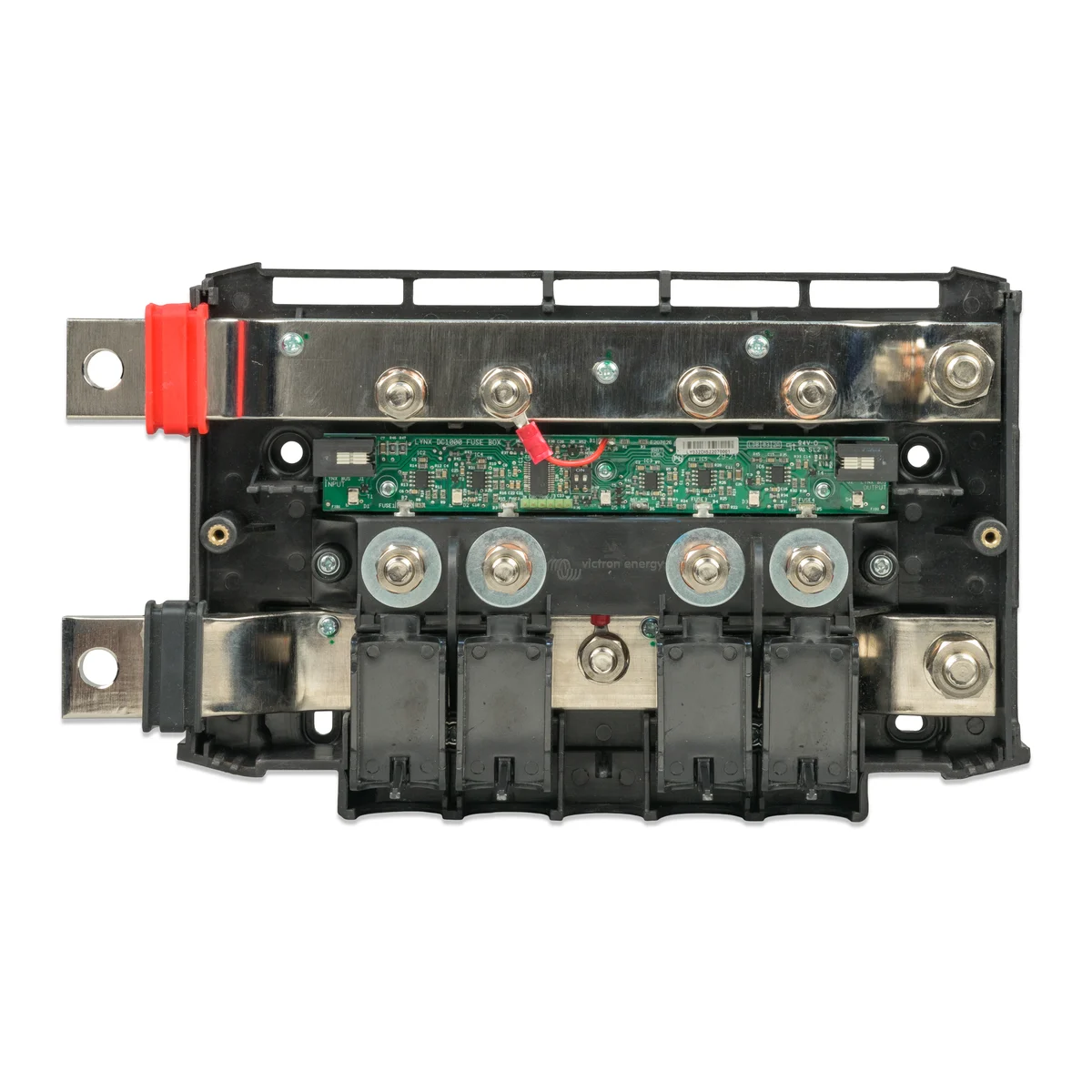
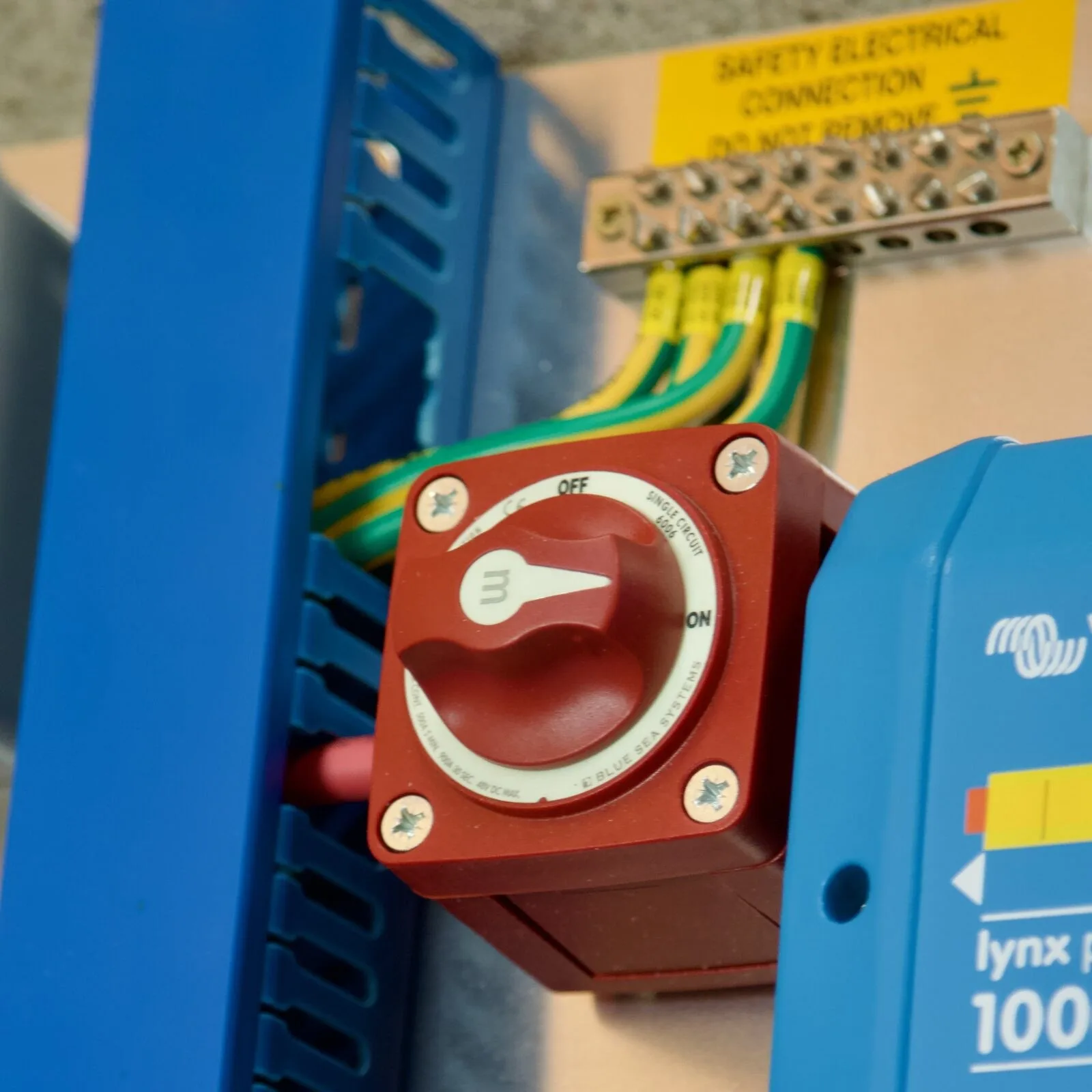
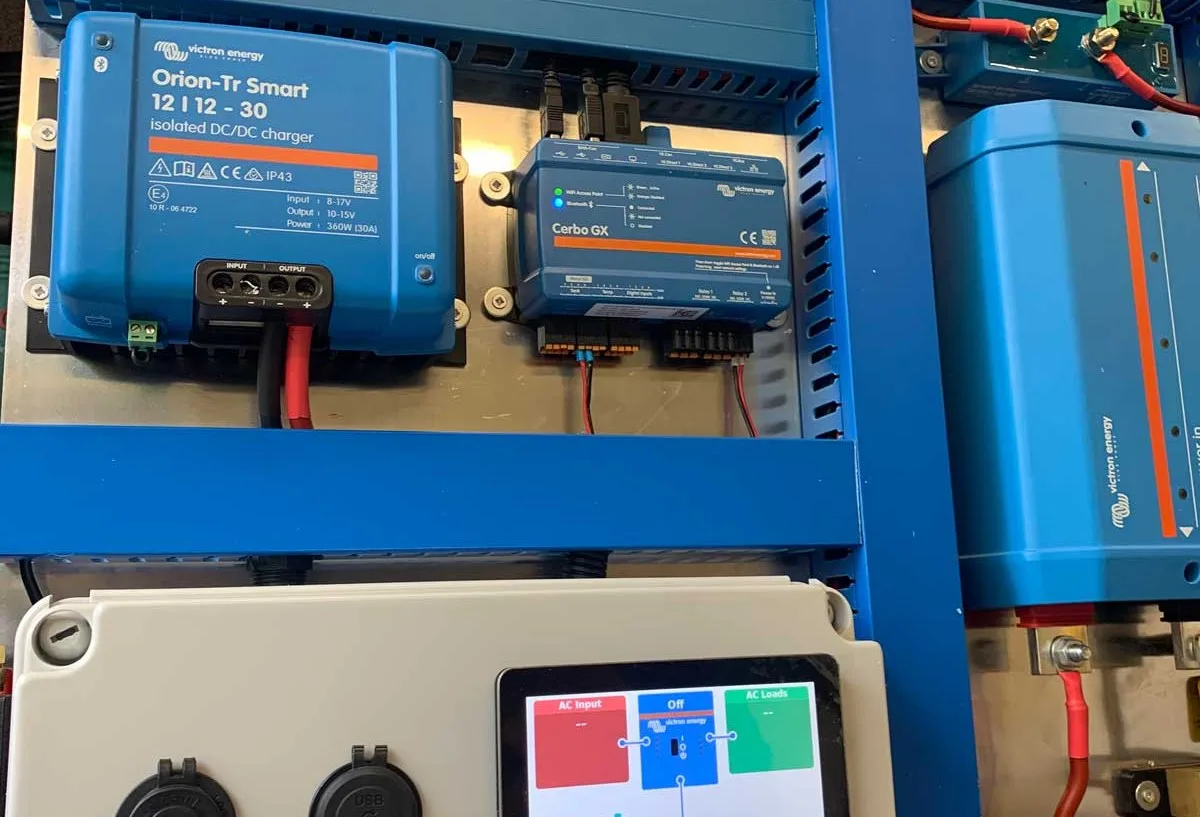
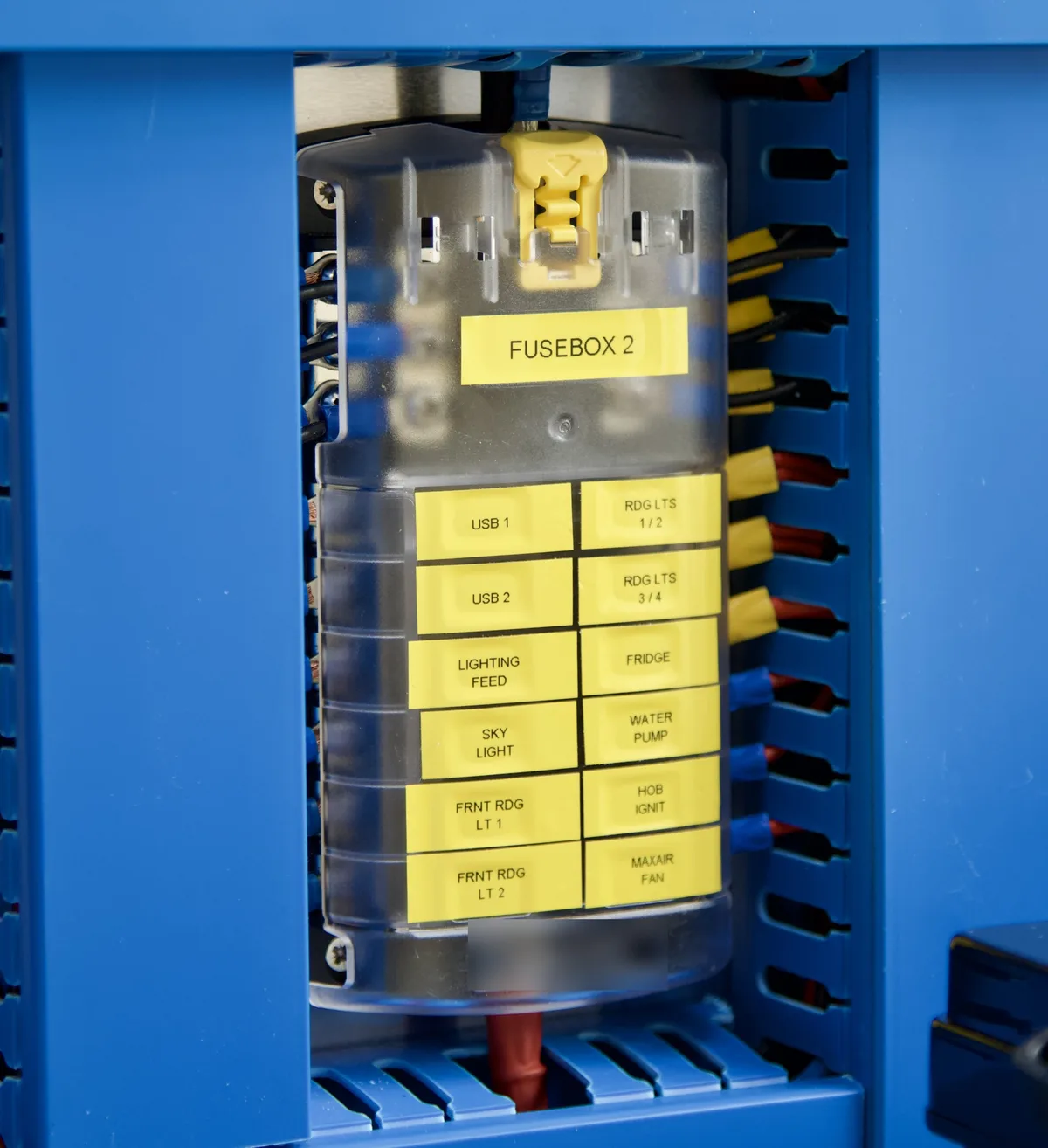
The main battery fuse comes before anything else. On 24V and 48V systems, and on 12V above 200Ah, it's a Class T fitted on the board, with the battery tails connected straight to it. On 12V, we allow an MRBF up to 200Ah per battery as a stated exception, fitted next to the battery. The battery isolator comes next, on short runs.
Victron Wiring Unlimited
It has four MEGA fuse ways, one for each main DC circuit, and we put a fuse in all four, as the manual asks.
Lynx Distributor manual, 5.2.2 and 6.2.4
Battery cables land on the Lynx's M10 busbar studs at 33 Nm, and the MEGA fuse ways and negatives take M8 lugs at 14 Nm. Every connection on the board is tightened to the maker's figure, then marked with a torque pen, so you can see at a glance that nothing has moved.
Lynx Distributor manual, 2.1 and 6.2.2
Every board has a 230V side with a metal consumer unit and double-pole RCBOs, which switch off both live and neutral if there's a fault. It's wired to BS 7671:2018+A4:2026 Section 721, the part written for caravans and motor caravans.
BS 7671, Section 721
Each circuit protective conductor (cpc) runs back to the main earthing terminal. The van's body is bonded to it with a 4 mm² highly flexible main protective bonding conductor, labelled at both ends.
BS 7671, 721.411.3.1.2 and 514.13.1
We inspect, test and record every circuit. With a 230V side you get an Electrical Installation Certificate to BS 7671, with our own record of the 12V side, checked against BS EN 1648-2, attached. A 12V-only van has no 230V installation, so there is no certificate to issue.
BS 7671, Part 6
Read more in our guides to lithium battery fuse sizing, earthing and bonding and cable termination.
Campervan electrics are the leisure battery, charging and 230V system that power your van away from hook-up. Every system does three jobs: it stores energy, refills that store, and feeds it safely to everything you use.
We don't size from a spec sheet. On your free call we ask three questions, then check the answer against real sun data for the places you plan to go.
A fridge, lights, phones and a laptop use very little. A coffee machine, induction hob or hairdryer use a lot. We total it in watt hours and add some headroom.
A weekend away needs far less than a fortnight wild camping in Scotland. The longer you stay off grid, the more battery and solar you'll want.
UK solar drops right off from November to February. For year-round trips we lean more on DC-DC charging from the engine and on hook-up.
Most of our vans carry 400 to 500 W of solar, roughly 2 W for every 1Ah of battery. That keeps a fridge, lights and devices going for most of the year.
Fitted is one of three ways to get camper van electrics. You can also buy a pre-built board, wired and tested on our bench for you to fit, or build it yourself with your own wiring diagram, drawn by Tom for your build and sent within 3 working days of checkout. Compare motorhome electrics or cabin electrics, see Darren and Cath's Grand California, or read our guides.
Updated 27 October 2026
Our two popular packages are all-in: Compact from £6,095 and Flagship Gasless from £7,895, including parts, fitting, testing and certificate. Labour makes up about £2,395 and £2,994 of that. Anything else is priced as a bill of materials plus labour, on one supply-and-fit invoice. Adding a Victron MultiPlus-II with Cerbo GX to an existing system is £2,750 all-in.
Doing it yourself rather than paying a campervan electrician saves the labour, which is about £2,395 of the Compact all-in price, but you still buy every part, the crimping and testing tools, and your time. The 230V side should still be inspected and tested before you use it; our inspection and testing at the workshop is £295. If you want to build it yourself with our help, see the Self-Build Package.
A good campervan electrician should answer five questions clearly. Who actually does the work? Is the 230V side tested and certificated to BS 7671? Where is the main battery fuse, and is every circuit fused? Are they authorised by the brand they fit? What support do you get afterwards? If a campervan electrician can't answer all five, keep looking. Our answers: our own Lead Electrician; yes, with an Electrical Installation Certificate; battery fuse first, at the battery end; Authorised Victron Energy Installer; 12 months of VRM support and lifelong WhatsApp Community membership.
Charlie Cable, our Lead Electrician, fits and tests your system in our Witherslack workshop. Tom Alderdice, our founder, designs it with you on a free 30-minute call. We don't pass your van to another firm.
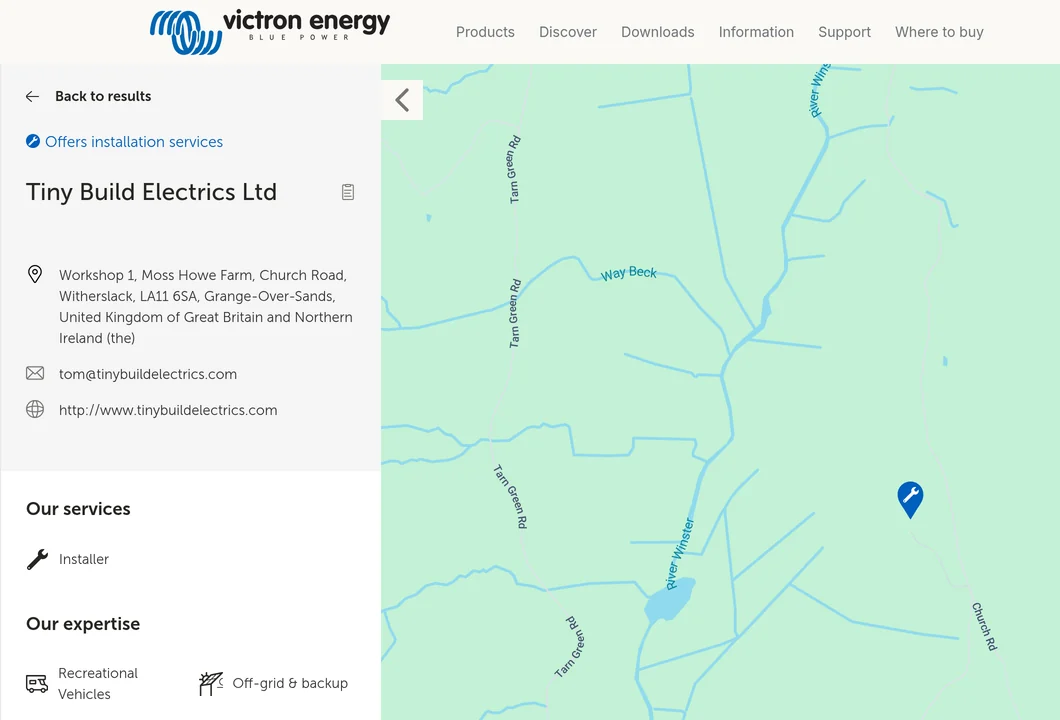
Yes. Tiny Build Electrics Ltd is an Authorised Victron Energy Installer, listed on Victron's own where-to-buy finder at our Witherslack workshop.
No to both. Our installs are supply and fit only: we supply every part and fit it ourselves, so one team is responsible for your whole camper van electrical system. We don't fit customer-supplied kit, such as a campervan electrics kit bought elsewhere.
Not for living in. A standard van has a 12V starter battery for the engine and nothing else. Campervan electrics add a second, leisure battery with its own charging, so you can run lights, a fridge and, with an inverter, 230V sockets without draining the starter battery.
It depends on how you travel. Weekends on campsites can work with a modest battery and hook-up. Longer stays off grid need more battery, DC-DC charging from the engine and solar. Cooking on induction needs a 3 kVA inverter/charger and a big lithium bank, like our Flagship Gasless. We work it out with you on the free call.
A leisure battery; a main battery fuse and isolator; DC distribution with a fuse for every circuit (we use a Victron Lynx Distributor); a DC-DC charger; a solar charge controller and panels; a hook-up inlet with an AC-in consumer unit; an inverter/charger with a 230V consumer unit; and a battery monitor. Each part has its own job, and the wiring between them is sized and fused to suit.
The whole campervan power system, supplied and fitted by us as one job: a Fogstar Drift lithium leisure battery, DC-DC charging from the alternator, solar, electric hook-up through an AC-in consumer unit, a Victron inverter/charger and fused 12V distribution, with the wiring between it all. We then test every circuit and commission the system. Commissioning worth £195 is included on every option.
Plan the loads and size the battery first. Then mount the board, fit the main battery fuse before anything else, add the isolator and DC distribution, then the chargers, inverter/charger and consumer units. Size and fuse every cable, torque every connection to the maker's figure, bond the chassis, then inspect and test every circuit before first use. Our planning guide covers the first step.
If your van has a 230V side, yes: test results and an Electrical Installation Certificate to BS 7671, with our own record of the 12V side, checked against BS EN 1648-2, attached. A 12V-only van has no 230V installation, so there is no certificate to issue. DVLA's motor caravan guidance says that if you sell, it's up to you to show the conversion work was done safely.
We're now booking installs from February 2027. Booking starts with a free call with Tom. Once your quote is agreed, a £500 deposit secures your install slot, and we confirm your fitting date, drop-off and collection in writing. The balance is due before your vehicle leaves the workshop.
No, but it helps in winter. A hook-up lead runs from the campsite bollard to an inlet on the van, then to an AC-in consumer unit with RCD protection and on to the MultiPlus, which charges the battery and runs your sockets. A plug-in van inverter kit can't charge from hook-up or switch over by itself. Every MultiPlus install we do includes the consumer unit.
It depends on the current each circuit carries and how far it runs. Longer runs need thicker cable to keep voltage drop down. We size every cable from Victron's guidance and BS 7671, and fuse it at the source. You can check a run yourself with our free cable size calculator. It's free with no sign-up, and we still check every size on the free call.
Yes. Most newer vans, especially Euro 6 models, have a smart alternator that drops its output once the starter battery is full. We fit a Victron Orion DC-DC charger set up for your vehicle, so the leisure battery still charges while you drive. Our DC to DC charger guide explains more.
Often, yes. A campervan electrician should check what's there first. If the basics are sound, we can add hook-up, DC-DC charging, solar, a lithium upgrade or a Victron MultiPlus-II with Cerbo GX to what you already have. Each is a fixed price under Smaller upgrades above. If we find wiring that isn't safe, we'll tell you before we build on it.
Yes. A Victron SmartShunt connects by Bluetooth to the VictronConnect app, so you can see the battery's charge at a glance. With a Cerbo GX, the whole system also reports to Victron's VRM portal, so you can check it from anywhere with a signal. Every system we fit comes with 12 months of VRM support.
Fogstar Drift lithium as standard, sized to what you run each day: typically 300Ah on Compact and about 628Ah on Flagship Gasless. Victron batteries are available on request. You can use most of a lithium battery's capacity, where lead-acid shouldn't go much below half.
Our workshop is in Witherslack, Cumbria, between Kendal and Grange-over-Sands and 15 minutes from the M6. You don't need a campervan electrician on your doorstep: most customers drive their van to us from the Lake District, Lancashire, Yorkshire, the North East and southern Scotland. Local on-site work is available on request, subject to review.
Start with step 1, a free 30-minute call with Tom. Then you get a clear price.