In short: In Cumbria, campervan solar in winter gives you about a fourteenth of what the same panels make in June. For example, 400 W of flat panels there average about 116 Wh, or 9 Ah, on a December day. So in winter, driving and hook-up do the real charging. Solar only slows the drain. A lithium battery also has to be warm before it takes a charge, so frosty mornings need a plan too.
- In Cumbria, December solar is a fourteenth of June’s
- An hour of driving can replace a day’s use
- Hook-up is the winter safety net
- Cold lithium warms up before it charges
If you use your van through the winter, the numbers change completely. This guide works out what campervan solar in winter really makes in the UK, using official EU solar data. Then it shows how driving and hook-up fill the gap, and what cold does to charging. We’re an Authorised Victron Energy Installer, so this is also how we set up vans that get used all year.
On this page 8 sections
How much does campervan solar make in winter?
To get real figures, we ran three UK locations through PVGIS. It’s the free solar calculator from the European Commission’s Joint Research Centre. Because it draws on satellite records from 2005 to 2023, it reflects real UK weather. We then modelled 400 W of panels lying flat, as most roof panels do, with PVGIS’s standard 14% system loss.
| Location | June day | December day |
|---|---|---|
| Exeter, Devon | 1,724 Wh | 196 Wh (about 15 Ah) |
| Witherslack, Cumbria | 1,636 Wh | 116 Wh (about 9 Ah) |
| Inverness, Highlands | 1,440 Wh | 56 Wh (about 4 Ah) |
400 W of flat panels, PVGIS averages (European Commission JRC), with amp hours worked at 12.8 V.
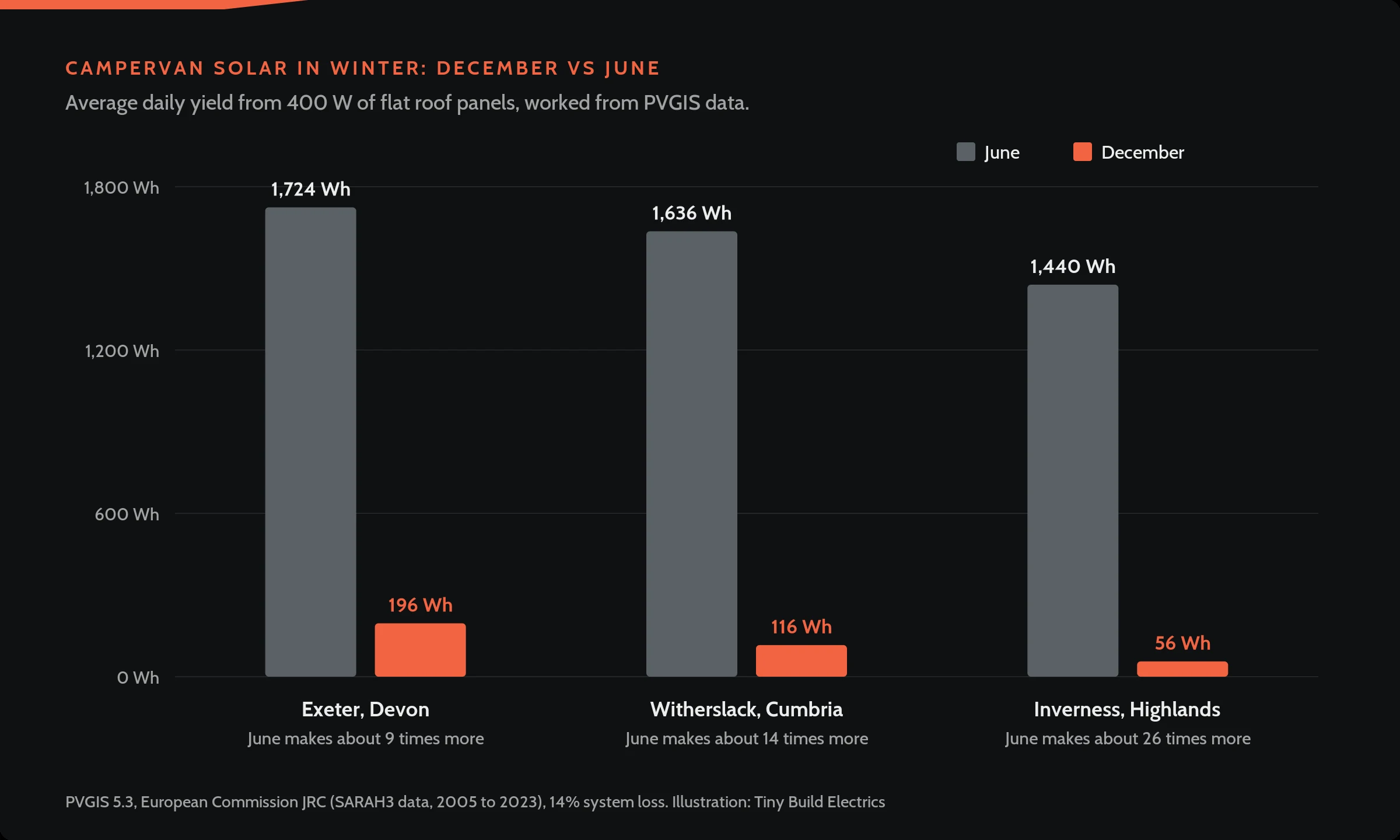
These are averages, so a grey week sits well below them and a bright frosty day can beat them. Even so, the gap between June and December is the point. In Cumbria, the same panels make about fourteen times more in June than in December. Further north, the gap gets wider still.
Why December is so poor
In December, the sun sits low and the days are short. At Witherslack, PVGIS puts the midwinter sun only about 12 degrees above the horizon at its highest, against 59 degrees in June. So its light hits a flat panel at a shallow angle, and far less energy lands on each square metre. Low sun also casts long shadows. At 12 degrees, a 5 m tree throws a shadow over 20 m long, so a tree line can shade the roof for much of the day.
Tilting a panel beats adding one
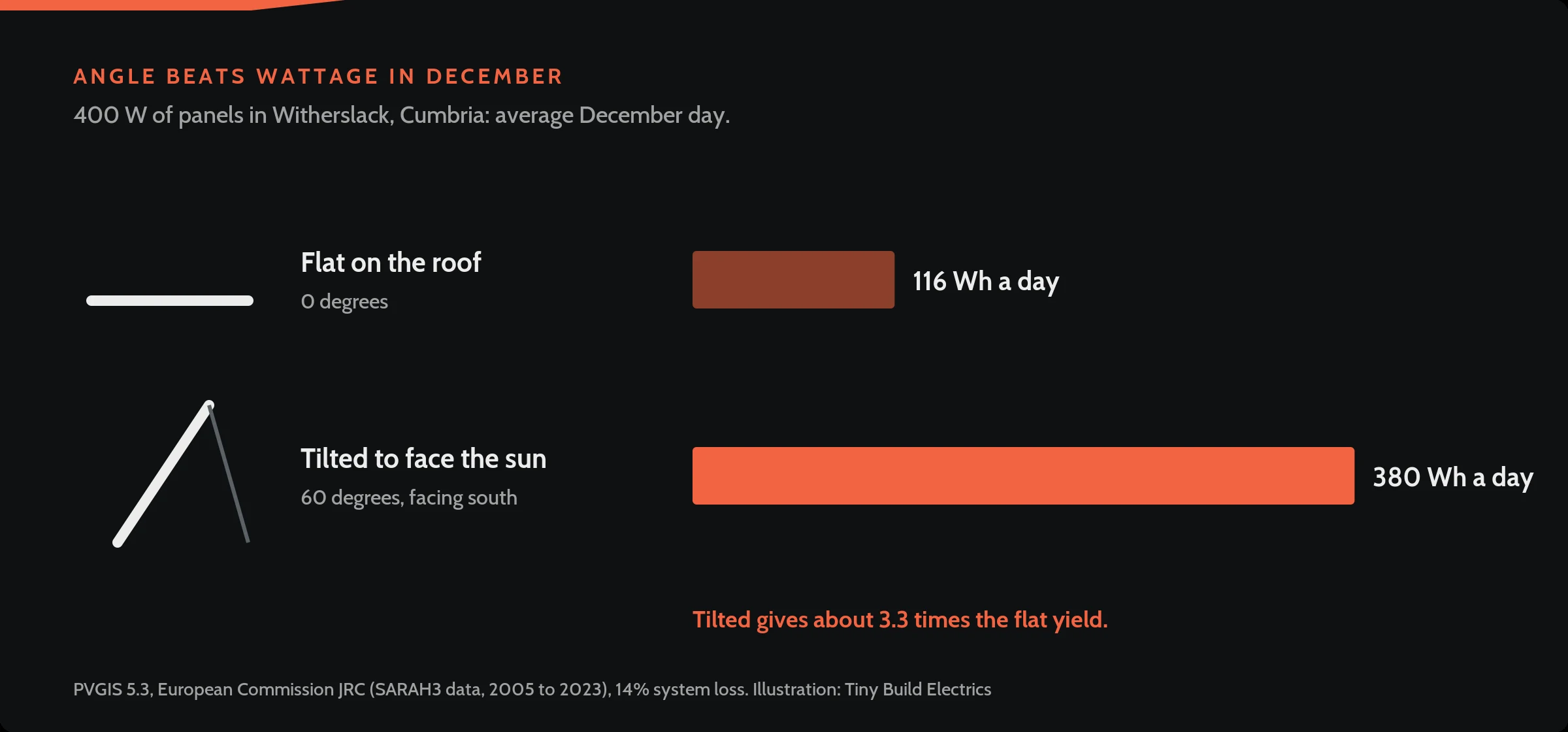
Angle matters more than wattage in winter. For instance, PVGIS puts the same 400 W at about 380 Wh on a December day in Cumbria when tilted to 60 degrees. That’s over three times the flat figure. So a portable panel propped up towards the sun often beats a bigger flat array in winter.
What a December day means for real use
Say your van uses 50 Ah a day in winter, which is about 640 Wh at 12.8 V. Then compare that with December solar in Cumbria, at about 9 Ah a day from 400 W of flat panels. That leaves a shortfall of about 41 Ah every day, even before a dull week.
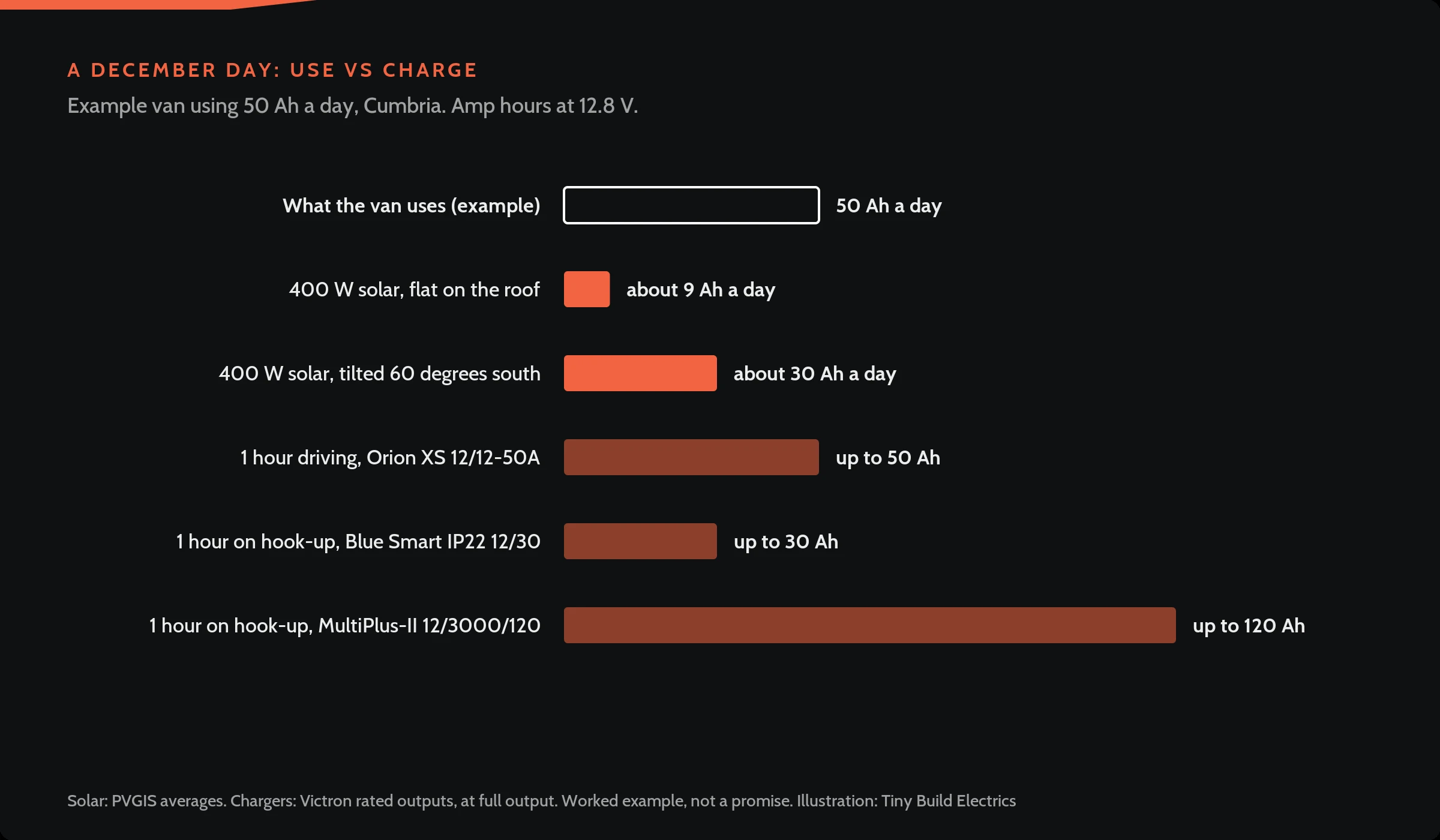
Over a long weekend parked up, that shortfall adds up to about 120 Ah. That’s more than half of a 230 Ah battery, so another source has to make it up. In practice, that means driving or hook-up. Because heaters, fridges and laptops vary a lot, use your own daily figure rather than ours. Our system designer works out your daily use from the kit you actually run.
Winter also changes what you use. For example, a diesel heater runs for longer and the lights come on earlier. If you’re working from the van, laptops and phones charge every day too. Our battery monitor guide shows how a SmartShunt tells you exactly what goes in and out, so you’re not guessing.
Charging from the engine: DC-DC in winter
In a UK winter, the alternator is your most reliable source because it doesn’t depend on the weather. While the engine runs, a DC-DC charger takes power from the alternator. It then charges the leisure battery at the right voltage for its chemistry.
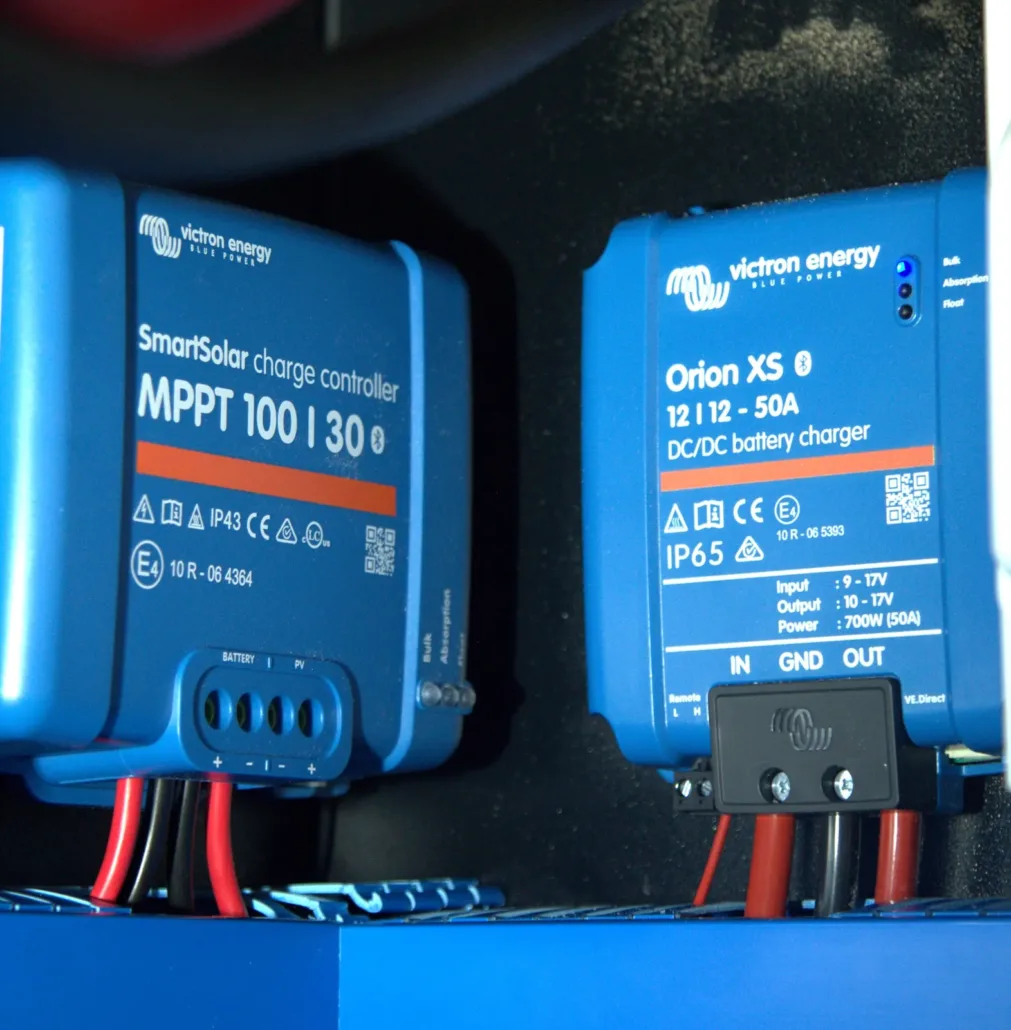
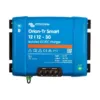
Here the sums are simple. A Victron Orion XS 12/12-50A charges at up to 50 A. So an hour of driving at full output puts back about 50 Ah. In other words, that’s a whole day of our example in one drive. By contrast, an Orion-Tr Smart 12/12-30 is rated at 30 A continuous, so the same top-up takes nearer two hours.
Two settings matter more in winter:
- Engine detection: Euro 5 and Euro 6 smart alternators can drop their voltage while the engine is running. The Orion XS reads the alternator voltage to tell when the engine is running. It only charges then. With a Euro 6 smart alternator, Victron’s manual says the detection sometimes needs fine-tuning in the app.
- Input current limit: you can also cap what the Orion XS draws, anywhere from 1 A to 50 A. We set it to suit the vehicle, because lights, heater fan and wipers already load the alternator.
If your lithium won’t take a charge on the road, start with our guide to a DC-DC charger not charging. If you want to know how these chargers work, read DC-DC charging in a campervan.
Shore power: the winter safety net
When the van sits still in grey weather, hook-up is the only source that keeps up. Once you plug in at a campsite pitch, a mains charger turns its 230 V into charge for the battery.
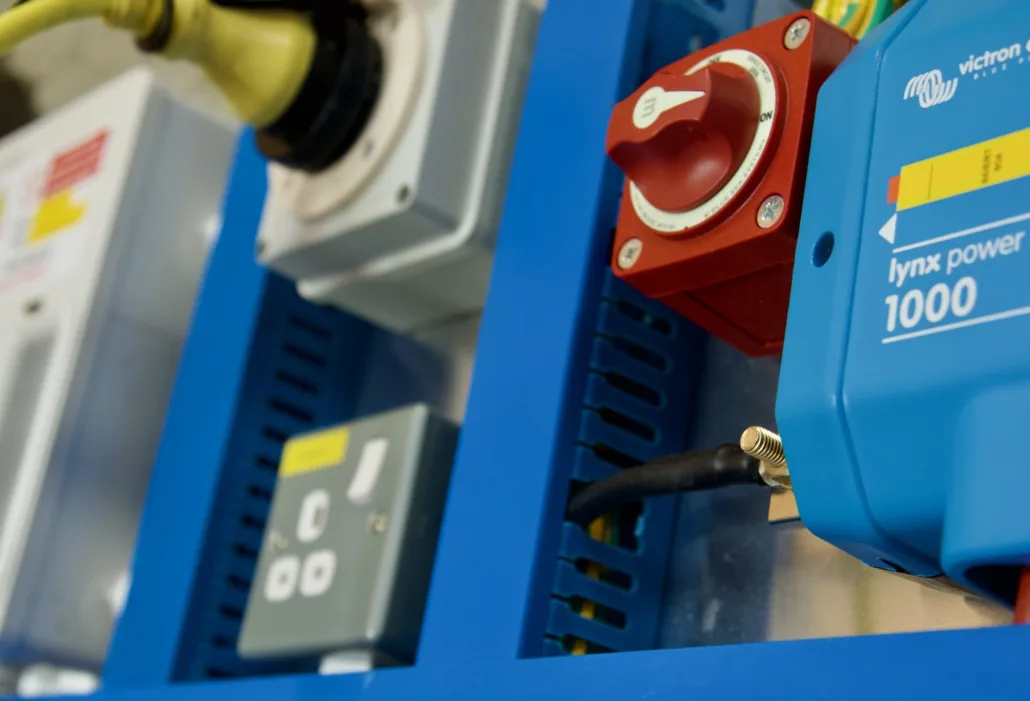
With Victron, there are two ways to do it:
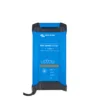
- A Blue Smart IP22 charger: the 12/30 model charges at up to 30 A. However, its NIGHT and LOW modes halve the current to keep it silent, which is handy overnight but slower.
- A MultiPlus-II inverter/charger: the 12/3000/120 model charges at up to 120 A. You also set a maximum shore current. It then works around your other AC loads and charges with whatever is left. As a result, a low-amp pitch doesn’t trip.
So set the shore current limit to match the pitch. BS 7671 Section 708 sets out how campsite pitch supplies are installed, so ask the site what current its pitches supply. If you’re fitting hook-up, we cover the inlet, lead and RCD in our BS 7671 Amendment 4 guide.
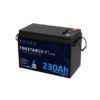
A lithium battery can still run the van below freezing, but it can’t safely charge until it warms up. Our guide to charging lithium below freezing covers the cut-off and the Victron settings. If the battery sits somewhere cold, a heated lithium battery can warm itself first.
Getting more from campervan solar in winter
Campervan solar in winter is a top-up, but a few choices make it a better one:
- Give a portable panel an angle: tilting towards the low sun gives about three times the flat output in December.
- Check the voltage for cold mornings: Victron warns that a panel’s open circuit voltage rises below 25°C. So if panels are wired in series, check the string with Victron’s MPPT sizing calculator.
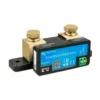
- Share the battery temperature: a SmartShunt with its sensor, or a Smart Battery Sense, sends the battery temperature to Victron chargers on a VE.Smart network. That way, they charge from the battery’s real temperature rather than their own.
- Park for the sun: when the sun barely clears the hedges, an open southern view beats an extra panel.

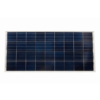
Still sizing the roof? Our guide to solar panels for a campervan covers panel choice. Then MPPT vs PWM explains the controller.
How we set up a van for winter use
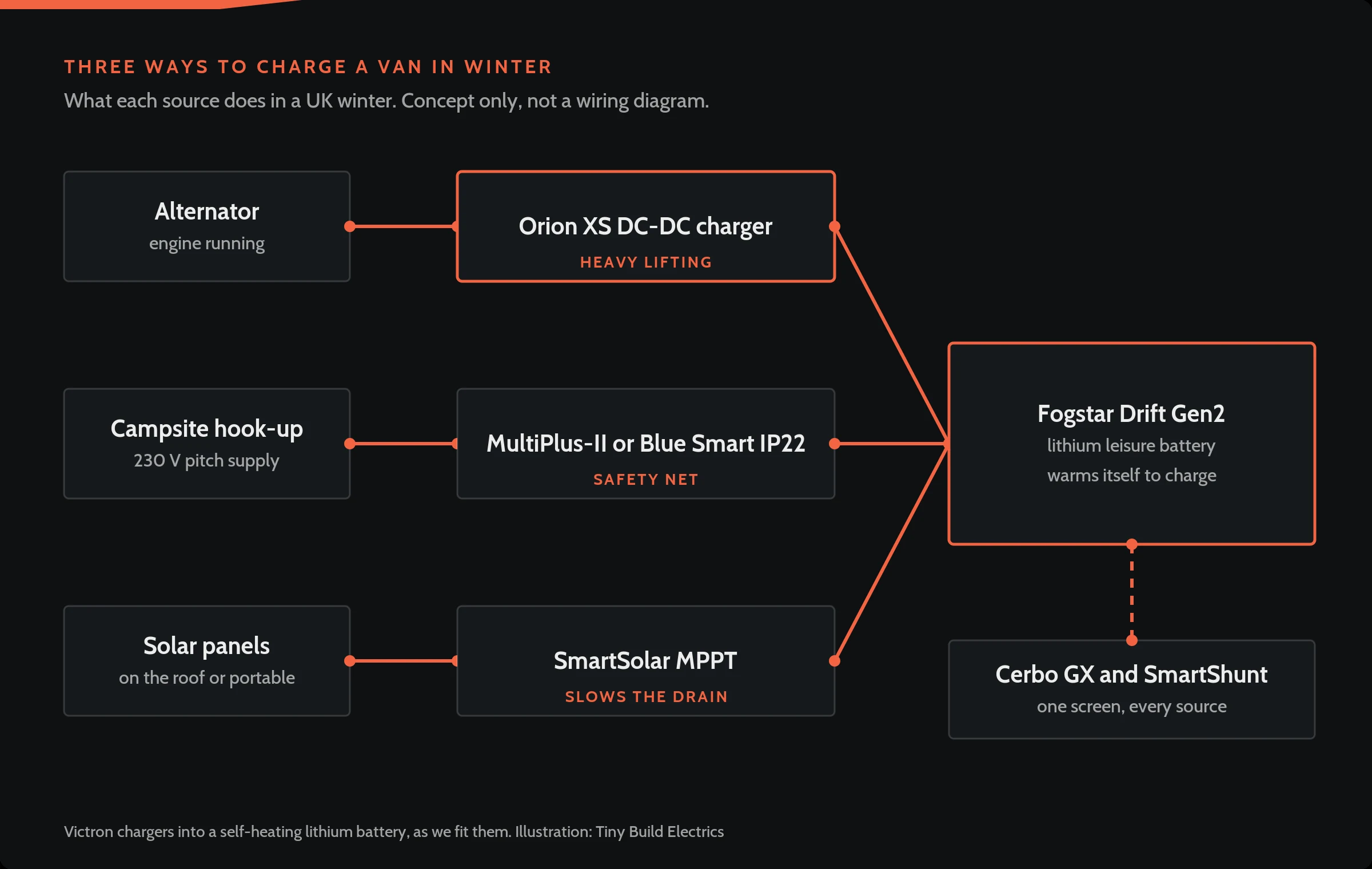
For a van that gets used all year, we treat the three sources as one system. These parts are standard in every system we build, and they’re what we recommend for winter:
- The alternator does the heavy lifting: an Orion XS sized to the battery and set so it protects the alternator.
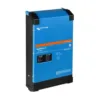
- Hook-up is the safety net: a MultiPlus-II, set to suit the pitch. We only fit a Blue Smart charger on a system without a MultiPlus.
- Solar slows the drain: a SmartSolar MPPT on the roof, plus a portable panel if you park up.
All three then charge a self-heating Fogstar Drift Gen2. Meanwhile, a Cerbo GX shows every source on one screen and in VRM.
Fitted at our Witherslack workshop: see campervan electrical installation and motorhome electrics. Alternatively, choose a pre-built campervan electrical system wired on our bench. We’re now booking installs from February 2027.
Self-Build: with the Self-Build package, Tom designs your custom kit after a free call, sized for winter use. In-stock items are usually dispatched in 1 to 2 working days. Meanwhile, if you want a head start, try the system designer.
Using the van all winter?
Tell us how and where you use it, and we’ll work out whether your charging keeps up.
Campervan solar in winter FAQs
Does campervan solar work in winter in the UK?
Yes, but it makes far less. For example, PVGIS puts 400 W of flat panels in Cumbria at about 116 Wh on a December day. In June, it’s about 1,636 Wh. That slows the drain on your battery, but it won’t keep up with daily use on its own.
How much solar do I need for a campervan in winter?
More panels help less than you’d hope. Even 400 W flat in Devon averages under 200 Wh on a December day. So size solar for spring to autumn, then cover winter with a DC-DC charger and hook-up. Meanwhile, a portable panel tilted towards the sun adds the most per watt.
How long do I need to drive to charge my leisure battery?
That depends on the charger. At full output, an Orion XS 12/12-50A puts back up to 50 Ah an hour. By comparison, a 30 A charger puts back up to 30 Ah. A battery that’s too cold to charge has to warm up first, so a frosty start takes longer.
Does a DC-DC charger work in winter?
Yes. Victron rates the Orion XS to work from minus 20°C, and its engine detection can be fine-tuned for a smart alternator. If the battery is too cold, charging pauses until it’s warm enough.
Should I angle my solar panels in winter?
If you can, yes. In PVGIS, for instance, 400 W tilted to 60 degrees gives about 380 Wh on a December day in Cumbria. That’s over three times the flat figure. Because roof panels can’t tilt, a portable panel is the easy way to do it.
Sources
- PVGIS 5.3, European Commission Joint Research Centre
- Orion XS DC-DC battery charger datasheet, Victron Energy
- Orion XS 12/12-50A DC-DC battery charger manual, Victron Energy
- Orion-Tr Smart non-isolated DC-DC charger datasheet, Victron Energy
- Blue Smart IP22 charger datasheet, Victron Energy
- MultiPlus-II inverter/charger datasheet, Victron Energy
- MPPT solar charger manual, configuration and settings, Victron Energy
- MPPT solar charger manual, installation, Victron Energy
- SmartSolar MPPT 100/30 and 100/50 datasheet, Victron Energy
- Lithium Battery Smart manual, operation, Victron Energy
- Fogstar Drift range manual 2026 (battery heating and BMS), Fogstar
- IET Wiring Matters, BS 7671:2018 Sections 708 and 721
About the reviewer: Tom Alderdice
Tom holds the 18th Edition (BS 7671) and inspection and testing qualifications, plus NCC training in caravan and motorhome electrics.
Tiny Build Electrics is an Authorised Victron Energy Installer. See Tom’s full qualifications