A lithium leisure battery fuse protects the cable it feeds. We size it from that cable’s current rating in BS 7671:2018+A4:2026 Table 4D1A[1], then check it against the Victron manual for the device on the end. Where the two disagree we keep to Table 4D1A, which is often a smaller fuse than Victron recommends. The fuse at the battery also has to break a lithium short circuit, so we check its breaking capacity against the bank[4].
This is how we do it on every campervan electrical system we design and fit at our Witherslack workshop. A worked example for a MultiPlus 12/3000 follows. Our guide to choosing a DC fuse type compares Class T, MRBF and MEGA fuses in more depth.
What a lithium leisure battery fuse protects
BS 7671 Regulation 433.1.1 sets the order: the design current of the circuit, then the fuse rating, then the current-carrying capacity of the cable. The fuse sits at or above the first and at or below the last[1]. Victron’s Wiring Unlimited book says the same thing in practical terms. With one device on a circuit, the fuse matches that device or the cable, whichever is lower. With several, it matches the cable[4].
A campervan leisure battery’s BMS does a different job. A Fogstar Drift’s BMS shuts the battery down on a short circuit and limits continuous discharge. Fogstar’s current figures are 100A continuous on the 105Ah Drift, 250A on the 230Ah to 628Ah Drifts and 300A on the full-size Drift Gen2 range, 230Ah to 668Ah[10]. The Drift PRO’s limit is 300A[9]. Those limits protect the cells. They know nothing about the 25 mm² cable running to a 12V fuse board across the van. That cable still needs a lithium leisure battery fuse sized to it.
How we size a lithium leisure battery fuse to the cable
We start from clipped direct, Reference Method C in Table 4D1A. Most cables in a van are fixed to a surface. A cable in free air, Reference Method F, is held clear of surfaces with air all round it. It sheds heat better, so Table 4D1A gives it a higher rating[1]. Ambient temperature and grouping factors from Tables 4B1 and 4C1 then come off the tabulated figure where they apply[1].
We size to the 70°C thermoplastic columns of Table 4D1A even though Victron specifies 90°C cable[5]. That keeps the margin on our side.
| Cable (mm²) | Clipped direct (A) | Free air (A) |
|---|---|---|
| 25 | 114 | 131 |
| 50 | 182 | 196 |
| 95 | 284 | 304 |
Source: BS 7671:2018+A4:2026 Appendix 4, Table 4D1A, single-core 70°C thermoplastic copper, two cables, d.c.
Where Table 4D1A rates a cable lower than a Victron manual assumes, the fuse comes down to suit the cable. It never goes up to suit the device.
Worked example: fusing a MultiPlus 12/3000
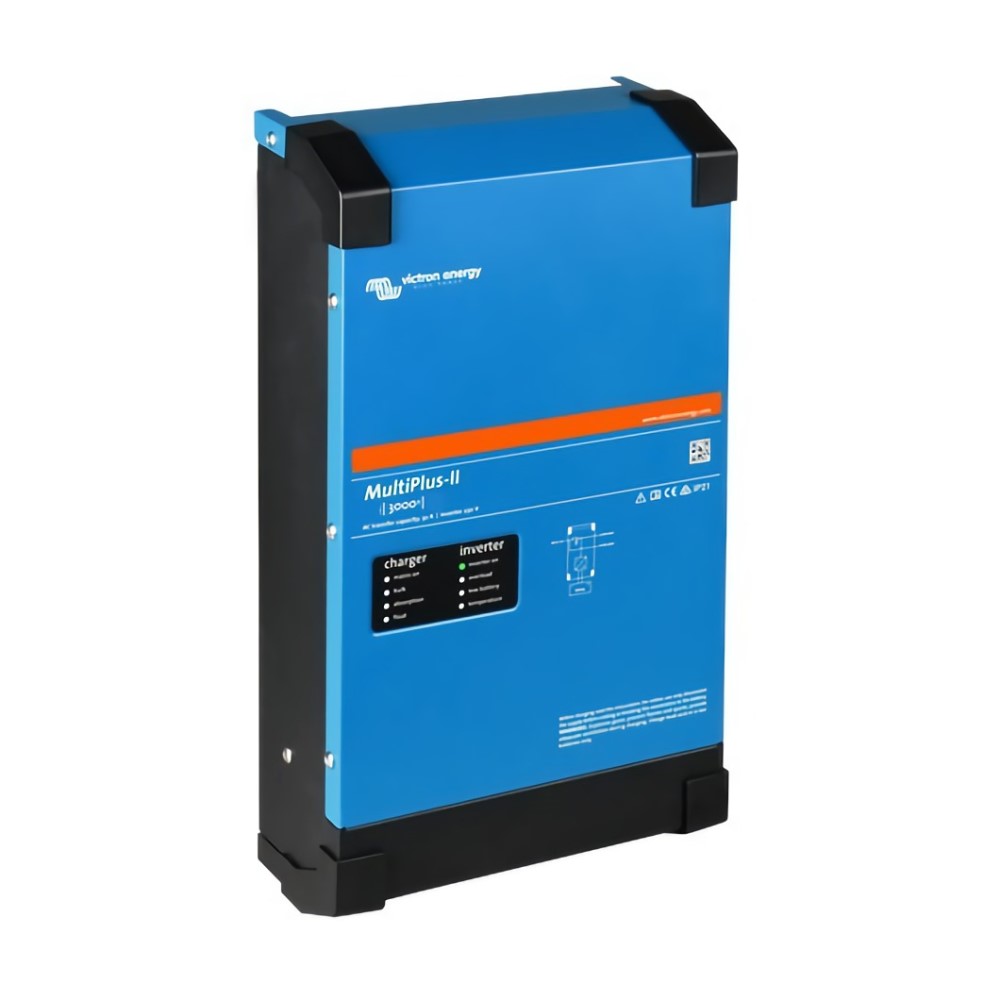
The MultiPlus-II 12/3000/120 delivers 2,400W continuously at 25°C[6]. At 12V and 90% efficiency, that is about 222A of continuous battery current. Victron’s manual pairs it with a 400A DC fuse, and its table for a run of 0 to 5 m permits two 50 mm² cables per pole[5].
Our choice is one 95 mm² cable per pole, with the MultiPlus mounted within 5 m of the battery. Table 4D1A rates 95 mm² at 284A clipped direct and 304A in free air[1]. Our standard fuse is 250A. That’s 150A under Victron’s figure, and it’s deliberate.
Why is 250A our standard?
The fuse is there to protect the cable, not the inverter. The MultiPlus already protects itself against overload and short circuits on its output[6]. The cable has no protection of its own. Its lithium leisure battery fuse must blow before the cable gets hot enough to damage its insulation.
A 250A fuse sits above the inverter’s normal draw of about 222A. Even at a low 11V, that draw is only around 242A. It also stays below the cable’s rating with our 10% margin to spare. 250A plus 10% is 275A, which is under both 284A and 304A. That’s the order BS 7671 Regulation 433.1.1 asks for: the circuit’s current, then the fuse, then the cable[1].
250A is our spec for a MultiPlus 12/3000 on this cable, and it does the job. If one blows, something is overloaded or faulty, and that’s exactly what the fuse is there to catch. Find and fix the cause. Don’t fit a bigger fuse.
When do we allow 300A?
If the whole battery cable run is in free air, Table 4D1A rates the cable at 304A. There we allow a 300A fuse[1]. That still sits below the cable’s rating, but with less margin. So we only fit it where we can see the run is in free air from end to end. Victron’s manual also says battery cables should not run in closed conduit[5]. Clipped to a surface, the same cable drops to 284A. A 300A fuse would then be bigger than the cable can take, so it gets 250A.
Can a MultiPlus 12/3000 run on one battery?
Victron’s MultiPlus-II manual lists 400 to 1,200Ah of battery for the 12/3000/120[5]. That’s a general recommendation, and it reads as one written with lead acid in mind. The table doesn’t split it by battery type. The manual’s charger section describes lead acid charging, and for lithium it points to Victron’s battery compatibility list rather than giving an Ah figure[12]. Its own note says internal resistance is an important factor with low-capacity batteries[5].
Why one lithium battery is enough
Lead acid gives less of its capacity under a heavy load. That’s Peukert’s effect, and Victron’s answer for lead acid is more Ah[13]. Victron also says lithium holds its voltage at high loads without going up in Ah[13]. A Fogstar Drift Gen2 230Ah can discharge at up to 300A, about 1.3 times its capacity in amps[9]. So one lithium battery can do the job, as long as its BMS can carry the inverter’s full draw.
At full output the MultiPlus pulls about 222A from the battery. The BMS limits continuous discharge to protect the cells, and it shuts the battery down if the load stays above that limit. So with one battery, the figure that matters is the BMS continuous rating, not the capacity in Ah. Look for at least 250A continuous. That covers the 222A draw with some headroom. It’s also the same as the 250A fuse, so the battery can supply everything the fuse lets through.
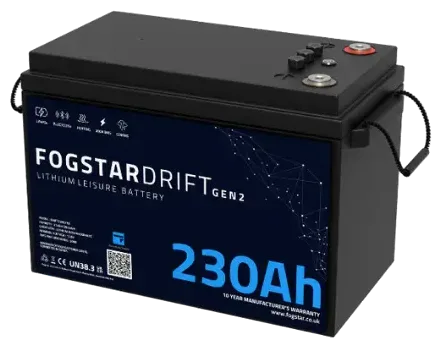
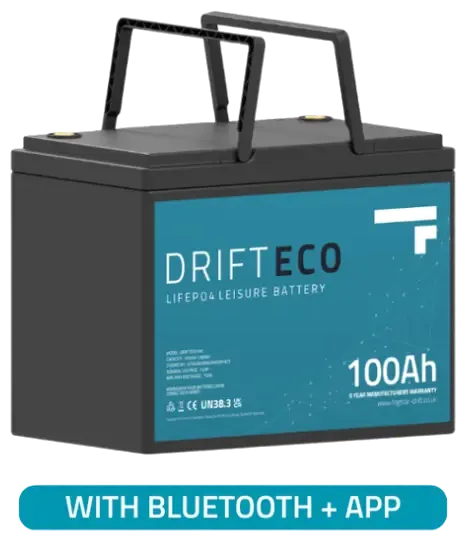
In Fogstar’s current 12V range, that’s the full-size Drift Gen2 range, 230Ah to 668Ah (300A), the 230Ah to 628Ah Drifts and the Seat Base Drift 230Ah (250A), and the 314Ah and 628Ah Drift ECO (250A)[10]. The 105Ah Drift and 100Ah Drift ECO (100A) and the 172Ah DIN Fit Drift (172A) can’t carry it on their own[10].
Fogstar asks for every battery in a bank to be the same capacity, make and model[9]. It also notes that a very large inverter charging its capacitors can trip the BMS short-circuit protection at switch-on. Its fix is a pre-charge resistor[9].
Breaking capacity: a lithium leisure battery fuse has to clear a short
A fuse whose breaking capacity is below the fault current can rupture instead of clearing the fault. Victron’s Wiring Unlimited says that in every lithium battery installation, at least one fuse in the DC line must have an interrupt rating at or above the bank’s maximum prospective short-circuit current[4]. BS 7671 Regulation 434.5.1 sets the general rule for every protective device[1].
Our rule of thumb for that fault current is the battery’s capacity in Ah multiplied by 50. That gives 5,000A for every 100Ah. We fit a lithium leisure battery fuse on each battery in a parallel bank. Each fuse then sees its own battery’s fault current, not the whole bank’s. Fogstar allows up to 16 of its 12V Drifts in parallel, or four of the 105Ah[9][10]. It asks that they are the same capacity, make and model[9].
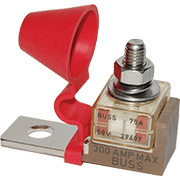
Each battery’s own fuse is an MRBF or a Class T. The MRBF maker rates it to break 10,000A at 14V, 5,000A at 32V and 2,000A at 58V[11]. It sits in a terminal fuse block, never directly on the battery terminal, as the maker’s instructions require[11]. Class T fuses break 20,000A[4]. Breaking capacities come from the fuse maker’s datasheet, never from the label on a listing.
When is an MRBF enough? Up to 200Ah, on 12V only
A 200Ah battery at Ah × 50 gives 10,000A, exactly what an MRBF is rated to break at 12V. That leaves no spare margin, so we treat 200Ah as a hard ceiling and never go over it. Allowing an MRBF as the lithium leisure battery fuse up to 200Ah is a TBE exception. We only make it because we control the rest of the system. That means a fuse on every battery in a parallel bank, quality cells, and short, protected cable runs to the fuse. Above 200Ah per battery, it’s always a Class T.
The exception doesn’t carry over to 24V. The 10,000A figure is rated at 14V, and a 24V system runs well above that. So the MRBF’s 32V figure of 5,000A applies[11]. That covers only a 100Ah battery at Ah × 50. On 24V and 48V banks, we fit a Class T on every battery. Fogstar explains how its BMS handles a short circuit but publishes no fault-current figure[9]. That’s why we work from Ah × 50 rather than guess.
| Battery | Fault current (Ah × 50) |
|---|---|
| 100Ah | 5,000A |
| 200Ah | 10,000A |
| 300Ah | 15,000A |
Source: TBE rule of thumb. In a parallel bank, each battery’s fuse covers that battery’s own figure. On 12V, an MRBF is allowed up to 200Ah per battery, and above that it’s a Class T.
Fitting the fuse to a Drift Gen2’s M8 posts
A Drift Gen2 has M8 terminals and comes with M8 bolts. Fogstar asks for 4 to 8 Nm, with 6 Nm recommended, and no more than two ring terminals per post. For more connections it asks for a busbar or DC distribution block[9].
An MRBF terminal fuse block isn’t made for that post. Blue Sea’s block mounts on a 3/8 inch terminal stud, and its M8 output stud takes no more than 8.47 Nm[14]. So we never bolt one straight onto a Drift. Where an MRBF is allowed, up to 200Ah on 12V, it goes on a 3/8 inch stud or busbar next to the battery, fed by a short cable from the post.
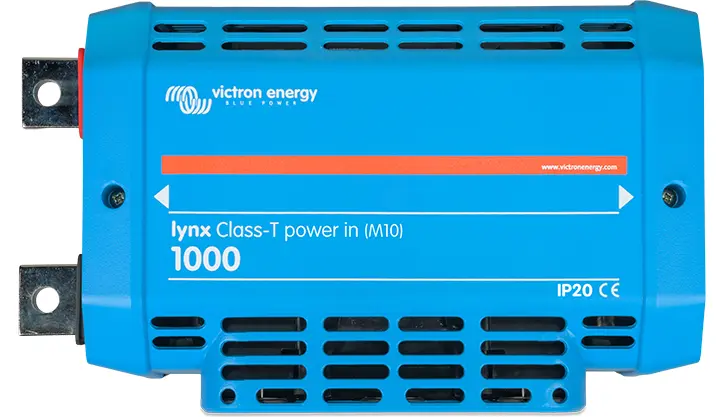
On a Drift Gen2 an MRBF wouldn’t be our fuse anyway. Every full-size Drift Gen2 is 230Ah or more, which is 11,500A or more at Ah × 50. That’s past an MRBF’s 10,000A, so a Drift Gen2 gets a Class T. Victron’s Lynx Class-T Power In takes up to two batteries, each on its own Class T fuse of 225A to 400A[15]. Each battery’s ring terminal goes on its post at Fogstar’s torque, then a short cable runs to its fuse.
With an MRBF or a Class T, the short cable from the post has no fuse ahead of it. We hold it to BS 7671 Regulation 434.2.1: no longer than 3 m, inherently short-circuit and earth-fault proof, and installed to keep the risk of fire to a minimum[1]. Ours run far shorter than 3 m, in extra sheathing and clear of anything that burns.
Where each lithium leisure battery fuse sits: the Lynx Distributor and inline fuses
The lithium leisure battery fuse sits close to the battery. A Class T goes on the board, within 1000 mm of the battery, to meet BS EN 1648-2[3]. An MRBF, used on a 12V battery up to 200Ah, fits next to the battery, close to its positive terminal. The short length of battery cable between the terminal and that fuse gets extra sheathing or taping.
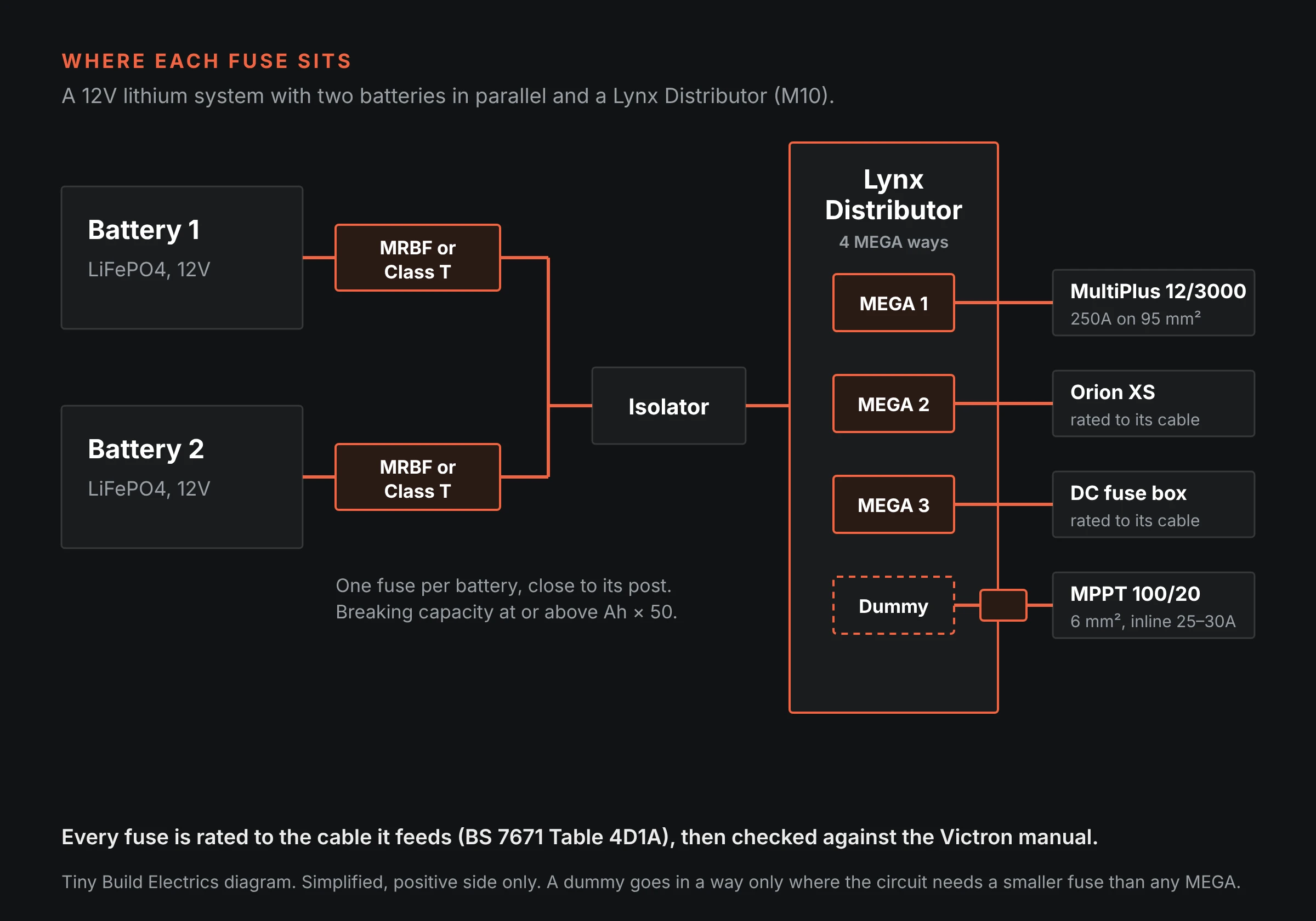
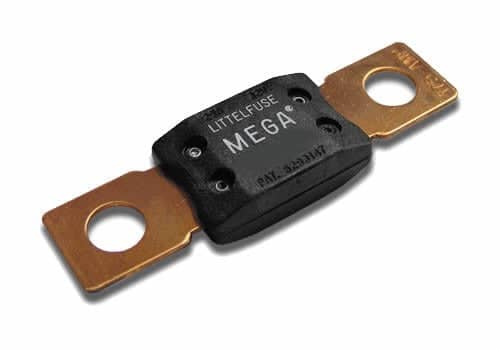
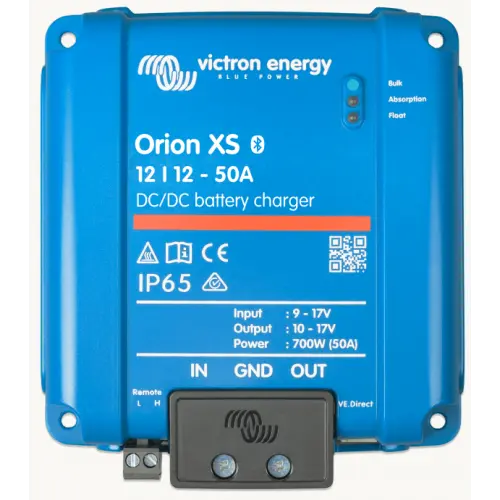
After the isolator, the Victron Lynx Distributor (M10) is our default DC distribution. Its positive busbar has four fused outputs that take MEGA fuses, with a status LED per fuse. The negative busbar has four connections[7]. The MultiPlus, the Orion XS, the feed to the campervan fuse box and the solar charge controller each get their own MEGA way. Victron gives one fuse space for each DC circuit[7]. Each MEGA is rated to the cable leaving it. A dummy fuse goes in a way only where that circuit needs a smaller fuse than any MEGA, and only if a way is free. Victron’s MEGA fuses start at 40A[16]. Wiring Unlimited asks for exactly this: every consumer on its own fuse in the positive cable[4].

Fusing the solar charge controller
The solar charge controller takes the fourth way, so nothing lands on the bare busbar. How we fuse it depends on the size of the controller.
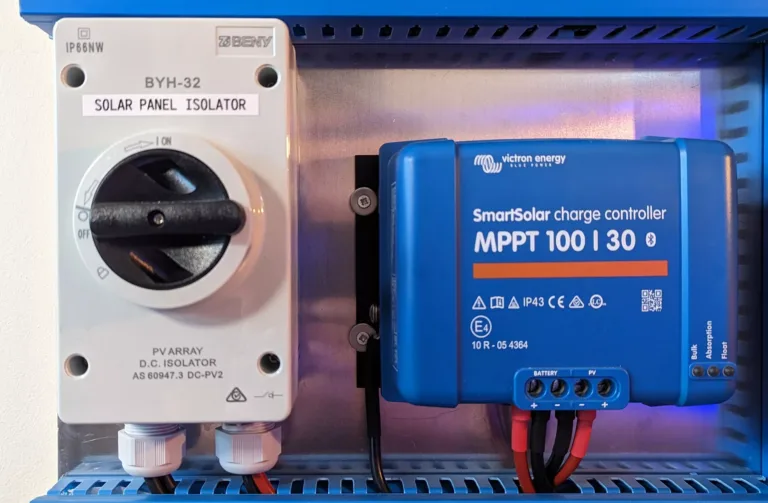
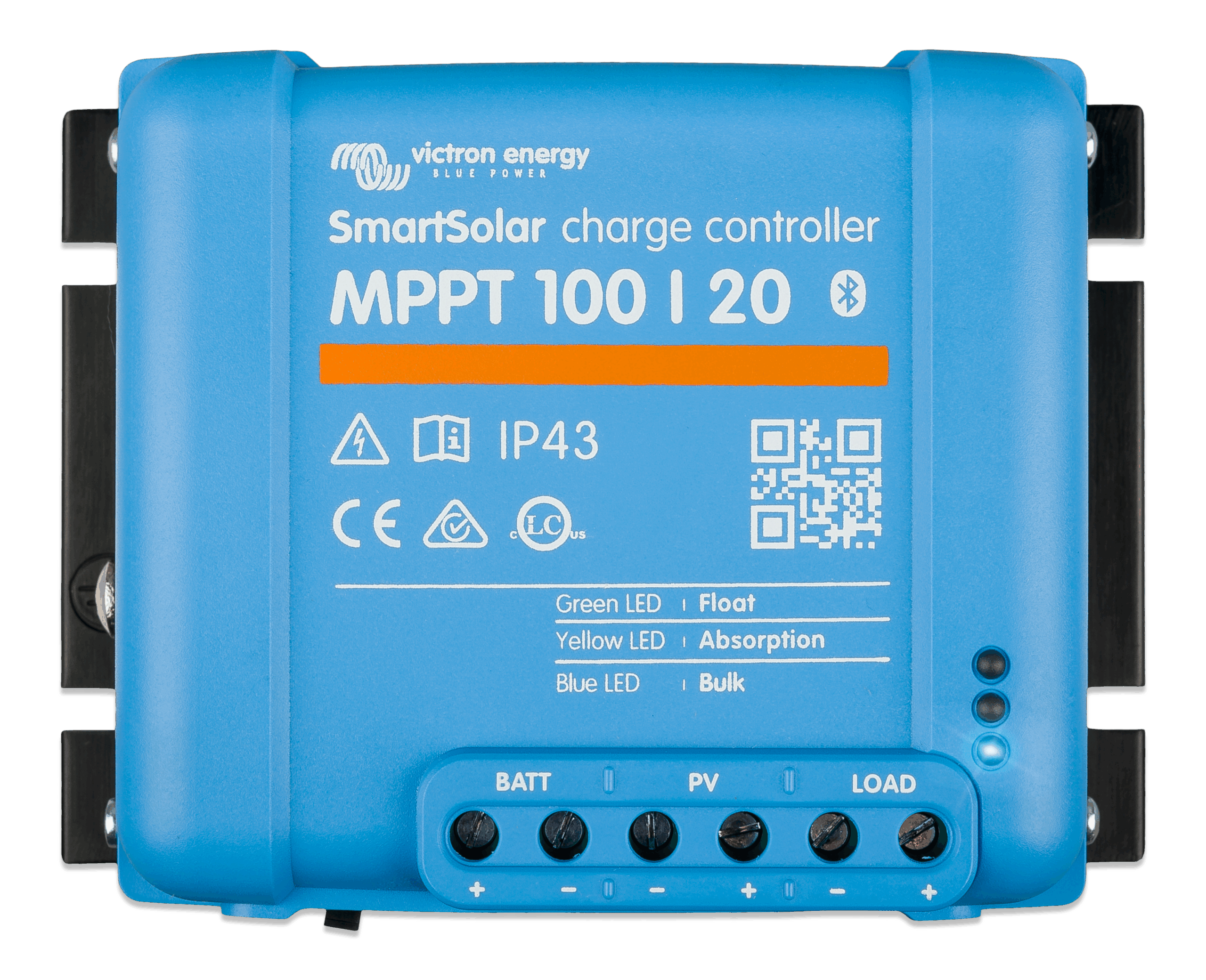
A small SmartSolar such as the MPPT 100/20 has power terminals that take 6mm² cable at most, and Victron’s table asks for a battery fuse of 25 to 30A[8]. That’s smaller than any MEGA. So its Lynx way gets a dummy fuse, and the 6mm² cable gets an inline fuse in that range, sized to protect it.
The bigger SmartSolar controllers we fit go straight to a MEGA fuse in their way, on 10 or 16mm² cable. Which one depends on the reference method, meaning how the cable is installed: clipped direct, enclosed in trunking or in free air[1]. We size each length of cable so its Table 4D1A rating sits above the fuse feeding it.
Torque and torque-pen marks on a lithium leisure battery fuse
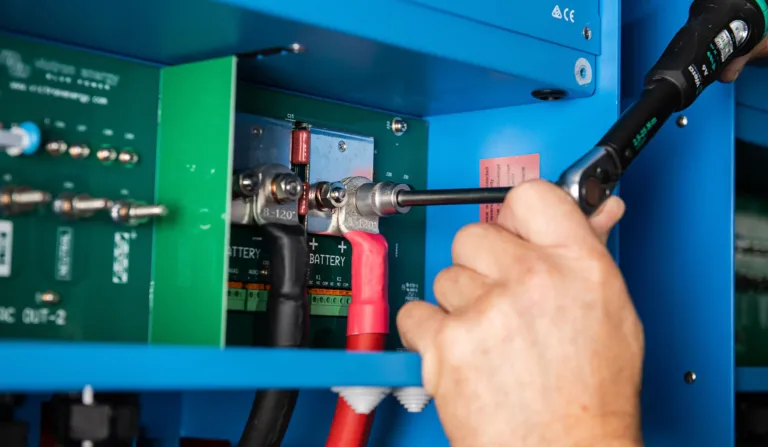
We torque every connection to the maker’s figure for that exact part and mark it with a torque pen. The figures come from the product datasheets and manuals. On a Lynx Distributor (M10), Victron gives separate figures for the M10 and M8 nuts[7]. Fogstar gives its own figure for the M8 posts on a Drift, and the Drift PRO has M10 posts[9]. A MultiPlus battery terminal has its own figure again[5].
The pen mark spans the nut and the stud, so a nut that has turned since torquing shows a broken line.
How a lithium leisure battery fuse is inspected and tested
The 12V side, fusing included, is inspected and tested to BS EN 1648-2 and Annex A721 of BS 7671[3][1].
The 230V side is tested to IET Guidance Note 3: insulation resistance, polarity, earth fault loop impedance and RCD operation[2].
If someone else built your van, our inspection and testing service covers kits bought anywhere. If you’re planning a build, our battery monitoring guide explains the SmartShunt that sits on the negative side of the same system.
Fitting a lithium leisure battery fuse with us
We’re an Authorised Victron Energy Installer, and we fit every system at our Witherslack workshop. January is fully booked; we’re taking bookings from February 2027.
FAQs
What size fuse does a lithium leisure battery need?
Whatever protects the cable it feeds. We take the cable’s rating from BS 7671 Table 4D1A and choose a fuse above the circuit’s continuous current and at or below that rating. Then we check it against the Victron manual. The battery fuse must also break the bank’s short-circuit current.
Does the BMS replace the main lithium leisure battery fuse?
No. A Fogstar BMS shuts down on a short circuit and limits continuous discharge to protect the cells. It knows nothing about the cables in the van. Each cable needs a fuse sized to it, and the battery fuse needs a breaking capacity above the bank’s fault current.
Why is your fuse smaller than Victron recommends?
Because the fuse protects the cable, and we size it to BS 7671 Table 4D1A. On a MultiPlus 12/3000 with one 95 mm² cable per pole, we fit 250A rather than Victron’s 400A. It covers the inverter’s 222A draw at 12V. Where the whole run is in free air, rated 304A, we allow 300A.
Do I need a fuse on each battery in a parallel bank?
Yes, on every lithium bank we fit. Each battery gets its own fuse: an MRBF next to the battery (up to 200Ah on 12V), or a Class T on the board within 1000 mm of the battery. Each fuse then only breaks its own battery’s fault current. Fogstar allows up to 16 of its 12V Drifts in parallel, all the same capacity, make and model.
Can I use a MEGA fuse on a lithium leisure battery?
Not at the battery itself. There we fit MRBF or Class T, because the fuse there has to break the battery’s full short-circuit current. MEGA fuses belong in the Lynx Distributor ways that feed the MultiPlus, Orion XS and DC fuse box, and a bigger solar controller. A small one, such as the MPPT 100/20, gets a dummy in its way and an inline fuse on its 6mm² cable.
What size cable for campervan electrics?
It depends on the current, the route and the device. We start from Table 4D1A, clipped direct as standard. Free air applies only where the run really is in free air. Temperature and grouping factors come next, then the Victron manual. A MultiPlus 12/3000 within 5 m of the battery gets 95 mm².
Are lithium leisure batteries safe?
Yes, when they’re fitted properly. A LiFePO4 leisure battery’s BMS shuts it down on a short circuit and limits continuous discharge, which protects the cells. However, the BMS doesn’t protect the cables. That’s why every positive cable still gets a fuse sized to it, as close to the battery as practical.
Sources
- IET, BS 7671:2018+A4:2026: Regulations 433.1.1, 434.2.1 and 434.5.1, Appendix 4 Tables 4A2, 4D1A, 4B1 and 4C1, and Annex A721. electrical.theiet.org
- IET, Guidance Note 3: Inspection & Testing, 10th Edition. shop.theiet.org
- BSI, BS EN 1648-2: 12V DC extra low voltage installations in motor caravans. knowledge.bsigroup.com
- Victron Energy, Wiring Unlimited (rev 04, 08/2026): 4.6 DC fuses, interrupt rating and fuse selection for lithium. www.victronenergy.com
- Victron Energy, MultiPlus-II 230V manual, 4.3: battery capacity, DC fuse, cable size, 90°C cable, no closed conduit, torque and internal resistance for the 12/3000/120. www.victronenergy.com
- Victron Energy, MultiPlus-II datasheet: continuous output at 25°C, charge current, output protection. www.victronenergy.com
- Victron Energy, Lynx Distributor (M10) manual: four MEGA fuse ways, fuse monitoring, dummy fuses, torque. www.victronenergy.com
- Victron Energy, SmartSolar MPPT 75/10 up to 100/20 manual: 4.2 battery fuse ratings, 9.1 terminals. www.victronenergy.com
- Fogstar, Knowledge Hub and Drift Gen2 user manual: BMS limits (300A on the Drift Gen2 230Ah), parallel limits, pre-charge, M8 posts, 4 to 8 Nm, two ring terminals per post. www.fogstar.co.uk, Drift Gen2 manual
- Fogstar, product pages and specification sheets: continuous discharge and parallel limits across the Drift range, including the 12V 668Ah (300A). www.fogstar.co.uk, 668Ah spec sheet
- Eaton Bussmann, MRBF series and retail catalogue: interrupt rating 10,000A at 14V DC, 5,000A at 32V DC, 2,000A at 58V DC. www.eaton.com, Eaton catalogue
- Victron Energy, MultiPlus-II 230V manual, 2.3: battery charger, lead acid charging and the pointer for other lithium batteries. www.victronenergy.com
- Victron Energy, Lithium-ion vs lead-acid batteries: Peukert’s effect and lithium under high loads. www.victronenergy.com
- Blue Sea Systems, MRBF terminal fuse block 5191: 3/8 inch mounting stud, M8 output stud, 8.47 Nm maximum. www.bluesea.com
- Victron Energy, Lynx Class-T Power In (M10) manual: two Class T fuses of 225A to 400A, up to two lithium battery strings. www.victronenergy.com
- Victron Energy, fuses datasheet: MEGA ratings from 40A. www.victronenergy.com
About the reviewer: Tom Alderdice
Tom holds the 18th Edition (BS 7671) and inspection and testing qualifications, plus NCC training in caravan and motorhome electrics.
Tiny Build Electrics is an Authorised Victron Energy Installer. See Tom’s full qualifications