A campervan MCB, or miniature circuit breaker, protects a circuit against overcurrents and short circuits. These compact devices are particularly vital for campervan electrical systems, where limited space and safety considerations play crucial roles.
Quick answer
In short
In a campervan or motorhome, every final circuit needs an MCB that disconnects all live conductors, so double-pole MCBs on every final circuit are the minimum (BS 7671 Regulation 721.43.1), with a double-pole main switch. We fit double-pole RCBOs, so every circuit has its own overcurrent and residual current protection. Use Type B or C, never Type D, rated for the cable and the load. Mount them in a consumer unit with RCD protection, labelled circuit by circuit, and have the 230V side tested by a qualified electrician.
- Double-pole on every final circuit
- Type B or C, never Type D
- Rated for the cable and the load
- 230V side tested by a qualified electrician
On this page 7 sections
Below we cover what MCBs are, how they work and how to use them in a campervan. We also explain the two types, B and C, and the codes printed on them.
Understanding Miniature Circuit Breakers
A miniature circuit breaker is an automatic switch that protects a circuit from damage caused by excessive current. They serve as vital safeguards, preventing overloads and short circuits that could potentially lead to fires or damage to sensitive equipment.
Functioning of MCBs
The primary function of an MCB is to interrupt the flow of current when it exceeds a predetermined threshold. They consist of a switch mechanism and a bimetallic strip or an electromagnetic coil. When the current exceeds the rated limit, the bimetallic strip heats up and bends, causing the switch to trip and disconnect the circuit. With an electromagnetic coil, current above the set limit generates a magnetic field that trips the switch. This quick response time ensures the protection of the electrical system.
Campervan MCB Selection For Your Electrical System
Campervans have limited space, making MCBs an ideal choice due to their compact size. Here are some considerations for MCBs selection in your campervan electrical systems:
Load Calculation: Begin by calculating the anticipated electrical load of each circuit. This includes appliances, lighting, heating, and any other A/C electrical devices you plan to install. This calculation will help determine the appropriate ampere rating for the MCBs.
Circuit Design: Designate circuits based on the electrical load calculations, grouping similar devices together. For example, sockets should be on a separate circuit from the hot water tank to avoid overloading.
MCB Selection: Choose MCBs with appropriate ampere ratings for each circuit. Ensure they are compatible with the electrical system voltage. Typical MCB ratings for campervan applications range from 6A to 16A.
Selecting a Circuit Breaker Based On The Following
- The circuit breaker construction standard, BS EN 60898
- Current rating for overload protection, with preferred values: 6 A, 10 A and 16 A.Rather than go to 16 A, however, the designer would be better specifying more circuits at 10 A, or even 13 A.
- Sensitivity for fault protection, with Type B or Type C; but NEVER Type D
- Short-circuit capacity: probably between 3000A (3kA) and 6000A (6kA)
- Energy limiting class: preferably 3
- That the circuit breaker must disconnect both line and neutral conductors (2-pole), to satisfy Regulation 721.43.1 of BS 7671 for touring caravans and motorhomes.
721.43.1 Final circuits: Each final circuit shall be protected by an overcurrent protective device which disconnects all live conductors of that circuit.
Why a campervan MCB must be double pole
As we have highlighted above in the last bullet point, circuit breakers used for the protection of circuits in touring caravans and motorhomes must be double-pole, including the main disconnector/main switch. (Regulation 721.537.2.1.1 of BS 7671).
721.537.2.1.1 Each installation shall be provided with a main disconnector which shall disconnect all live conductors and which shall be suitably placed for ready operation within the caravan. In an installation consisting of only one final circuit, the isolating switch may be the overcurrent protection device fulfilling the requirements for isolation.
Some confusion lies here for installers and van builders as the obvious choice is a single-pole device, making and breaking the line conductor only.
BS 7671 treats a touring caravan or motorhome as a special location, so slightly stricter rules apply. A double-pole overcurrent protective device is one of them.
Motorhome and caravan owners often travel to countries where supply polarity is less rigorously enforced than in the UK. So the designer will specify 2-pole devices that protect both the line and neutral conductors.
Types of MCB and their codes
Type B MCBs: These are the most common MCBs in homes and commercial buildings. They provide protection against overloads and short circuits caused by general-purpose equipment. The alphanumeric code for Type B MCBs starts with the letter “B.”
Type C MCBs: These MCBs offer increased protection for circuits with equipment that have a higher inrush current, such as motors or transformers. The alphanumeric code for Type C MCBs starts with the letter “C.”
Reading the markings on a campervan MCB
Every MCB carries letters and numbers that tell you its specification. Let’s decode these markings:
- Current Rating (In Amperes): This indicates the maximum current that an MCB can handle without tripping.
- Trip Curve: The letter associated with an MCB (e.g., B or C) denotes its trip curve, which indicates the response time of the circuit breaker to an overload or short circuit.
- Breaking Capacity: Represented in kiloamps (kA), this value signifies the maximum fault current that an MCB can safely interrupt without causing damage. Typically 6kA (6000a) or 10kA (10,000a).
How do Miniature Circuit Breakers Work?
MCBs operate based on the principle of thermal and magnetic tripping. They consist of a bimetallic strip and an electromagnet, which respond to different types of electrical faults:
Thermal Tripping: The bimetallic strip inside the MCB heats up when the current flowing through it exceeds the rated value. As the temperature rises, the strip bends and eventually trips the circuit breaker, disconnecting the circuit. This mechanism protects against overloads.
Magnetic Tripping: In the presence of a high magnitude short-circuit current, the electromagnet within the MCB generates a magnetic field. This magnetic field rapidly pulls the trip mechanism, causing the circuit breaker to trip. Magnetic tripping provides rapid protection against short circuits.
The combination of thermal and magnetic tripping ensures that MCBs can respond to a wide range of electrical faults, thereby safeguarding the connected circuits and devices.
*Can’t find miniature circuit breakers in our online shop? That’s because qualified staff build all our 230V distribution boards in house, to your specific needs, so you get the correct product for your installation.
Get in contact today and we’ll be happy to size and design your board.

How MCBs fit into the consumer unit
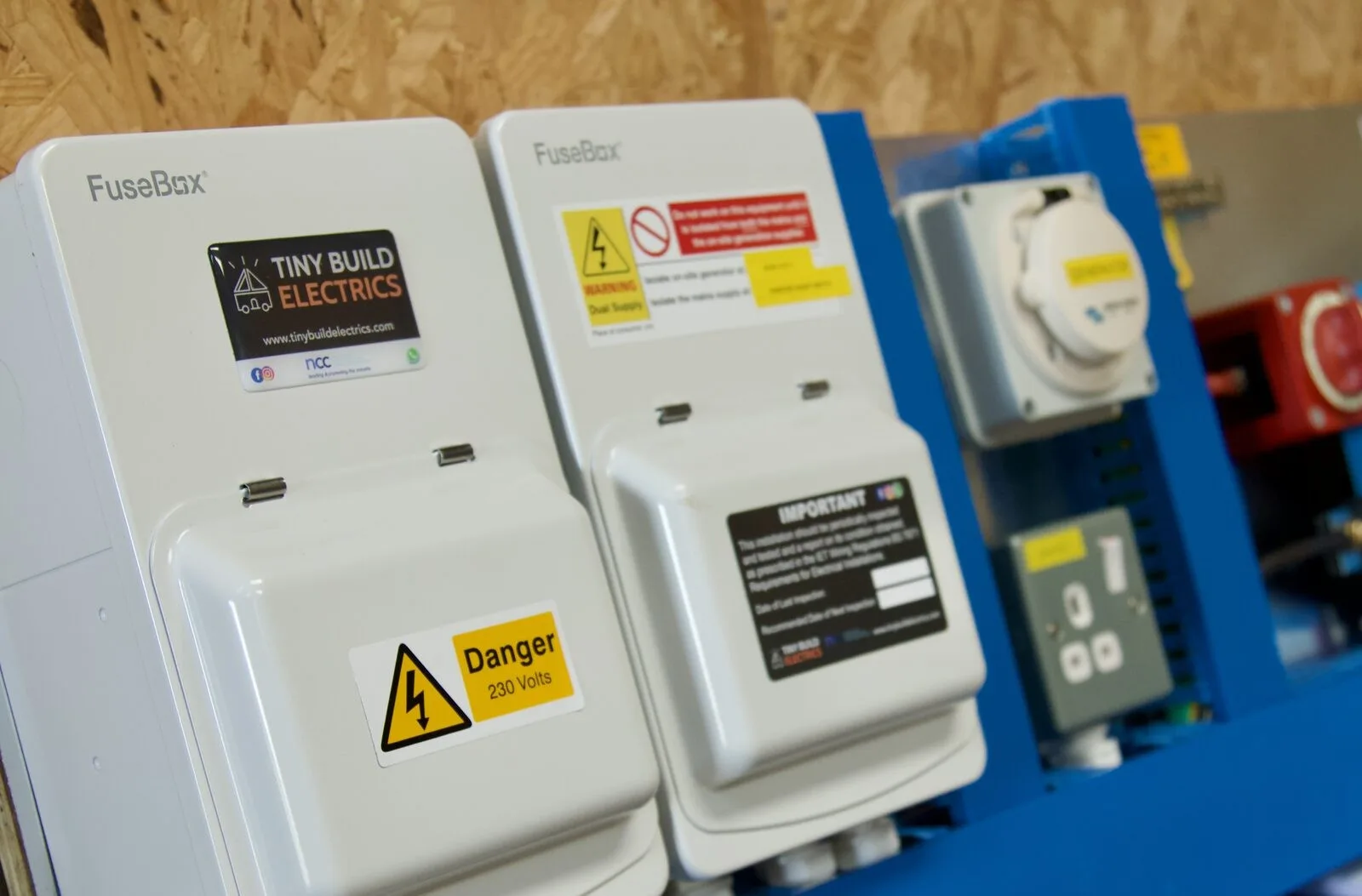
Distribution boards, also known as consumer units or fuse boxes, are key elements in electrical installations. They provide a centralised location for housing MCBs and other protective devices, enabling efficient power distribution and electrical system control.
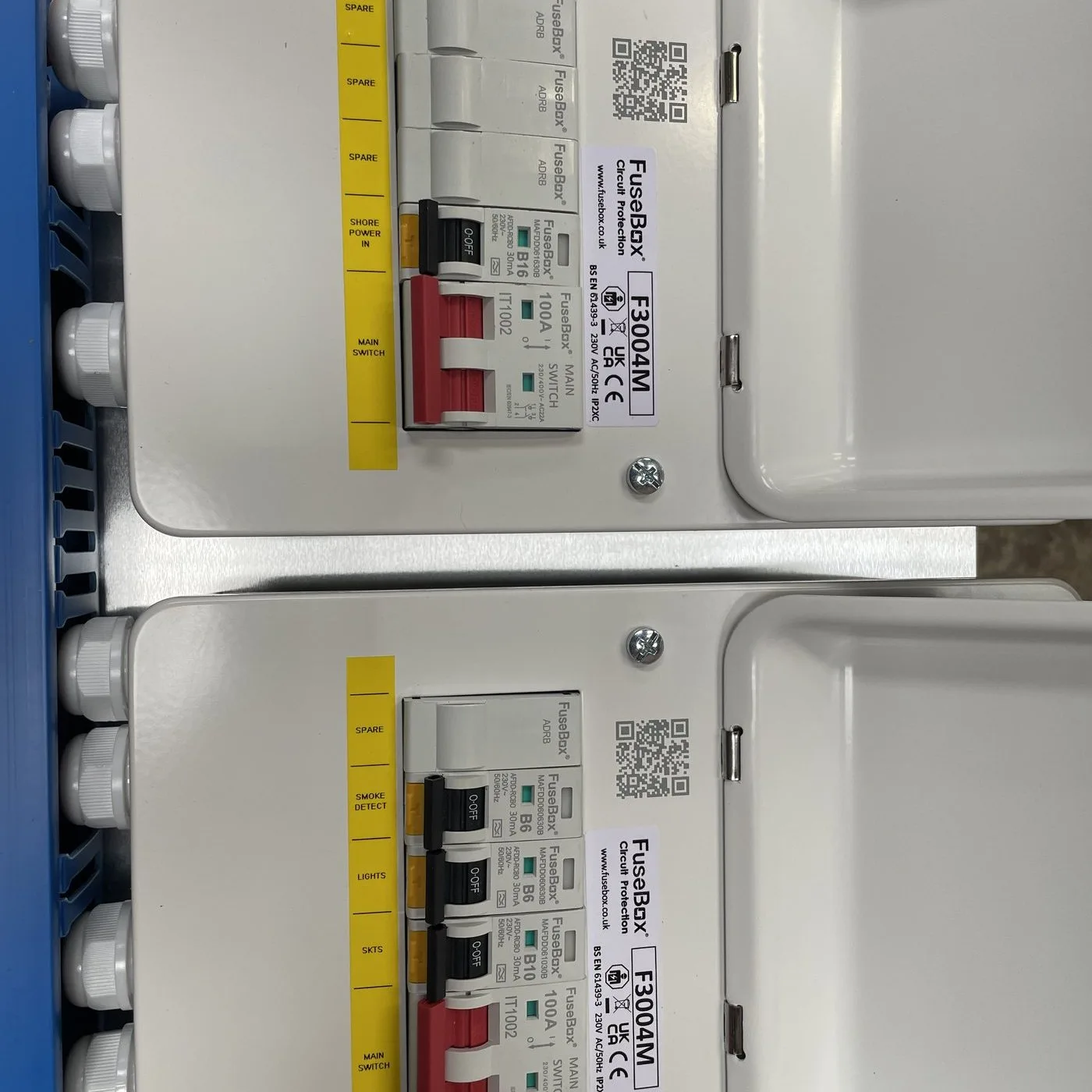
Mounting: MCBs clip onto DIN rails inside the distribution board. DIN rail mounting allows for easy installation, removal, and replacement of circuit breakers.
Circuit Configuration: Each MCB in the consumer unit feeds its own circuit in the campervan, such as the sockets or a specific appliance. This arrangement allows selective disconnection of individual circuits in case of a fault, minimising downtime and ensuring safety.
Circuit Identification: Label or number each MCB to match its circuit, which makes maintenance and fault finding simpler. This labelling helps electricians and campervan owners quickly locate and address any issues.
Additional Protection: In addition to MCBs, distribution boards may incorporate other protective devices such as residual current devices (RCDs). These devices provide additional protection against electric shock and earth faults, enhancing overall electrical safety.
Read more about RCD’s and choosing the correct type here.
Regulations
The regulations specify the selection and coordination of MCBs to ensure proper protection against overcurrents. They outline the maximum permitted Zs (impedance of the circuit) values for different types of MCBs, taking into account various factors like cable size, protective device characteristics, and fault currents.
The Wiring Regulations also address issues related to discrimination, which is the ability to isolate a faulty circuit without affecting the supply to other circuits. With discrimination, only the faulty circuit disconnects and the rest of the installation stays on. So select and coordinate MCBs to achieve it.
Furthermore, the regulations emphasise the importance of proper installation, labelling, and periodic testing of MCBs to maintain their effectiveness. Qualified electricians are responsible for ensuring compliance with the Wiring Regulations and conducting the necessary inspections and tests.
Choosing the right campervan MCB
Miniature Circuit Breakers are vital components of electrical installations. They protect circuits and electrical equipment from overcurrents and short circuits, mitigating the risk of fires and damage.
By understanding the different sizes of MCBs and adhering to the regulations outlined in the British Standard 7671, you can ensure the safe and effective operation of electrical systems.
Remember, for any 230V installation, consult qualified electricians who know the regulations and can install and maintain MCBs to meet the Wiring Regulations.
Campervan MCB FAQs
Do campervan MCBs have to be double pole?
Yes. Regulation 721.43.1 requires each final circuit’s protective device to disconnect all live conductors, so double pole is the minimum.
Should I use Type B or Type C MCBs?
Either, chosen for the load and rated for the cable. Type C tolerates higher inrush current. Never fit Type D in a van.
What is the difference between an MCB and an RCBO?
An MCB protects against overcurrent. An RCBO adds residual current protection in the same device. We fit double-pole RCBOs, so every circuit has both.
About the reviewer: Tom Alderdice
Tom holds the 18th Edition (BS 7671) and inspection and testing qualifications, plus NCC training in caravan and motorhome electrics.
Tiny Build Electrics is an Authorised Victron Energy Installer. See Tom’s full qualifications