Quick answer: How do I choose the right inverter for my campervan?
Add up the continuous and start-up power of the 230V appliances you will run at the same time, choose a pure sine wave inverter rated above that, and make sure your battery, cabling and fusing can supply it. This guide walks through each factor, plus installation and safe use.
How to size a campervan inverter, which type to fit, what the battery needs, and how we fit and test one as an Authorised Victron Energy Installer.
In short
A campervan inverter turns 12V from your leisure battery into 230V for mains appliances. Size it from the 230V appliances you’ll run at the same time, with headroom for start-up surges. Fit a pure sine wave unit, fuse the battery feed and feed the 230V side through a proper consumer unit with RCD protection. Never an extension lead.
- Size: add up what runs at once, then add headroom
- Type: pure sine wave only
- Battery: the bank and its BMS must cover the inverter’s full draw
- Safety: main battery fuse, consumer units, RCD protection, chassis bond, tested
Book a free 30-minute call with Tom
On this page 13 sections
- In short
- What does a campervan inverter do?
- Why fit an inverter in van conversions?
- What size inverter do I need?
- Pure sine wave or modified: which campervan inverters should you fit?
- Campervan inverter and leisure battery: sizing the bank
- Why we fit a Victron MultiPlus-II inverter/charger
- What is the best inverter for campervan builds?
- How to fit an inverter safely in a campervan
- Testing the 230V side before you use it
- Fit it yourself or have it fitted
- FAQs
- Sources
What does a campervan inverter do?
It turns your leisure battery’s 12V DC into 230V AC, so a normal UK plug works in the van. (Searching for a “12v to 240v inverter for van”? UK mains is 230V.)
Meanwhile, lights, pump, fans, USB and a compressor fridge stay on 12V. See 12V and 230V explained.
Standing load
Even with nothing plugged in, the MultiPlus-II 12/3000 draws 13 W, or 3 W in search mode[1]. Switch it off or use search mode when you don’t need 230V.
Why fit an inverter in van conversions?
The inverter decides how much 230V you can use; the battery decides for how long.
Worth fitting if you run
- Laptop chargers
- An induction hob or kettle
- A coffee machine or hairdryer
- Cordless tool chargers
Probably not needed if
- Your 230V list is a phone charger and the occasional laptop
- A 12V laptop supply and USB sockets will do
In particular, an induction hob is usually the biggest single load, and it shapes both inverter and battery. See induction cooking in a campervan.
What size inverter do I need?
- 01
Add up what runs at the same time
First, read each rating plate. For example, a kettle and hob at breakfast is the real peak in most vans.
- 02
Size to continuous output, with headroom
Then pick a continuous rating comfortably above that peak, and allow for motor and compressor start-up surges.
- 03
Check the battery can keep up
Finally, the battery and its BMS must supply the inverter at full output.
Campervan inverter output: continuous vs peak
Size to continuous output, not peak, which only covers a few seconds of surge. However, continuous output also falls as the inverter warms up, so a hot, tight cupboard costs you watts.
Victron rates the MultiPlus-II 12/3000 at 3000 VA: 2400 W continuous at 25°C, 2200 W at 40°C, and 5500 W peak[1]. The VA figure in the model name is not the watts you can run.
Which Victron campervan inverter size suits your loads?
For vans we work with two Victron families. The smaller MultiPlus models, from 500 VA to 1600 VA, suit vans with modest 230V use. From 3 kVA up, we fit the MultiPlus-II only. Figures are from Victron’s datasheets[1][2].
| Model (12V) | Rated | Continuous at 25°C | Peak | PowerAssist |
|---|---|---|---|---|
| MultiPlus 12/500/20 | 500 VA | 430 W | 900 W | No |
| MultiPlus 12/800/35 | 800 VA | 700 W | 1600 W | Yes |
| MultiPlus 12/1200/50 | 1200 VA | 1000 W | 2400 W | Yes |
| MultiPlus 12/1600/70 | 1600 VA | 1300 W | 2800 W | Yes |
| MultiPlus-II 12/3000/120-32 | 3000 VA | 2400 W | 5500 W | Yes |
Source: Victron MultiPlus 500VA to 1600VA datasheet and MultiPlus-II datasheet. Continuous output at 25°C.
A MultiPlus 12/1200 (1000 W) covers laptops and smaller appliances. A kettle or induction hob on full power is often 2000 W or more: MultiPlus-II 12/3000 territory.
What size power inverter do I need for common loads?
| Appliance | Check on the rating plate | Watch for |
|---|---|---|
| Laptop and phone chargers | Input watts | Low load; several can share a small margin |
| Kettle | Rated watts | Runs flat out until it boils |
| Induction hob | Maximum rated watts | Largest load in most vans; some can be power limited |
| Microwave | Input watts, not cooking output | Input is higher than the cooking figure |
| Hairdryer | Rated watts on the highest setting | Heavy load; lower settings help |
| Coffee machine | Rated watts | Heater and pump together |
| Tool chargers, anything with a motor | Running watts plus start-up | Start-up surge above the running figure |
Pure sine wave or modified: which campervan inverters should you fit?
Fit pure sine wave. It matches mains, so everything behaves as it would at home.
Modified sine wave Stepped
- Square steps with pauses at zero (dashed line shows mains)
- Heating elements tolerate it
- Motors, chargers and anything with a power supply or timer can run hot, hum or fail early
Pure sine wave Matches mains
- The smooth curve every appliance is built for
- Chargers, motors and electronics run as they would at home
- What every inverter/charger we fit produces
You can’t control what gets plugged in over the years, so a modified unit puts every future appliance at risk.
Campervan inverter and leisure battery: sizing the bank
At 12V, every 230V watt becomes a large DC current, plus inverter losses. So cables, fuse and battery are sized from the inverter’s full output.
01Capacity
Hours of 230V between charges. A hob or kettle empties a small bank quickly.
02Continuous discharge
Ask a lithium BMS for more than its limit and it shuts the battery down. The van goes dark.
For the MultiPlus-II 12/3000, Victron’s manual recommends a battery capacity of 400 to 1,200 Ah[3]. Our reading is that this figure relates to lead-acid battery banks. In fact, Victron’s own comparison says a 400 Ah lead-acid battery is needed to match the usable energy of a 200 Ah lithium one[4]. With lithium, we size the bank from your loads and nights off hook-up, and check the BMS continuous discharge rating covers the inverter’s full draw.
Battery and main fuse
Our default is a Fogstar lithium battery, with Victron lithium as the alternative where the system calls for it. An MRBF fuse is only used on 12V batteries up to 200Ah. Above that, and on every 24V and 48V battery, the main fuse is a Class T fitted on the panel. The inverter and battery are matched as one design.
The MultiPlus-II recharges the bank on hook-up; DC to DC charging tops it up while you drive. See also choosing a leisure battery.
Why we fit a Victron MultiPlus-II inverter/charger
Three in one case
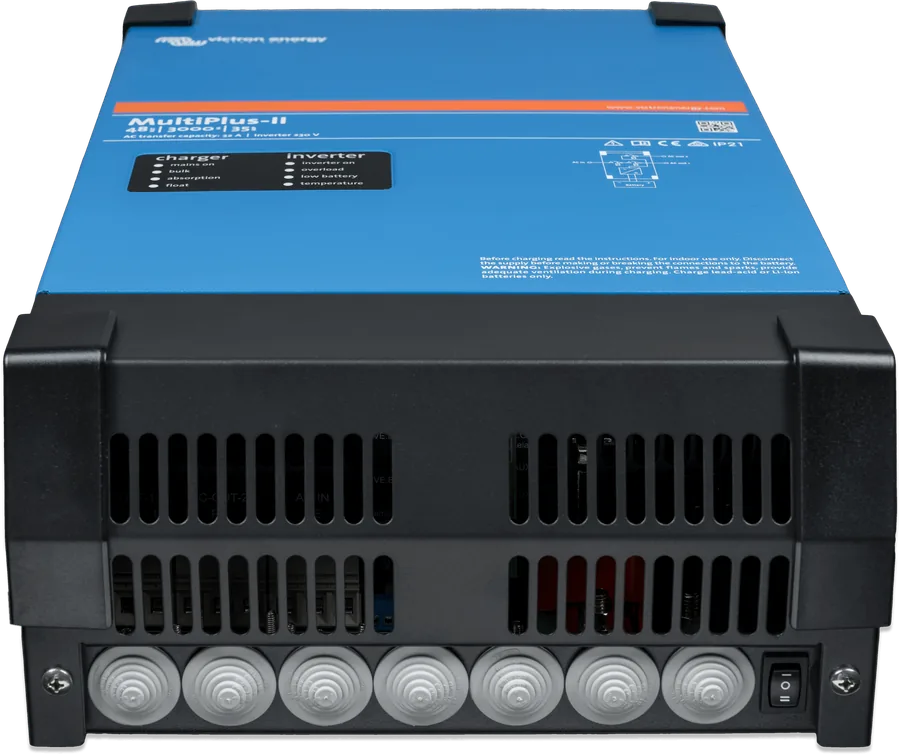
A pure sine wave inverter, a mains charger and a transfer switch. On hook-up it feeds your sockets and charges the battery. Unplug and it takes over from the battery in under 20 milliseconds[1], so a laptop or router carries on.
How the 230V side is laid out
- Hook-up16A site supply
- AC-in consumer unitProtects the feed in
- MultiPlus-IIInverter, charger, transfer switch
- AC-out consumer unitDouble-pole RCBOs
- SocketsYour 230V appliances
Leisure battery, through the main battery fuse. Charged by the MultiPlus-II on hook-up, and powers the sockets when you unplug.
PowerAssist: more than the hook-up can give, for short peaks
We set the AC input current limit to the hook-up supply, 16A at most in a campervan. When loads need more, PowerAssist makes up the difference from the battery straight away; when the load drops, spare power goes back into charging the battery[3].
Victron’s manual says the 3 kVA model can add up to 13A from the battery during peak demand[3]. On a 16A hook-up that’s up to about 29A at the sockets for short peaks, without overloading the site supply.
The smaller MultiPlus models from 800 VA up have PowerAssist too; the 500 VA model doesn’t[2]. Add a Cerbo GX MK3 and you (and we, if you ask us to look at a fault) can see battery, loads and charging on Victron’s VRM portal.
We fit the Victron MultiPlus-II 12/3000 in most vans. The full range is in our victron multiplus category.
What is the best inverter for campervan builds?
The best campervan inverter ticks every box below. Brand comes after that.
Miss the middle boxes and you’re adding a separate charger, changeover switch and monitor. That’s why we fit an inverter/charger.
How to fit an inverter safely in a campervan
Where the campervan inverter goes
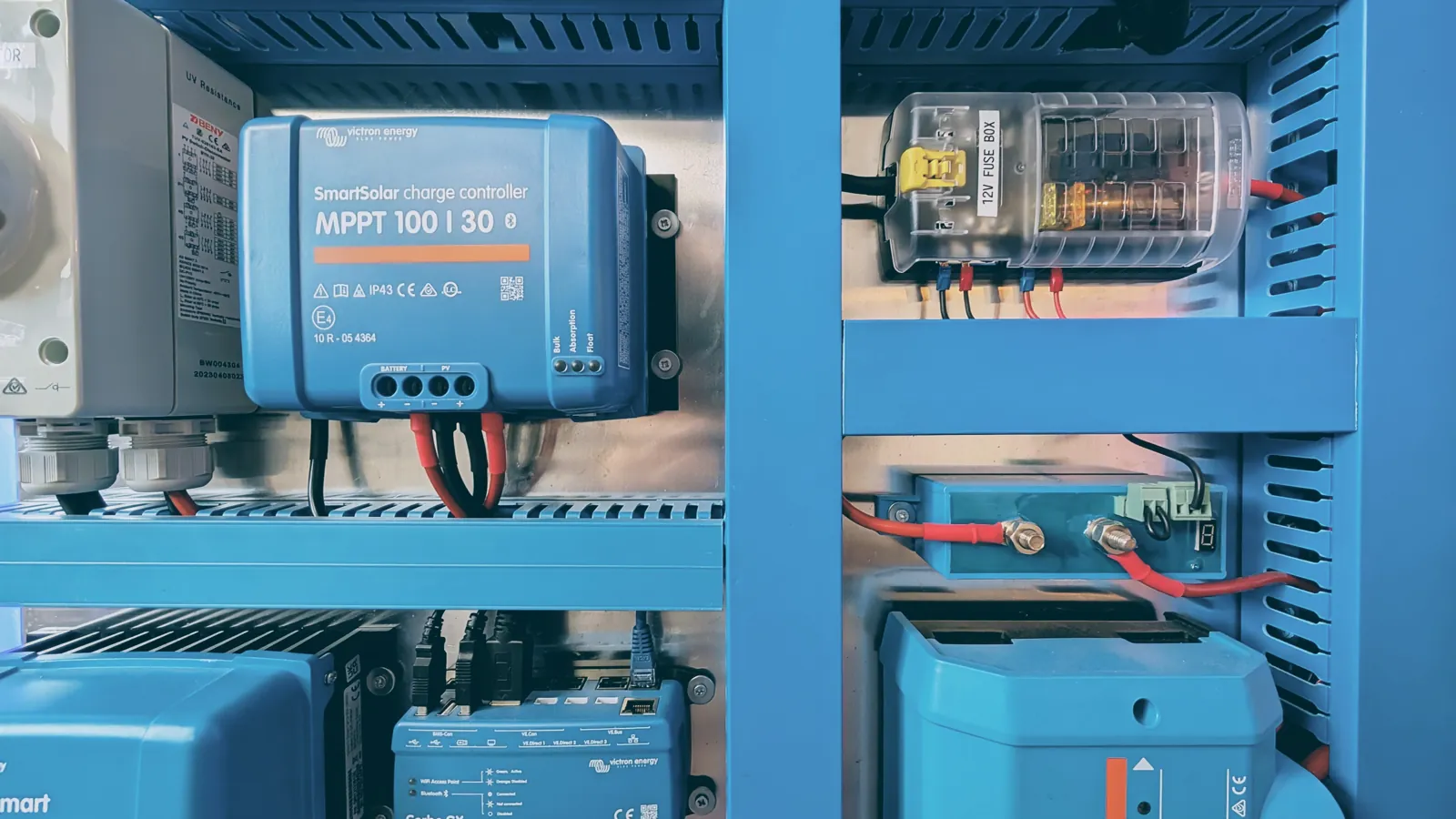
Victron’s manual says to install the MultiPlus-II in a dry, well-ventilated area, as close as possible to the batteries, to keep cable losses down[3]. Mount it solidly, with nothing flammable around it.
Victron warns against electronics directly above lead-acid batteries, even sealed ones[5], and says corrosive battery gases will damage a unit placed above the battery[3]. That warning is about lead-acid. Even so, we apply the same rule to lithium anyway: close to the batteries, never directly above them.
DC side: the main battery fuse
The battery to inverter cable carries the van’s highest current, so the main battery fuse protects it from the battery end: a Class T on the panel, or an MRBF fuse on a 12V battery up to 200Ah only. See choosing DC fuses and cable termination.
Every connection is torqued to the maker’s figure and torque-pen marked, so a loose terminal shows at a glance.
230V side: consumer units and RCD protection
Never plug an extension lead into an inverter. The 230V side needs overcurrent protection, RCD protection and an earth, the same as a house.
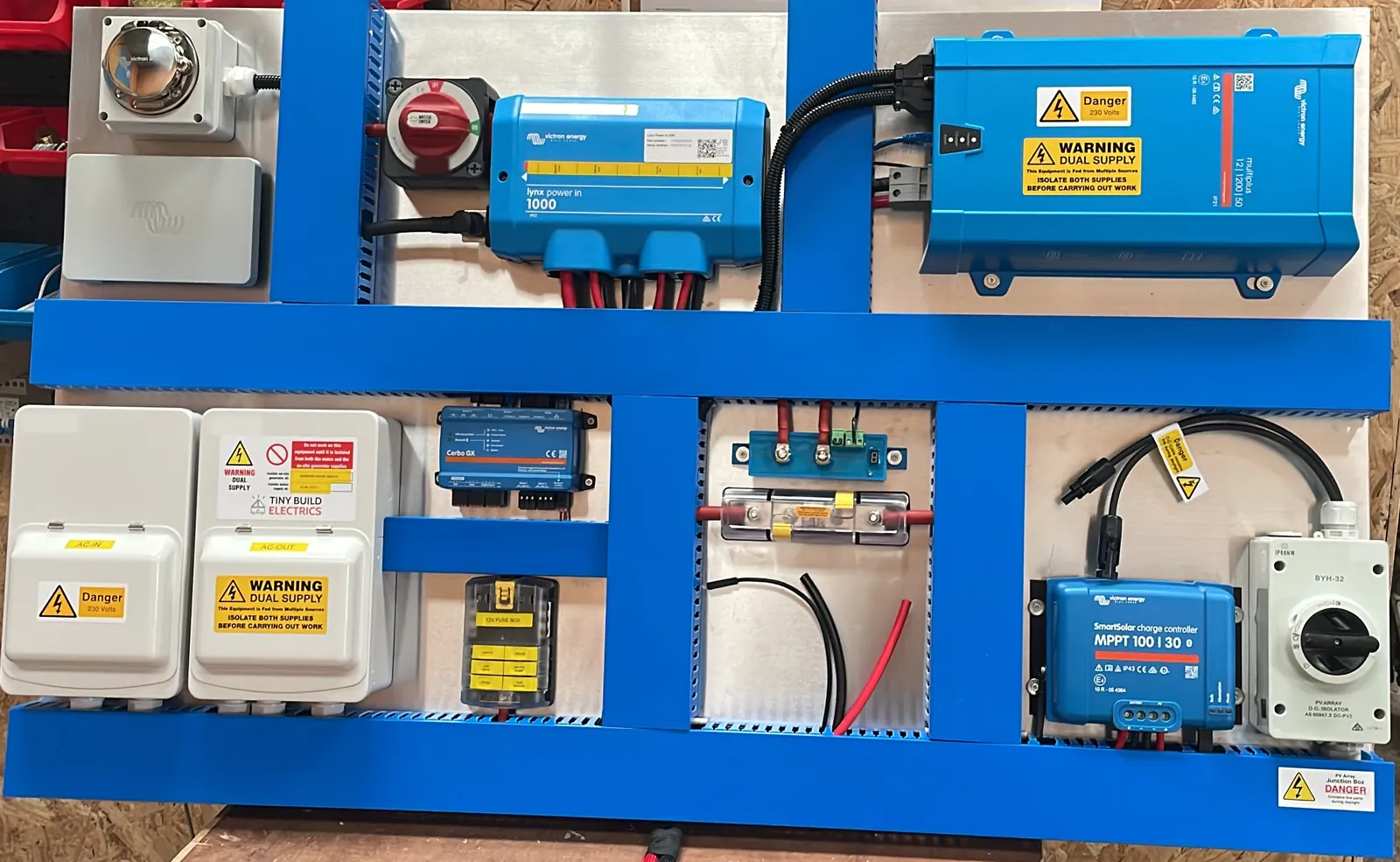
On our panels a MultiPlus-II feeds through two consumer units: AC-in protects the hook-up feed, AC-out carries double-pole RCBOs for your sockets. See which RCD for a campervan.
What BS 7671 Section 721 says
Regulation 721.55.2.6 and Table 721 set the hook-up lead for a 16A supply at a minimum of 2.5 mm² flexible cable, and H07RN-F is one of the cable types named. Regulation 721.415.1 requires a 30 mA RCD that breaks all live conductors, with the inlet connected directly to it[6].
Our practice: we protect the AC-in at 16A and carry the same 2.5 mm² H07RN-F from the inlet to the MultiPlus-II AC-in, whatever the inverter size.
Earthing and the chassis bond
Off hook-up, however, there’s no site earth. The MultiPlus-II’s ground relay links output neutral to chassis whenever there’s no AC input, so the RCDs still have a reference, and opens that link before connecting the hook-up[3].
The AC-out earth bar is the main earthing terminal (MET); the main protective bonding conductor runs from it to the chassis. That’s the chassis bond, and Victron requires the MultiPlus-II casing to be connected to the chassis in a vehicle[3]. See chassis bond and earthing.
An inverter for campervan use is only as safe as its earthing.
Testing the 230V side before you use it
A campervan inverter’s 230V side is a mains installation, so we test it like one, to BS 7671 and IET Guidance Note 3[7]:
- Continuity of protective conductors, including the chassis bond
- Insulation resistance
- Polarity
- Earth fault loop impedance
- RCD operation
The 12V side is inspected and tested separately, against BS EN 1648-2[8] and the guidance in Annex A721 of BS 7671.
Certificates
On our install jobs, you get an Electrical Installation Certificate (EIC) for the 230V side. A van we fit with 12V only has no 230V installation, so there’s no EIC to issue for it.
Built it yourself? Our inspection and testing service checks it before you rely on it.
Fit it yourself or have it fitted
Workshop installation
We supply and fit it
The whole system, fitted and tested at our Cumbria workshop. See workshop installation.
Self-Build
You fit it, with our design
After a consult, Tom designs a custom kit list for your van and loads, and you build to it. See the Self-Build package, or book a paid consultation for advice on part of a build.
Either way, every campervan inverter project starts with the same free call.
FAQs
What size inverter do I need?
Add the watts of every 230V appliance you’ll run at once, allow for motor start-up surges, and pick a pure sine wave inverter whose continuous rating sits comfortably above that total. Then check your battery and its BMS can supply the inverter at full output.
What size battery for 3000w inverter setups?
Size it from your loads and nights off hook-up, then check it can deliver the inverter’s full draw. Victron recommends 400 to 1,200 Ah for its MultiPlus-II 12/3000; our reading is that this relates to lead-acid banks. With lithium, the BMS discharge rating matters as much as capacity.
Lithium battery for 3000w inverter: what to check?
Check the BMS continuous discharge rating covers the inverter’s full draw, with margin for surges. If it doesn’t, the BMS cuts out under load. Our default is Fogstar lithium, with Victron lithium as the alternative, and we match the battery and fusing to the inverter.
Do I need a pure sine wave inverter?
Yes. Pure sine wave matches mains, so chargers, motors and electronics run as they would at home. Modified sine wave suits only simple heating loads and can make other appliances run hot, hum or fail early. We only fit pure sine wave inverters.
Can I plug an extension lead into my inverter?
No. An extension lead gives you no RCD protection, no overcurrent protection on each circuit and no proper earth. The inverter output must feed a consumer unit with RCD protection, with the system bonded to the chassis and tested before use.
Sources
- Victron Energy, MultiPlus-II inverter/charger datasheet: 12/3000 output at 25°C and 40°C, peak power, zero load power, transfer time, PowerAssist. www.victronenergy.com
- Victron Energy, MultiPlus 500VA to 1600VA datasheet: continuous and peak output, PowerAssist by model. www.victronenergy.com
- Victron Energy, MultiPlus-II 230V manual (Rev 14): location, battery capacity table, PowerAssist, ground relay and chassis connection. www.victronenergy.com
- Victron Energy, Lithium-ion vs lead-acid batteries: usable capacity of lead-acid and lithium. www.victronenergy.com
- Victron Energy, Wiring Unlimited: keep battery to inverter cables short, not directly above lead-acid batteries. www.victronenergy.com
- IET, BS 7671:2018+A4:2026, Section 721 (caravans and motor caravans) and Annex A721. electrical.theiet.org
- IET, Guidance Note 3: Inspection & Testing. shop.theiet.org
- BSI, BS EN 1648-2: 12V installations in motor caravans. knowledge.bsigroup.com
About the reviewer: Tom Alderdice
Tom holds the 18th Edition (BS 7671) and inspection and testing qualifications, plus NCC training in caravan and motorhome electrics.
Tiny Build Electrics is an Authorised Victron Energy Installer. See Tom’s full qualifications