Quick answer: Which leisure battery is best for a campervan: lithium, AGM, gel or flooded?
It depends on how far you need to discharge the battery, how many cycles you need and how you charge it. This guide compares lithium, AGM, gel and flooded lead-acid batteries on depth of discharge, cycle life and charging needs, and explains why a battery monitor is the best way to protect whichever you choose.
Choosing the right campervan leisure batteries is one of the most important decisions in any off-grid electrical system. With lithium, AGM, gel and flooded lead acid options available, understanding depth of discharge, cycle life and charging requirements is essential before investing in your battery bank. If you have undertook even a small amount of research regarding batteries for your tiny build, then you have quickly come to realise it is a bit of a minefield.
Quick answer
In short
For most campervans, lithium (LiFePO4) is the battery to consider. It is lighter, lets you use most of its capacity, and lasts thousands of cycles, so it works out cheaper per cycle than AGM despite the higher price. Flooded lead acid is the cheapest to buy, but it needs ventilation, maintenance and careful siting.
- We fit Fogstar lithium as standard
- Lead acid: keep discharge between 10% and 50%
- Lithium: 80 to 100% of capacity is usable
- Fit a battery monitor to track depth of discharge
On this page 13 sections
- In short
- Depth of discharge in campervan leisure batteries
- State of charge (SOC)
- Cycles
- How long campervan leisure batteries last
- How can you increase the life of your campervan leisure batteries?
- Types of campervan leisure batteries
- Flood lead acid (FLA)
- Gel
- Absorbed glass mat (AGM)
- Lithium LiFePO4 / Lithium-ion / Li-ion
- Summary: which campervan leisure batteries to choose
- Tiny Build Electrics’ experience
Battery technology is developing faster than you can imagine. They are becoming lighter, more powerful and their life cycles are ever increasing.
So what’s best? Well… how long is a piece of string?
There are a few fundamentals that are worth understanding before we proceed with the types of campervan leisure batteries in which you could fit into your tiny build.
Depth of discharge in campervan leisure batteries
The first being depth of discharge (DOD). Depth of discharge is how far you can discharge a battery relative to its capacity. Different batteries have different depth of discharge ratings, so you can take some further than others.

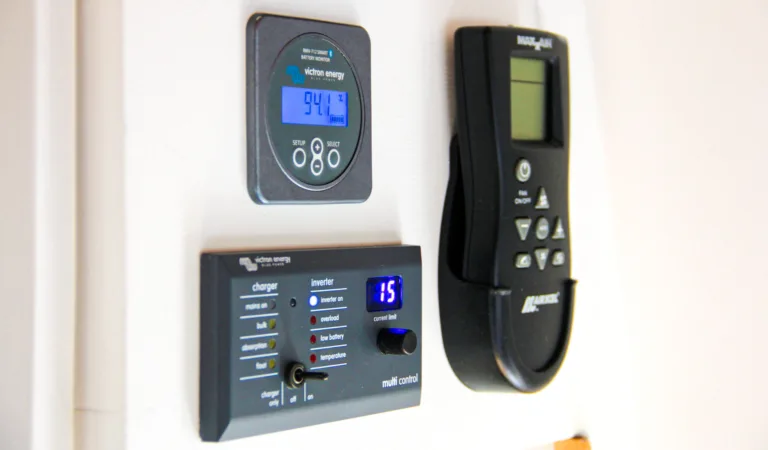
We recommend that you always use a battery monitor, such as the Victron BMV, to accurately determine the depth of discharge of your battery. Not only do the battery management devices monitor DOD, they also give you an array of information regarding your battery. Once setup correctly these monitors become extremely useful in your tiny build and help prolong the life of your batteries.
State of charge (SOC)
A batteries state of charge is simply the amount of charge within the battery.
A fully charged battery would be 100% SOC whilst an empty battery would be 0% SOC.
State of charge is the inverse of depth of discharge. Put another way, if a battery is at 100% state of charge, then its depth of discharge is 0%. The opposite is also true. If a battery is 100% discharged, its state of charge is 0%.

Cycles
The second fundamental is a cycle. A cycle is when the battery goes from fully charged, to discharged, then back to fully charged. Each time it completes that circle, it counts as one cycle. Although by completing this cycle the battery is technically aging, it also keeps the battery active and healthy. Different batteries have different life cycles, some more than others.
The number of charge cycles a rechargeable battery can withstand before performance degrades is the method in which we use to measure how long our batteries will last, if taken care of properly.

How long campervan leisure batteries last
The lifespan of campervan leisure batteries is a time frame the manufacturer gives. It shows how many cycles a battery can perform in a certain period.
Over time your battery monitoring system may tell you your system is at 100% charge but this isn’t necessarily accurate. This is a depletion in its lifespan, the battery will take longer to charge and be quicker to discharge in some circumstances.
Batteries coming to the end of their lifespan also struggle to hold a charge, so if everything is turned off in your tiny build and the battery is struggling to hold a healthy voltage you know your batteries are on their way out. If we look after our batteries, connect them in the correct way and use the correct equipment to charge them they will live long and prosper!

How can you increase the life of your campervan leisure batteries?
Once you begin to understand how different factors impact your battery’s life cycle, it becomes clearer how you can increase your battery’s life. Following some simple “best practices” can help you get the most out of your battery, regardless of whether it’s a lead-acid or lithium-ion battery.
Best Practice 1: As much as possible, use your battery in moderate temperatures. Of course, this may not always be possible but if you can keep your batteries in a moderate temperatures this can have a dramatic affect on its life cycles. Optimal temperature for most batteries is between 20 to 25 degrees centigrade. Lithium-Ion batteries are particularly sensitive to discharging and charging in colder weathers. To get around this you can surround your batteries with heat pads to keep them warm and operating efficiently.
Best Practice 2: If you have a lead-acid battery (FLA, AGM, GEL) ensure that you minimise how often you discharge the battery below 50% of its capacity. Ideally, the depth of discharge on each cycle should be between 10% and 50% (Energy Unlimited; Victron AGM datasheet). With lithium you can use 80 to 100%. Victron prefers 80%, and Fogstar rates its cycles at 80%. Refer to your battery manufacturer’s recommendations to be safe.
Best Practice 3: If you have a flooded lead-acid battery, make sure to keep the electrolyte solution topped up.
Best Practice 4: Ensure you use the correct charging equipment for your campervan leisure batteries. Better yet, ensure the charge equipment that you are using has the correct charge parameters for your battery type. These parameters vary from battery type to battery type and needs to be done correctly. This is something that we, at Tiny Build Electrics, can help you with.
Types of campervan leisure batteries
Batteries is a stage you want to get right, after all, no one wants to be sat in the dark sipping warm beers, right?!
Understanding the types of campervan leisure batteries available, the capacity you need for your van lifestyle, the relative cost and how to take care of them will help when it comes to choosing the best camper van batteries for you.
The four battery types we will be considering are:
- Flooded Lead Acid batteries (FLA)
- Gel batteries (GEL)
- Absorbed Glass Mat batteries (AGM)
- Lithium-ion batteries (LiFePO4)
Each type has a different make up and because of this perform differently under different circumstances.
Flood lead acid (FLA)
Flood lead acid batteries consist of two lead plates, one positively charged, the other negative. The battery is then flooded with a liquid electrolyte, sulphuric acid which covers all internal parts. When charging commences the acid and lead plates react to store electricity.
Pros
- Low cost
- Resilient to occasional over charging
- Proven technology
- Lifespan can be 4-8 years with regular maintenance and careful charging
- Less susceptible to temperature differences
Cons
- As the campervan leisure batteries age the performance will degrade to the point where the battery won’t hold a charge
- Needs to sit inside an enclosure (battery box)
- Battery can only be drained to a maximum DOD of 50%, otherwise you’re likely to incur damage.
- Needs venting in an enclosed area, as some FLA batteries emit gases.
- Stricter regulations on how FLA batteries are fitted and how close they are installed to inverters and chargers.
- Require regular maintenance
- Heavy
Gel
Gel batteries use the same technology as FLA but instead of liquid acid they are filled with Gel. This gives it more advantages than FLA, as you will see below.
Pros
- Doesn’t emit any nasty gases
- Sealed so can’t leak or produce any gas
- Maintenance free
- Operates in a wider array of temperatures than AGMS.
- Ideal for vans that are stored over winter and not used for long periods of time
Cons
- Very sensitive to depth of discharge
- Do not recover well from a low DOD
- More expensive than conventional FLA and AGM
- Heavy
View All
Absorbed glass mat (AGM)
AGM batteries work in a similar manner to FLA and Gel. Instead of acid or gel they have electrolyte soaked glass fibres between the positive and negative plates.
Pros
- Long shelf life
- Maintenance free
- Ideal for vans that are stored over winter and not used for long periods of time
- You can install it sideways, as it is a sealed unit and cannot leak (unless damaged)
- Smaller than the conventional Gel equivalent
Cons
- Very sensitive to depth of discharge
- Do not recover well from a low DOD
- More expensive than FLA
- Heavy
- Poor performance in colder temperatures
View All
Lithium LiFePO4 / Lithium-ion / Li-ion
The famous lithium-ion battery. If you have done any sort of research on tiny building or off grid systems then it is highly likely you have come across the lithium battery, currently at the top end of the battery technology market. This is a battery you should be considering for your build, there’s just one downside… £££!
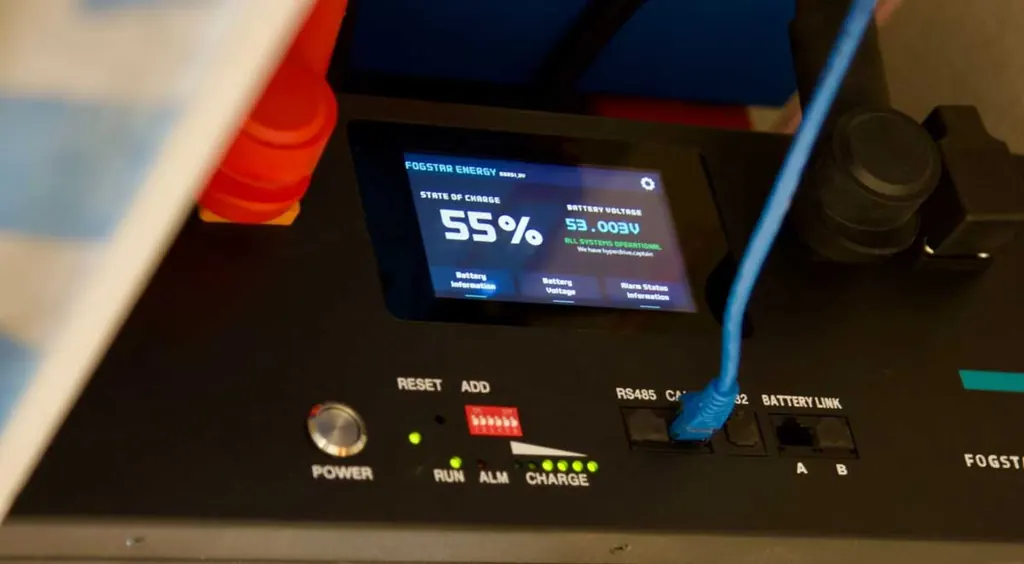
Pros
- 30% lighter than FLA, GEL & AGM
- Smaller frame size than FLA, GEL & AGM
- 80 to 100% of their capacity is usable meaning you need less batteries for the same amp hours as FLA, GEL & AGM
- Low internal impedance (resistance) mean these batteries also charge a lot quicker than the other types of batteries.
- You can install them in various orientations
- Maintenance Free
- Long life cycles if charged and discharged in accordance with manufactures instructions
Cons
- Very sensitive to charging in low temperatures
- Expensive, although prices have started to drop over the past few years
- A battery management system is required to protect the lithium-ion battery bank from excessive discharging, over charging and to control the load and balancing of each internal cell. Most of the time this system is built into the battery itself.
- Some extra monitoring may be required such as battery temperature monitoring
Lithium-ion batteries (LiFePO4)
Can I use a vehicle engine battery as a leisure battery?
Cars, boats, lorries, buses and generators use start batteries. They are not suitable for uses where they are discharged and then recharged again, also known as a cyclical use.
They also cannot be used in connection with an inverter, although technically they can the batteries make up means that it will not last very long while feeding an inverter.
The reason that start batteries are not suitable for frequent deep discharging is because of the way they have been constructed. They have thin plates with a large surface area. They are designed purely for short-term high discharge currents like engine starting.
During an engine starting the battery is exposed to high current draw in a short period of time. This high current draw turns a starter motor which in turns causes the engine to turn over and start. It might be tempting to use start batteries in a battery bank in smaller inverter systems, but please don’t do it. It will only cause trouble in the long run.

Cycle life compared
| Battery | Rated cycles | At depth of discharge |
|---|---|---|
| Fogstar Drift Gen2 12V 230Ah | 4,000 | 80% |
| Victron AGM Deep Cycle 12V 110Ah | 600 | 50% |
Cycle figures: Fogstar Drift Gen2 230Ah product page and Victron GEL and AGM batteries datasheet.
A lithium battery costs more to buy, but it is rated for far more cycles and lets you use more of its capacity on each one, so it usually works out cheaper per cycle over its life. The life cycle of the lithium-ion battery is certainly unmatched and is something to seriously consider if you want a ‘fit and forget’ electrical system in your campervan.

Summary: which campervan leisure batteries to choose
If you are wanting the cheapest method of powering your tiny build then Flood Lead Acid is for you.
These batteries are as cheap as chips and can be picked up in various frame sizes as well as amp hour sizes. But please note, these batteries need ventilation and you need to monitor them to ensure they do not leak. We advise against installing FLA deep in your build. They need to be installed with in a battery enclosure and well vented should they need to vent or worst case, leak. When they vent, FLA batteries will emit dangerous gases into your campervan or motorhome.
Our pick
Lithium (LiFePO4)
80 to 100% usable, 30% lighter and thousands of cycles. It costs more to buy but less per cycle.
Budget
AGM
Sealed and cheaper to buy, but heavier, and you only get about half its capacity before it starts to suffer.
If you are wanting a ‘fit and forget’ system with efficiency and a long cycle life then Lithium-ion is for you.
The lithiums are expensive, but, they are slowly coming down in price due to their popularity. When you consider the price of the lithium you must consider its lifecycle and DOD. An AGM is rated for about 600 cycles at 50%, and a Fogstar Drift Gen2 for 4,000 at 80%. Not only will they last longer (if installed and charged correctly) they’re a LOT lighter which is important when it comes to conversions such as vans, motorhomes, buses and lorries which have weight limits.
Tiny Build Electrics’ experience
I upgraded my campervan system from absorbed glass mat (AGM) to lithium-ion at the end of 2021. The main reason for this change was to save weight as I knew my self built van conversion was starting to get heavy. I removed my AGM batteries and weighed them. Both batteries weighed in at a whopping 35kg each! 70kg of batteries being pulled around by my van. It is not only the weight though, as only about half the capacity of my two x 100ah batteries was really usable.
Well, each lithium battery weighed in at… 11kg, yes 11kg! 70kg swapped out for 22kg. My van certainly thanked me! The weight saving was fantastic but what was even better was the power upgrade. My two 100ah lithium batteries now gave me 180ah of usable power, this is because the lithium batteries can be drawn down to about 10% state of charge without causing any damage. (They can theoretically go to 0% but most manufactures do not recommend this) I had literally doubled my power bank whilst saving two thirds of the weight!
I haven’t had any power worries since and because I have an electric hot water system the batteries take a beating. They cycle regularly but with a manufacture rating of over 5000 cycles this is not something I’m yet worrying about.
Campervan leisure batteries FAQs
Which leisure battery is best for a campervan: lithium, AGM, gel or flooded?
It depends on how far you need to discharge the battery, how many cycles you need and how you charge it. This guide compares lithium, AGM, gel and flooded lead-acid batteries on depth of discharge, cycle life and charging needs, and explains why a battery monitor is the best way to protect whichever you choose.
Which leisure battery is best for a campervan?
For most vans, lithium (LiFePO4). It is lighter, gives you 80 to 100% of its capacity and lasts thousands of cycles, so it costs less per cycle than AGM. We fit Fogstar lithium as standard.
Is AGM or lithium cheaper?
AGM is cheaper to buy. Lithium works out cheaper per cycle, because it lasts far more cycles and you can use more of its capacity.
Can I use my engine battery as a leisure battery?
No. A starter battery is built to give a short burst of high current, not a steady discharge. Run the habitation side from its own leisure battery.
About the reviewer: Tom Alderdice
Tom holds the 18th Edition (BS 7671) and inspection and testing qualifications, plus NCC training in caravan and motorhome electrics.
Tiny Build Electrics is an Authorised Victron Energy Installer. See Tom’s full qualifications