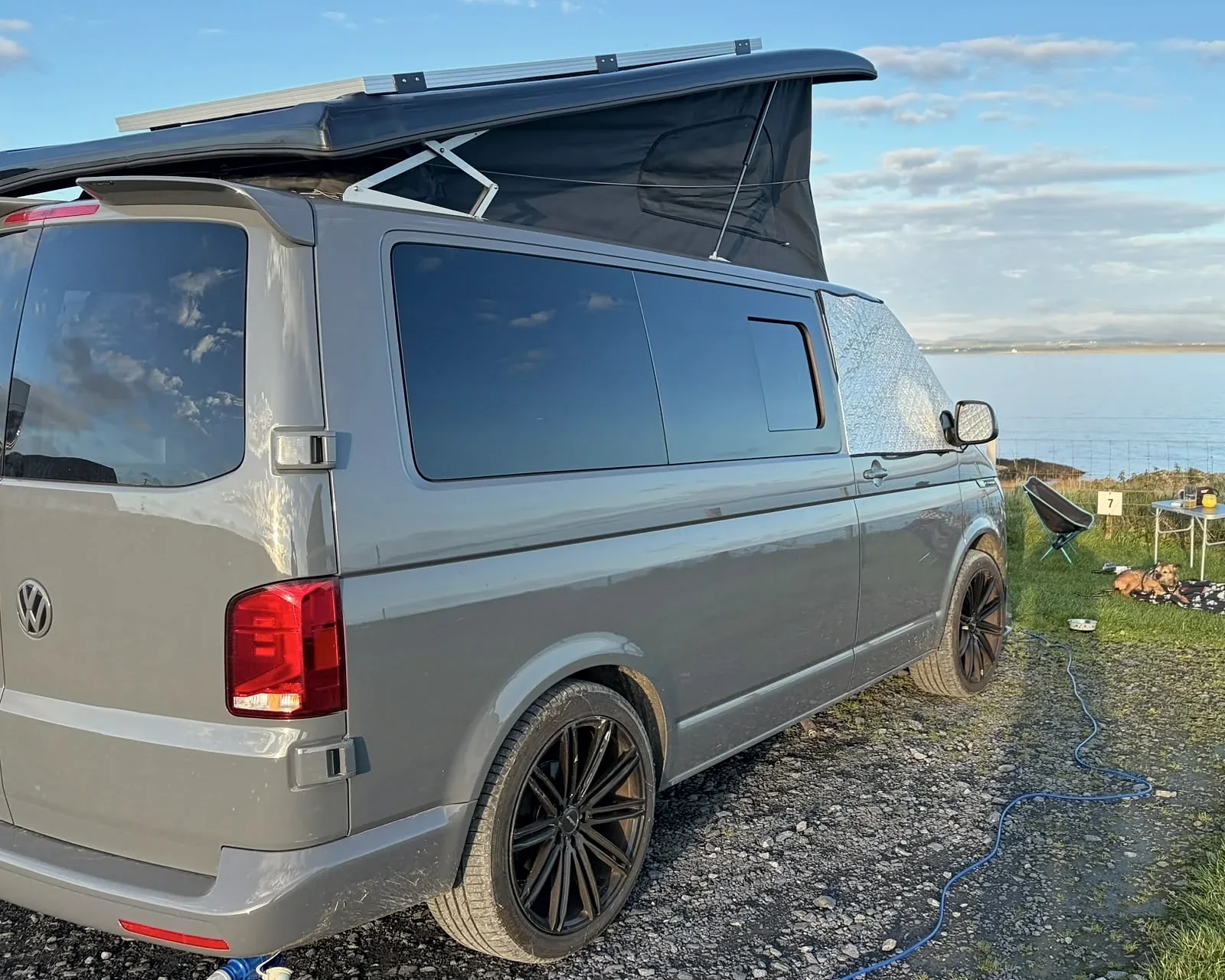
Mark’s T6.1 with the pop-top up. Under the new DVLA motorhome conversion checklist, a pop-top roof counts towards the external features. Photo: Mark, a Tiny Build Electrics customer.
In short
On 19 October 2026 the DVLA motorhome conversion guidance changed. Pop-top roofs now count, motor caravan graphics and awning bars are no longer listed, and owners who were refused can ask for a review or reapply. If you sell, it’s on you to show the conversion work is safe.
Why the DVLA motorhome conversion change matters
For years, DVLA turned down well-built van conversions for a motor caravan body type because the van didn’t have stickers on the side or a fixed high roof. DVLA has now rewritten its guidance, published a review route and issued a new V1006 checklist, all dated 19 October 2026.[1][2][3][4] If you’re converting a van to a motorhome, or you’ve already finished one, this guide covers what the official pages say and don’t say, and where the electrics come in.
We’re electricians, not a DVLA agent, so we can’t tell you whether your van will be accepted. What we can do is explain the paperwork that shows a qualified electrician fitted and tested your electrics properly, because that’s the part of the safety question we deal with every week.
What changed on 19 October 2026?
Three things went live on GOV.UK on the same day:
Here’s how the external features compare between the earlier DVLA motorhome conversion checklist and the October 2026 one:
| External feature | Earlier V1006 (10/19) | V1006 from 19 Oct 2026 |
|---|---|---|
| Two or more windows on one side of the main body | Listed | Listed |
| Separate door into the living area | Listed | Listed |
| High-top roof | Listed, pop-tops excluded | High-top or pop-top roof |
| Motor caravan style graphics | Listed | Not listed |
| Awning bar | Listed | Not listed |
Which external features does DVLA look for?
Whatever stage your campervan conversion is at, DVLA says one thing hasn’t moved: the body type on your V5C has to describe what the vehicle looks like in traffic.[1] The guidance lists the external features it commonly sees on motor caravans and says they’re there to show what DVLA expects when it considers an application:[1]
- Windows. Two or more windows on at least one side of the main body, giving daylight to the living area. Windows in the driver and passenger doors don’t count.
- A habitation door. A separate door into the living accommodation, not a cab door. A window in that door counts as one of the side windows.
- The roof. A high-top roof or a pop-top elevating roof.

The checklist asks you to tick which of these your van has, and says your photos must show a combination of them.[3] DVLA doesn’t say anywhere we could find that all three are compulsory, so read the wording on the form yourself rather than relying on a summary, ours included.
The inside matters too. DVLA expects seats and a table, sleeping accommodation, cooking facilities and storage, rigidly fixed to the living area, although the table can be removable.[1][5] The detailed rules, such as a cooker fixed to the floor or side wall, sit on the GOV.UK internal features page.[5]
Some vehicles can’t be changed at all. DVLA says a vehicle with a frame or outer structure that’s very distinctive, such as a bus, may have to keep its original body type.[1]
Refused before? Ask for a review or reapply
There are now two routes, and they work differently.
Asking for a review
The review form needs the name and address the vehicle is registered to, the registration number and an image of your latest V5C.[4] DVLA then makes its decision on the evidence you’ve previously provided. If it’s acceptable, you get a new V5C with the amended body type. If not, DVLA tells you its decision and the V5C stays as it is.[4]
Reapplying
DVLA’s publication page says that if you were refused before, you can reapply because its policy has recently changed.[2] A new application means a new V1006, a new set of photos and your V5C.
DVLA doesn’t say which route to pick. Our reading is simple. A review only looks at the photos you already sent, so it suits a van whose earlier photos clearly showed a pop-top or the other listed features. If your old photos missed something, or the van has changed since, a fresh application is the way to show it.
What DVLA asks you to send
DVLA wants clear photographic evidence that the van is permanently a motor caravan and that the furniture and fixings are fitted to a satisfactory standard.[1] The list is short:
- The V1006 checklistDVLA calls it the motor caravan conversion checklist. Complete it, tick the boxes and sign it. The declaration says you’ve made sure the alterations haven’t compromised the safety of the vehicle.
- Interior photosEach required feature, with the bed and the table in the position you’d use them, and at least two windows lighting the living area.
- Exterior photosThe front, both sides and the rear, with the number plates clearly visible.
- VIN or chassis numberA photo of the number stamped on the plate fixed to the original chassis or bodyshell.
On the back of each photo, write what it shows, the date and the registration number. Fill in section 1 of a new-style V5C (the one with coloured numbered blocks on the cover) or section 7 of an older one, and post it all to DVLA, Swansea, SA99 1BA.[1] Also, DVLA doesn’t return photos unless you ask.
In addition, DVLA may want to inspect the van. It pays for the inspection but not for getting the vehicle there, and if the inspection can’t go ahead, DVLA refuses the application.[1][6]
The guidance also has a short safety paragraph that’s easy to skip. Seats and seat belts used while travelling must be securely mounted, and everything you fit adds to the unladen weight, which eats into your payload.[1] Batteries, an inverter and heavy cable are part of that weight, so weigh the finished van and check you can still carry everyone, their luggage and full water tanks.
Body type, insurance and speed limits
DVLA states that it uses the body type for appearance and identification, and that it shouldn’t affect the insurance category, speed limits or other legislative requirements.[1] It also says that even if your body type stays as a van, you can still use it as a motor caravan, provided you’re satisfied it meets the required internal features.[1] Insurers set their own terms, so check your policy wording rather than assuming either way.
Showing the conversion work is safe when you sell
This is the line in the new guidance that we think matters most for owners:
DVLA says it’s the keeper’s responsibility to make sure alterations don’t compromise the vehicle’s safety, and that if you sell, it’s your responsibility as registered keeper to demonstrate the conversion work was safely completed.[1][2]
DVLA doesn’t say what that evidence should be, and it doesn’t ask for an electrical certificate with a body type application. So we won’t claim a certificate gets you a motor caravan V5C. What a certificate does do is cover the electrics, which are one of the riskiest parts of any conversion: a hook-up inlet, a 230V consumer unit, an inverter/charger and a large lithium battery, all in a metal box you sleep in.

What to keep from your electrical install
- An electrical installation certificate to BS 7671. Section 721 of BS 7671, the IET Wiring Regulations, covers the 230V side of a motor caravan, and the current edition is BS 7671:2018+A4:2026.[7][8] The certificate comes with a schedule of inspections and a schedule of test results, which record the measured values for each circuit and the RCD tests.
- Separate records for 230V and 12V. The two sides can only be tested separately, because each voltage band takes different tests. The 230V side gets the GN3 tests, while we inspect the 12V side to BS EN 1648-2 and BS 7671 Annex A721. Every connection is torqued to the maker’s figure and torque-pen marked.
- Your Victron settings and firmware. The VictronConnect app and the VRM portal show how each Victron product is set up, such as battery charge voltages, DC-DC charger set-up and inverter/charger configuration, and the firmware it runs. We check them at handover.
- The wiring diagram and parts list. So a buyer, or the next electrician, can see what’s fitted and how it’s protected.
- A copy of your DVLA application. Keep your photos and V1006, accepted or not.
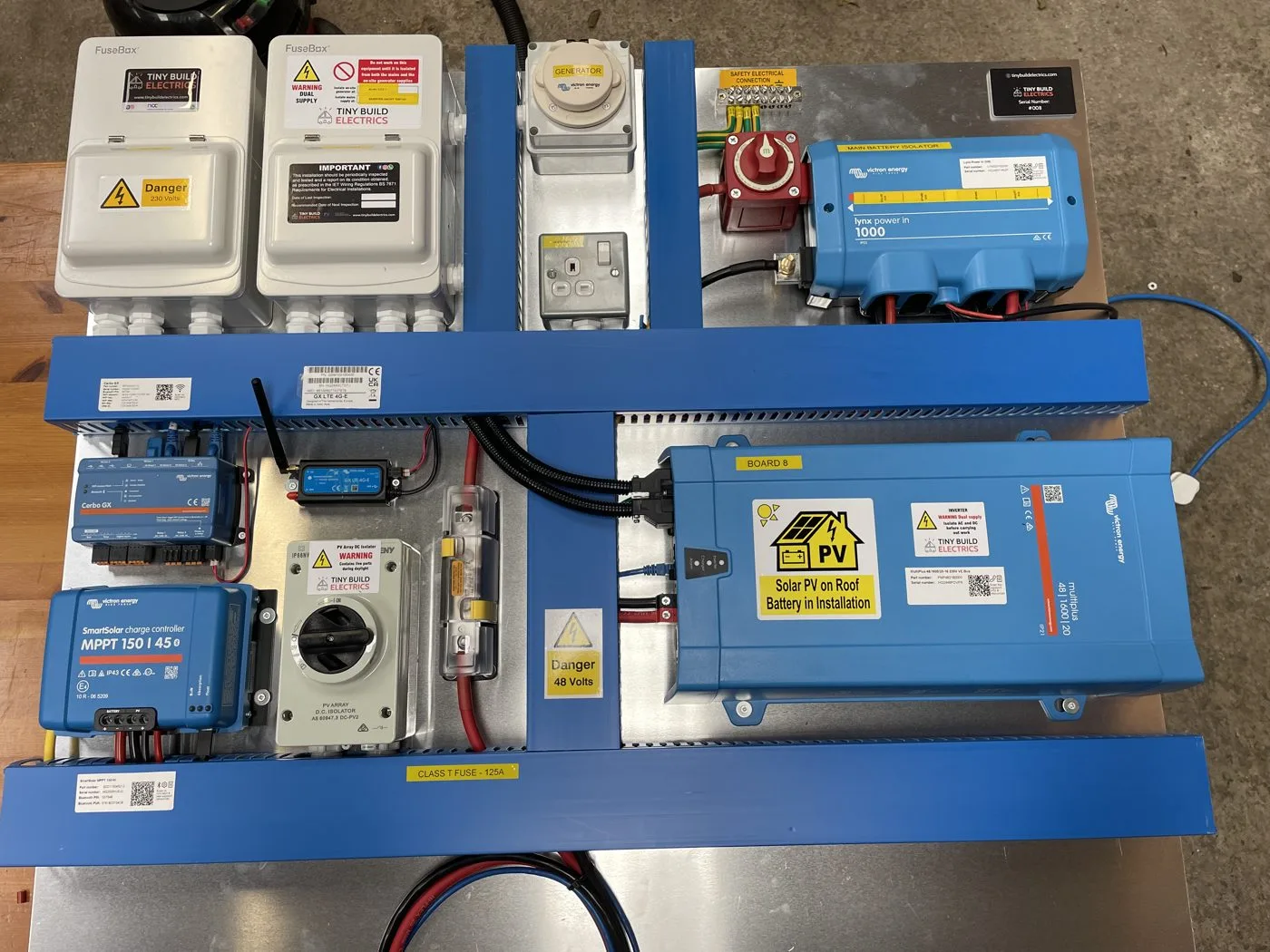
What we hand over, and how it helps
We fit every campervan and motorhome installation at our workshop in Witherslack, Cumbria. On-site work is only available on request, subject to review. At handover you get your electrical installation certificate and test results to BS 7671. Then keep them with the V5C and service history. When you sell, they’re how you show the electrics were done safely. Your Victron settings and firmware are visible in the VictronConnect app and the VRM portal, and we check them at handover.
If you’ve wired your own van, we can test the finished build at our workshop with an electrical inspection, even if you didn’t buy your kit from us. You get an inspection report, so you’ve got something to show a buyer too. We can’t guarantee a pass, and we quote any remedial work needed to bring it up to standard after the assessment on the day. Our Self-Build support can include the inspection too. For full installs, see our campervan electrical installations and motorhome electrical installations. Our guide to BS 7671 Amendment 4 explains what the current wiring rules change for vans.
Tiny Build Electrics is an Authorised Victron Energy Installer.
DVLA motorhome conversion FAQs
Do I have to change my van’s body type to motor caravan?
No. DVLA says that if the body type isn’t changed, you can still use the van as a motor caravan, as long as you’re satisfied it meets the internal features. The body type only describes how the vehicle looks in traffic.
Does a pop-top roof count now?
Yes. Since 19 October 2026, DVLA’s guidance and V1006 checklist list a high-top roof or a pop-top elevating roof as one of the external features. The earlier checklist excluded pop-tops, so owners refused on that point may want to look again.
My application was rejected. Should I ask for a review or reapply?
It depends on your photos. DVLA decides a review on the evidence you sent before. If that evidence already showed features that now count, a review may be enough. If it didn’t, DVLA says you can reapply, and a fresh application lets you send new photos.
Does DVLA ask for an electrical certificate?
No. DVLA’s evidence list is the V5C, the V1006 checklist and photos, including the VIN. An electrical certificate isn’t on it. It matters later: when you sell, it’s your job as keeper to show the conversion was done safely, and test records do that for the electrics.
Will changing the body type change my insurance or speed limits?
DVLA says not. Its guidance states the body type is for appearance and identification and shouldn’t affect the insurance category, speed limits or legislative requirements. Check your own policy wording with your insurer before you rely on that.
Can you test electrics I fitted myself?
Yes, through our electrical inspection, even if you didn’t buy your kit from us. We test the finished build at our Witherslack workshop and report what we find. We can’t guarantee a pass, and we quote any remedial work needed to bring it up to standard after the assessment on the day.
Want your electrics on paper before you sell?
Book a free 30-minute call with Tom. We’ll talk through your van, what’s fitted and what paperwork you’ve already got.
Sources
- DVLA, Converting a vehicle into a motor caravan (motor home), updated 19 October 2026
- DVLA, Converting a vehicle into a motor caravan: publication summary and change history
- DVLA, V1006 Motor caravan conversion checklist (10/26 edition)
- DVLA, Ask DVLA to review a rejected motorhome body type application, published 19 October 2026
- DVSA, Internal features for motor caravans
- GOV.UK, Change vehicle details on a V5C registration certificate
- IET, Electrical installations in caravan/camping parks, caravans and motor caravans (BS 7671 Section 721)
- IET, Ensure you are up to date with BS 7671 (BS 7671:2018+A4:2026 is current)
About the reviewer: Tom Alderdice
Tom holds the 18th Edition (BS 7671) and inspection and testing qualifications, plus NCC training in caravan and motorhome electrics.
Tiny Build Electrics is an Authorised Victron Energy Installer. See Tom’s full qualifications